Stability In Afghanistan Vital For Dushanbe & Regional Security, Says Tajik President
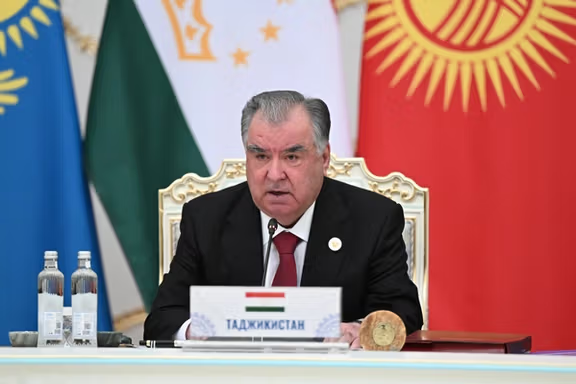
Tajikistan’s President Emomali Rahmon has emphasised that stability in Afghanistan is a key factor for the security of Tajikistan and the wider region.
Tajikistan’s President Emomali Rahmon has emphasised that stability in Afghanistan is a key factor for the security of Tajikistan and the wider region.
He warned that the spread of extremism and terrorism poses a growing threat to Commonwealth of Independent States (CIS) member countries.
Rahmon’s message was delivered on his behalf by Yusuf Rahmon, secretary of Tajikistan’s Security Council, during the third CIS conference on combating terrorism and extremism, held on Thursday, 23 October, in Dushanbe.
The Tajik president expressed concern about the spread of terrorist ideologies along CIS borders and called for joint and coordinated measures to counter extremist movements. He urged closer cooperation among intelligence and security agencies of member states to strengthen regional defences.
Rahmon also voiced alarm over the expanding narcotics trade, particularly the trafficking of synthetic drugs, which he said has become one of the main sources of financing for terrorist groups operating across the region.
The Commonwealth of Independent States (CIS) is a regional intergovernmental organisation established after the dissolution of the Soviet Union. Its permanent members include Russia, Moldova, Kazakhstan, Kyrgyzstan, Tajikistan, Belarus, Uzbekistan, Armenia, and Azerbaijan.
Rahmon’s remarks coincided with the visit of a Taliban delegation to Dushanbe. On the same day, Yousuf Wafa, the Taliban-appointed governor of Balkh province, travelled to Tajikistan and held discussions with Tajik officials on security cooperation and border management.
Pakistan’s Foreign Ministry said on Friday that the second round of talks between Pakistan and the Afghan Taliban will take place in Istanbul, Türkiye, on Saturday with the primary aim of halting terrorist attacks launched from Afghan soil.
Foreign Ministry spokesperson Tahir Hussain Andrabi told reporters in Islamabad that the Istanbul dialogue seeks to establish a “tangible and verifiable monitoring mechanism” to curb cross-border militant activity.
Andrabi said Pakistan welcomes the agreement finalised in Doha on 19 October 2025, calling it an “important step toward ensuring regional peace and stability.” He added that Islamabad hopes the Istanbul meeting will help both sides create an effective framework to address what Pakistan views as the terror threat originating from Afghanistan.
It remains unclear which officials will represent the two sides in Istanbul. In the first round of talks, held in Doha last Saturday, Khawaja Asif, Pakistan’s defence minister, and Mohammad Yaqub Mujahid, the Taliban’s defence minister, led their respective delegations.
The Doha talks came after several days of deadly border clashes between Taliban and Pakistani forces. That round, mediated by Qatar and Türkiye, ended with an agreement on a temporary ceasefire, which remains largely intact, according to Andrabi.
The Taliban has not yet issued a statement regarding the upcoming Istanbul meeting.
Andrabi expressed Pakistan’s appreciation to Qatar and Türkiye for their constructive roles in facilitating dialogue between Islamabad and Kabul, saying continued engagement was crucial to promoting regional security and stability.
Pakistani police have arrested Asma Wesal, an Afghan female singer, in Islamabad after her visa expired, her family confirmed to Afghanistan International on Thursday.
Her sister, Khushi Mahtab, said Wesal was detained by police and later transferred to the Haji Camp migrant detention centre in Islamabad. The family said she now faces the risk of forced deportation to Afghanistan.
Wesal has been living in Islamabad for the past three years with her sister and brother.
Her arrest comes amid an intensified crackdown on Afghan migrants in Pakistan, as authorities continue large-scale detentions and deportations of undocumented Afghans following recent border clashes between the Taliban and the Pakistani military.
Human rights groups have repeatedly warned that Afghan women particularly artists, journalists, and activists face severe persecution under Taliban rule if returned to Afghanistan.
Noor Wali Mehsud, the leader of Tehreek-e-Taliban Pakistan (TTP), visited a hospital in Kabul just days before Pakistan carried out an airstrike on the Afghan capital, informed sources told Afghanistan International.
According to the sources, Mehsud visited Hewad Shifa Hospital, located in Qala Cha along the Kabul–Logar highway, to visit wounded members of his group. They said the hospital had previously signed a contract to treat injured TTP fighters, but terminated the agreement after the airstrike.
Hewad Shifa Hospital denied the claim, however. A hospital spokesperson told Afghanistan International: “We have no specific contract to treat the wounded; all patients come on an individual basis.”
After Pakistan’s recent airstrike on Kabul, Mehsud released a video statement showing himself in Khyber Pakhtunkhwa province, following unconfirmed reports suggesting he had been targeted in the attack. Sources later confirmed the video was recent and filmed in Khyber district, though Mehsud’s current location remains unknown.
The same sources said the vehicle carrying Mehsud was targeted in the airstrike, but he survived.
Mehsud became the leader of the TTP in 2018 after his predecessor, Mullah Fazlullah, was killed in a US drone strike.
Following Pakistan’s airstrikes on Kabul and Paktika provinces, reports also circulated claiming that Hafiz Gul Bahadur, a senior TTP commander, had been killed. However, Afghanistan International sources confirmed that Bahadur is alive and had been residing mainly in Barmal district of Paktika province.
Bahadur, who leads the Hafiz Gul Bahadur faction of the TTP, belongs to the Madukhil branch of the Wazir tribe. He has also been seen in other parts of Afghanistan, including Shakardara district of Kabul in 2022.
Both Noor Wali Mehsud and Hafiz Gul Bahadur, key figures in the Pakistani Taliban movement, hail from Waziristan and have played central roles in sustaining the TTP and its affiliated networks. Despite a longstanding rivalry, both men continue to wage separate insurgencies against Pakistan, while maintaining close ties to the Haqqani Network, from which they reportedly receive official support.
The United Nations Assistance Mission in Afghanistan (UNAMA) said it continues to engage with all Afghan stakeholders in support of inclusive governance, human rights, and international cooperation.
In a statement issued on Friday, 24 October, to mark United Nations Day, UNAMA said its engagement aims to “safeguard human rights and strengthen global support for the Afghan people.” However, the mission did not specify which groups it has engaged with, at what level, or whether its dialogue includes Taliban opponents.
For the past four years, the international community and regional powers have urged the Taliban to form an inclusive government, calls the group has repeatedly ignored.
Indrika Ratwatte, the UN’s Humanitarian Coordinator in Afghanistan, urged renewed global solidarity, saying: “Together, let us uphold the promise of the UN Charter and work toward a peaceful, prosperous, inclusive, and sustainable Afghanistan.”
Situation of Women and Girls Worsening
UNAMA expressed deep concern over the continuing deterioration of conditions for women and girls under Taliban rule. It said the Taliban’s restrictions on education, employment, and public participation undermine the fundamental rights of Afghan citizens and the country’s future prospects.
The statement reaffirmed the UN’s enduring commitment to peace, security, human rights, justice, and sustainable development, noting that the organisation has stood by Afghans “through both progress and hardship”, from peacebuilding and institutional reform to life-saving humanitarian aid.
UN’s Role in Afghanistan
UNAMA said the UN’s agencies, funds, and programmes have enabled millions of Afghans to gain access to education, healthcare, clean water, and livelihoods. It underscored the UN’s crucial role in protecting the rights of women and girls and its ongoing principled engagement to support Afghanistan’s recovery.
However, the mission warned that Afghanistan’s humanitarian crisis remains among the world’s most severe, with roughly two-thirds of the population in need of assistance. Declining donor funding, it said, threatens the delivery of essential services. The statement also highlighted how the return of millions of migrants and the impacts of climate change have further deepened Afghans’ vulnerability.
Georgette Gagnon, the UN Deputy Special Representative and head of UNAMA, said Afghanistan cannot achieve lasting stability and development on its own. “This 80th anniversary reminds us of the power and necessity of multilateralism and collective action,” she said.
“Regional cooperation, international engagement, and a shared commitment to dialogue and diplomacy are essential,” Gagnon added. “The United Nations remains a vital platform for bringing nations together to address common challenges and support the aspirations of the Afghan people.”
UNAMA reaffirmed that, under its Security Council mandate, it will continue to engage with all Afghan stakeholders to promote inclusive governance, protect human rights, and strengthen international support for Afghanistan.
The United Nations was formally established on 24 October 1945, following the ratification of its Charter by founding members. The UN Assistance Mission in Afghanistan (UNAMA) was created in March 2002 through a Security Council resolution, with a mandate to coordinate international support for peace and reconstruction in the country.
The Taliban leader has ordered Afghanistan’s Ministry of Energy and Water to begin construction of a dam on the Kunar River “as soon as possible,” in a move seen as potentially heightening tensions with Pakistan over shared water resources.
According to Taliban Energy and Water Minister Abdul Latif Mansoor, the leader, Hibatullah Akhundzada, instructed the ministry not to wait for foreign companies and instead to sign contracts with domestic firms to launch the project. Mansoor quoted Akhundzada as saying that “Afghans have the right to manage their own waters.”
The Kunar River, one of Afghanistan’s five main rivers, originates in Chitral, Pakistan, flows for around 482 kilometres through Afghanistan’s Kunar province, and then joins the Kabul River before returning to Pakistan. Most of the Kabul River’s flow eventually reaches Pakistan, where provinces such as Khyber Pakhtunkhwa rely heavily on Afghan waters.
Afghanistan is rich in water resources, but decades of war and instability have prevented the country from developing effective water management systems.
Rising Sensitivity In Pakistan
The renewed push for dam construction on the Kunar River comes amid escalating border tensions between the Taliban and Pakistan. Water sharing has long been a sensitive issue between the two neighbours, which have no formal water treaty and divide water based on customary practices.
Recently, Pakistani media reported that Islamabad is considering diverting the flow of the Chitral River before it enters Afghanistan, redirecting it toward the Swat River. The Nation newspaper quoted a Pakistani government source saying Islamabad aims to alter the river’s course before it merges with the Kunar and Kabul rivers inside Afghanistan.
Last year, after reports surfaced of the Taliban’s plans to build dams in eastern Afghanistan, former Pakistani provincial official Jan Achakzai warned that any unilateral construction by the Taliban on the Kunar (also known as the Chitral River) would be viewed as a hostile act against Pakistan. He said such action could have serious consequences, including heightened tensions and the potential for conflict.
A Baloch activist also argued that the Taliban’s dam project aligns with India’s strategy to limit water flows to Pakistan.
Despite these objections, the Taliban have consistently reiterated their commitment to dam construction on the Kunar River. Mansoor previously said that some neighbouring countries are “unhappy that Afghanistan is finally gaining control over its waters.”
In an interview with Shamshad TV, Mansoor said building a dam on the Kunar River was one of the Taliban government’s top priorities. Quoting Akhundzada, he said: “If we do not build a dam on the Kunar now, we never will.”
Mansoor noted that the Kunar River offers unique potential for hydropower generation, unmatched elsewhere in Afghanistan.
Regional Water Tensions
The minister also referred to disputes with other neighbouring states, saying that Central Asian countries have benefited from Afghan water for decades and built their own dams. Citing the Qosh Tepa Canal project, Mansoor said, “Even constructing several canals like Qosh Tepa would not compensate for the water lost in the past.”
He added that during his visit to Turkmenistan, officials there urged the Taliban to adhere to Soviet-era water-sharing arrangements. Mansoor responded that the Taliban do not recognise agreements signed during the period of occupation, asserting that “except for Iran, Afghanistan has no water treaties with its neighbours.”
He stressed that the Taliban respect the Helmand River treaty with Iran, but said dam construction elsewhere “faces no restrictions.”
Chinese Interest and Financial Constraints
Despite the Taliban leader’s directive, Mansoor complained about a lack of funding for dam projects. He said the ministry has repeatedly appealed to domestic and foreign investors to finance water initiatives, including a plan to transfer Panjshir water to Kabul, but none have yet followed through.
In August 2024, the ministry announced that a Chinese Energy Company had expressed interest in investing in three hydropower dams Shal, Sagi, and Sartaq on the Kunar River. Mansoor claimed that with these dams, “Afghanistan will be able to export electricity to neighbouring countries.”
However, it remains unclear how willing or technically capable domestic investors are to take on such an ambitious infrastructure project.
