• العربية
  • پښتو
  • فارسی
Brand
  • Afghanistan
  • Sport
  • Markets
  • Afghanistan
  • Sport
  • Markets
  • Theme
  • Language
    • العربية
    • پښتو
    • فارسی
  • Afghanistan
  • Sport
  • Markets
All rights reserved for Volant Media UK Limited
volant media logo

Clashes Reported Between Pakistani Forces & Taliban In Spin Boldak

Nov 6, 2025, 15:00 GMT+0

As Taliban–Pakistan talks opened in Istanbul, local sources told Afghanistan International on Thursday that Pakistani border guards and Taliban forces had clashed in Spin Boldak, Kandahar.
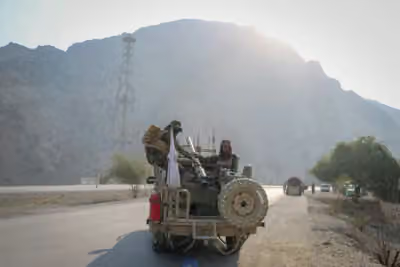
Videos from the area captured the sound of gunfire and showed residents fleeing. According to the sources, the shooting occurred near the border gate. Several witnesses said Pakistani troops initiated the exchange and fired multiple mortar rounds into Afghan territory. They added that Taliban forces had not yet responded.

Neither Taliban nor Pakistani officials have commented on the incident.

Residents expressed fears that the fighting could escalate, with some leaving their homes for safer areas. Footage received by Afghanistan International shows panic among civilians, including women and children fleeing the clashes.

Spin Boldak is one of the most sensitive border crossings between Afghanistan and Pakistan and has seen repeated clashes in recent years.

The incident comes as the two sides begin their third round of negotiations in Istanbul, aimed at sustaining the ceasefire and reaching a broader agreement.

Most Viewed

Taliban Governors, Intelligence Chiefs Hold Security Meet In Northern Afghanistan
1

Taliban Governors, Intelligence Chiefs Hold Security Meet In Northern Afghanistan

2

China, Qatar Discuss Taliban-Pakistan Tensions & Regional Stability

3

Hazara Leader Accuses Taliban Of Escalating Pressure On Shia Community in Afghanistan

4

‘System Built On Oppression Cannot Survive’, Warns Taliban Chief Justice

5

Prominent Shia Cleric Calls On Taliban To End Detentions & ‘Humiliation Of Shias’

•
•
•

More Stories

Third Round of Taliban–Pakistan Talks Opens In Istanbul

Nov 6, 2025, 13:44 GMT+0

The third round of talks between the Taliban and Pakistan began on Thursday, 6 November, in Istanbul, with both sides discussing a mechanism to sustain the ongoing ceasefire.

Pakistan is seeking decisive action against Tehreek-e-Taliban Pakistan (TTP), while the Afghan Taliban are emphasising respect for Afghanistan’s territorial integrity. Representatives from Qatar and Türkiye are attending the discussions, which are aimed at preventing the fragile truce from collapsing.

Narges Hurakhsh, Afghanistan International’s correspondent in Türkiye, reported that media access to the venue is heavily restricted, underscoring the sensitivity of the negotiations. The first and second rounds, held in Doha and Istanbul, were also conducted behind closed doors.

The Taliban delegation arrived in Istanbul around midnight, followed by the Pakistani delegation early Thursday morning.

According to Afghanistan International’s reporter, expectations for this round remain low, though Qatar and Türkiye are working to maintain communication between the sides and prevent a breakdown of the ceasefire.

Pakistan has warned that if negotiations fail, a military confrontation could follow.

Jawad Hamdani, Afghanistan International’s correspondent in Islamabad, reported that Pakistani officials are not optimistic about the talks, citing ongoing disagreements over how to contain TTP.

Pakistan is demanding that the Taliban curb the TTP’s activities, while the Taliban insist that Pakistan must respect Afghanistan’s airspace and territorial sovereignty.

The Doha talks resulted in a temporary ceasefire and a halt to border clashes, but the second round in Istanbul ended without progress.

Taliban Asked UN Not To Report On Badakhshan Poppy-Eradication Protests, Says UNODC

Nov 6, 2025, 12:21 GMT+0

The Taliban urged the United Nations not to comment on recent public protests in Badakhshan over poppy-eradication operations, according to a new report by the UN Office on Drugs and Crime (UNODC).

The report said that from May to July 2025, Taliban efforts to destroy poppy fields in Badakhshan prompted demonstrations in the Argo, Jurm and Khash districts. During the Taliban’s crackdown on the protests, at least 12 civilians were killed and several others injured, UNODC said.

Residents in several districts have staged protests in recent months against the Taliban’s destruction of poppy farms, with some turning violent. Local sources said Taliban forces opened fire on demonstrators and used force to disperse crowds.

According to the UN report, protesters burned tractors belonging to the Taliban’s Counter-Narcotics Directorate and blocked multiple roads. In response, the Taliban temporarily suspended eradication operations and cut internet services in the affected areas.

In a written response appended to the report, the Taliban Interior Ministry’s Counter-Narcotics Directorate asked UNODC to avoid mentioning “public resistance to poppy eradication in Badakhshan.”

The report also said that while poppy cultivation in Afghanistan has fallen by 20 percent compared with last year, the production and trafficking of synthetic drugs, particularly methamphetamine, continue to rise.

Methamphetamine Production Rising In Afghanistan, Says UN

Nov 6, 2025, 10:39 GMT+0

The United Nations Office on Drugs and Crime (UNODC) says that while opium poppy cultivation in Afghanistan has fallen by 20 percent this year, the production and trafficking of synthetic drugs particularly methamphetamine continue to rise.

According to the agency, the Taliban’s ban on opium has coincided with a surge in synthetic drug activity. Seizures of methamphetamine and other synthetic substances inside and around Afghanistan by the end of 2024 were about 50 percent higher than in the third quarter of 2023.

The report noted that with the decline in agriculture-based opiate production, synthetic drugs appear to have become the new business model for organised crime groups. It attributed the shift to easier production methods, greater difficulty in detection, and stronger resilience to climate change.

UNODC said drug control strategies must go beyond opium and include synthetic drugs in monitoring, analysis and demand-reduction efforts.

Opium Cultivation Falls Sharply

The UN estimated that opium poppy cultivation now covers 10,200 hectares down from 12,800 hectares last year. Before the Taliban imposed a ban in 2022, around 232,000 hectares were under cultivation.

The report said that opium production in 2025 has dropped even faster than cultivation down 32 percent from 2024 levels to an estimated 296 tonnes. Farmers’ income from opium has fallen by 48 percent, plunging from $260 million in 2024 to $134 million this year.

However, the UN warned that adverse weather conditions, including drought and reduced rainfall, have left more than 40 percent of former opium farmland barren. It added that the return of roughly four million Afghans from neighbouring countries now representing about 10 percent of the population has increased competition for jobs and scarce resources.

The agency cautioned that these pressures, combined with declining humanitarian assistance, could push farmers back toward opium cultivation.

Oliver Stolpe, UNODC’s representative in Afghanistan, said Afghanistan’s path away from illicit crops requires “coordinated, long-term investments, including through international partnerships.” He stressed the need to prioritise both alternative livelihoods for farmers and efforts to counter drug trafficking and reduce demand.

The UN also reported that the price of dry opium has fallen by 27 percent this year to $570 per kilogram, down from $780 in 2024, a sign, it said, of a shifting drug market that may stimulate poppy cultivation elsewhere.

The organisation concluded that cultivation patterns, pricing, and seizure data all point to a major transformation in drug markets and trafficking routes in and around Afghanistan.

Georgette Gagnon, Deputy Special Representative of the UN Secretary-General for Afghanistan, said the country’s drug problem extends beyond its borders and involves both domestic and international actors. She added that close cooperation between key stakeholders is essential and said the counter-narcotics working group under the Doha Process is vital to developing shared solutions.

IS-Khorasan Commander Killed in Pakistani Police Raid

Nov 6, 2025, 09:33 GMT+0

Pakistani media reported that security forces have killed a senior commander of Islamic State Khorasan Province (ISKP) in Karak district, Khyber Pakhtunkhwa.

According to Dawn newspaper, Nisar Hakim described as a “key commander” of ISKP was killed during a police raid on his hideout in the village of Ambari, Karak.

Police launched the operation after receiving intelligence, the report said. A clash broke out during the raid, resulting in Hakim’s death.

Citing its sources, Dawn reported that the firefight lasted four hours and left four police officers wounded.

Hakim was reportedly the main planner behind the failed assassination attempt on Maulana Fazlur Rehman, the leader of Jamiat Ulema-e-Islam (JUI-F), according to the report.

Taliban Bar Women Without Burqas From Entering Herat Hospital, Say Sources

Nov 5, 2025, 16:56 GMT+0

Taliban forces barred women including female doctors from entering Herat Regional Hospital on Wednesday. The ban order was issued because they were not wearing the Taliban-mandated blue burqa, local sources told Afghanistan International. Witnesses said several women were beaten.

According to sources, dozens of women including patients, healthcare workers and visitors were turned away at the hospital gates for failing to comply with the requirement. Videos obtained by Afghanistan International show large groups of women standing outside the entrance, many already wearing full-body coverings; however, only those in the traditional blue burqa were allowed to enter.

A female doctor at the hospital wrote to Afghanistan International: “We are women who have stepped forward to serve humanity, not to hide behind coercion.”

She added that although she works to heal others, she herself is “wounded every day by the pain of being unseen.”

Another source said Taliban officials at the Herat Civil Registration Office also blocked women without burqas from entering on the same day.

The doctor said: “We have been forced to wear the burqa not out of choice or belief, but out of command and compulsion.”

Since returning to power more than four years ago, the Taliban have imposed sweeping restrictions on Afghan women, including banning girls’ education above the sixth grade, limiting women’s movement without a male guardian and barring them from most public spaces and workplaces. The Taliban’s Ministry for the Propagation of Virtue and Prevention of Vice has declared women’s voices “awrah” forbidden to be heard and ordered the segregation of men and women in hospitals and workplaces.

The latest ban on entry for women without a burqa marks a further escalation in the Taliban’s systematic crackdown on women’s rights in Afghanistan.