Taliban Block Women Without Burqas From Entering Herat Hospital
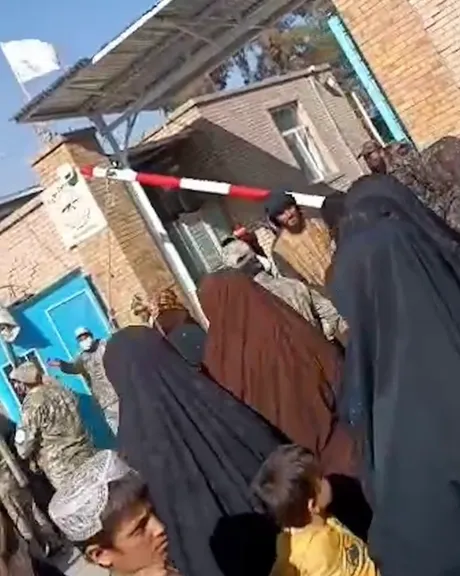
Local sources told Afghanistan International early Monday that Taliban members once again prevented hundreds of women without burqas from entering Herat Regional Hospital.
Local sources told Afghanistan International early Monday that Taliban members once again prevented hundreds of women without burqas from entering Herat Regional Hospital.
The Taliban’s Ministry for the Promotion of Virtue and Prevention of Vice earlier rejected claims that wearing a burqa was mandatory in Herat, but sources said the restriction remains strictly enforced.
A viewer in Herat shared a video with Afghanistan International, saying that Taliban officers used violence while blocking women from entering and that they were beating them.
On Sunday, the Taliban’s virtue ministry denied that the burqa had been made compulsory for women in Herat and said women in the province had not been denied government services for not wearing one.
However, according to local sources and videos received by Afghanistan International, Taliban members have required women to wear the burqa in public places and government offices in Herat since Wednesday.
Ahmad Massoud, leader of the National Resistance Front of Afghanistan, told an annual forum in France that Afghanistan has once again become a global centre for militant training under Taliban rule.
He delivered the remarks on Saturday in Saint-Raphaël, in France’s Var region, at the “Meetings for the Future” conference, where he addressed challenges to democracy.
Massoud said his movement had not pursued armed resistance as a goal but as a last resort after attempts at dialogue were rejected by the Taliban. He described the resistance as a means to achieve a political settlement that would allow Afghans to choose their own government and enable women and girls to access education and equal opportunities.
He argued that while international dynamics have shifted since the time of his father, Ahmad Shah Massoud, the Taliban’s behaviour has remained unchanged. He said the group continues to inflict repression similar to its earlier rule and warned that global fatigue and competing crises may be contributing to declining international attention to Afghanistan.
Massoud called on the international community to keep Afghanistan high on both humanitarian and political agendas. He said Afghanistan should remain under consideration by international judicial mechanisms, that sanctions against Taliban leaders should remain in place, and that no government should grant the Taliban formal recognition. He described these steps as straightforward measures that could significantly improve the lives of millions of Afghans.
He highlighted values such as democracy, women’s rights, and freedom of expression as shared principles between Afghans and Europeans, and said they had been systematically dismantled by the Taliban.
The “Meetings for the Future” conference, held annually in France, brings together policymakers, academics, and civil society leaders to discuss long-term global challenges.
Massoud also commented on recent clashes between the Taliban and Pakistan, saying the tensions reflected long-standing structural problems. He said Pakistan had long believed it could control the Taliban but that the group has its own ideology and maintains ties with organisations such as Tehreek-e-Taliban Pakistan, which claims territory inside Pakistan.
He added that Western governments had previously attempted to convince themselves that the Taliban had changed, possibly due to diplomatic misjudgements or a desire to move past the war. However, he said current Taliban actions and policies make clear that such assumptions can no longer be sustained.
Pakistan’s Ministry of Foreign Affairs said on Sunday that certain elements within the Taliban were attempting to inflame Pashtun nationalism inside Pakistan.
It warned that such efforts undermined ongoing diplomatic engagement between the two sides.
In a detailed statement issued on 8 November, the ministry said the Taliban had used recent talks to level unfounded accusations against Pakistan, promote nationalist rhetoric, and prolong discussions without addressing Islamabad’s core security concerns. According to the statement, these tactics prevented any meaningful progress in negotiations.
The ministry argued that specific actors within the Taliban, allegedly supported financially by external players, were engaged in promoting “Pashtun nationalism” in Pakistan. It said the Pashtun population in Pakistan was larger than in Afghanistan and formed a dynamic, influential segment of Pakistani society, with many having held senior political and administrative roles.
Islamabad said that rather than trying to stir ethnic sentiment across the border, the Taliban should instead focus on improving ethnic inclusion within their own governing structures.
The ministry added that Pakistan had spent the past four years attempting to address security concerns over the presence of Tehreek-e-Taliban Pakistan (TTP) and other groups in Afghanistan through constructive engagement. In return, it said, Islamabad had received only empty assurances and no measurable action from the Taliban.
Pakistan again accused the Taliban of harbouring, supporting, and training anti-Pakistan militants, saying that the increase in attacks originating from Afghan soil since August 2021 was “undeniable and documented.” The statement said the issue was no longer one of the Taliban’s capacity but of their willingness to confront terrorism.
The ministry warned that Pakistan would take all necessary measures to defend its territory and citizens, adding that any party that offered refuge or support to militant groups “cannot be considered a friend of Pakistan.” Despite the strong language, it said Islamabad remained committed to resolving differences through diplomacy and dialogue.
Pakistan has also claimed that, beyond failing to curb extremist activity, some Taliban members were directly involved in sheltering Pakistani militants.
The Taliban’s Ministry of Foreign Affairs, in a separate statement, said the Pakistani delegation at the third round of talks in Istanbul had refused to accept any responsibilities, which, it said, led to the collapse of the negotiations.
The Taliban–Pakistan talks, mediated by Türkiye and Qatar and launched after deadly border clashes, concluded their third round without any breakthrough.
Pakistan’s Ministry of Foreign Affairs said in a detailed statement on Sunday that the Taliban in Afghanistan has been providing refuge to anti-Pakistan militant groups.
They include Tehreek-e-Taliban Pakistan (TTP) and Baloch separatists, and avoids any verifiable action against them, the statement said.
The statement, issued on 8 November in response to questions about the deadlock in the third round of Pakistan-Taliban talks in Istanbul, said that despite Islamabad’s repeated requests, the Taliban had failed to take steps that were tangible, measurable, and confirmable.
According to the ministry, militant attacks inside Pakistan have intensified since the Taliban seized power in Kabul in 2021. Officials said expectations that the Taliban would restrain such groups had not been met, and that instead, the regime had offered them protection under the guise of hosting refugees.
The foreign ministry said Pakistan had taken what it described as positive steps, including facilitating trade, providing humanitarian assistance, easing student and medical visas, and encouraging the international community to engage with the Taliban. It said the Taliban’s response amounted only to unfulfilled assurances.
The statement added that the Taliban had repeatedly attempted to dilute Pakistan’s central demand, action against groups targeting Pakistan, by linking it to what Islamabad viewed as irrelevant or hypothetical issues. This approach, the ministry said, appeared designed to create a narrative that freed the Taliban of responsibility toward both the international community and the Afghan people.
Pakistan reiterated that the TTP and Baloch separatists were declared enemies of the state and that any actor offering them refuge or financial support could not be considered a friend of Pakistan.
While the statement emphasised that diplomacy should remain the preferred approach, it said the Taliban had evaded earlier commitments throughout all three rounds of talks and seemed interested only in prolonging the temporary ceasefire rather than resolving core issues.
The ministry also accused the Taliban of trying to frame the presence of TTP and Baloch fighters in Afghanistan as a humanitarian problem. It said the TTP had fought alongside the Afghan Taliban for years and that Kabul was now offering these fighters and their families sanctuary as a reward for their loyalty. The statement further alleged that TTP training camps operate inside Afghanistan and are used to plan attacks against Pakistan.
The remarks came after Taliban spokesperson Zabihullah Mujahid acknowledged that tribal migrant families including some linked to Pakistani militants had been moved to central Afghanistan and housed in designated camps. Afghanistan International previously reported, through an investigative inquiry, that in January 2025 the Taliban had secretly relocated dozens of families affiliated with the TTP to Ghazni province.
Pakistan’s foreign ministry warned that what it described as the Taliban’s hollow assurances would no longer be sufficient and said that decisive measures were now required to safeguard Pakistani lives and national interests.
The Taliban’s foreign minister, Amir Khan Muttaqi, said Pakistan’s delegation “refused to accept any responsibility” during the third round of talks in Istanbul, leading to the negotiations ending without progress.
He made the remarks during a phone conversation with Iranian Foreign Minister Abbas Araghchi, according to a statement issued on Sunday, 9 October, by the Taliban’s Ministry of Foreign Affairs.
The ministry said the two foreign ministers discussed bilateral relations between Afghanistan and Iran, as well as the recent Taliban-Pakistan negotiations. It added that Araghchi underscored the need for continued dialogue to resolve differences between Kabul and Islamabad and expressed Iran’s readiness to play a constructive mediating role.
Muttaqi said the Taliban delegation had attended the Istanbul talks with the full authority of their leadership and with “good intentions”, but claimed that the Pakistani side had declined to shoulder any responsibilities. The ministry did not clarify what specific responsibilities he was referring to.
He said the Taliban continues to prioritise diplomacy, understanding and dialogue in addressing disputes with Pakistan.
Before his call with Muttaqi, Araghchi had also spoken with Pakistan’s Foreign Minister Ishaq Dar and stressed the importance of continued engagement between Pakistan and the Taliban.
India’s Ministry of External Affairs said on Friday that New Delhi is reviewing the duties, responsibilities and staffing of its embassy in Kabul, with further details to be announced once a decision is finalised.
The ministry declined to comment on whether India is considering formal recognition of the Taliban.
Speaking at a press briefing on 7 November, ministry spokesperson Randhir Jaiswal said that following the recent visit of Taliban Foreign Minister Amir Khan Muttaqi to New Delhi, a series of exchanges had taken place between the two sides on development cooperation. He added that phone contacts had also been established between the foreign ministers of India and the Taliban.
When asked by a Business India reporter whether the Taliban intended to send an ambassador to New Delhi and if Afghanistan’s national flag would be replaced with the Taliban flag, Jaiswal did not answer directly. He said only that India’s mission in Afghanistan had already been upgraded to the level of an embassy and that work on its reorganisation was under way.
Relations between India and the Taliban have expanded in recent months. Earlier, the Taliban’s deputy agriculture minister travelled to New Delhi, which also hosted Muttaqi for bilateral talks. The increased contacts coincide with heightened tensions between the Taliban and Pakistan.
In October, the Indian Ministry of External Affairs announced that New Delhi had upgraded its technical mission in Kabul to the status of an embassy, a move Indian officials described as a sign of its commitment to broaden engagement with the Taliban. The upgrade took effect immediately.
Muttaqi’s visit to India took place as Pakistan launched airstrikes inside Afghanistan. The Taliban responded, triggering more than a week of border clashes. During the escalation, Pakistan’s Prime Minister Shehbaz Sharif accused the Taliban of attacking on India’s instructions, alleging that the assaults occurred while the Taliban foreign minister was in New Delhi.
