Taliban Vow ‘Appropriate Response’ To Pakistani Airstrikes

The Taliban on Tuesday condemned Pakistan’s recent airstrikes in Khost, Kunar and Paktika, describing them as a violation of Afghanistan’s airspace and a breach of international norms.

The Taliban on Tuesday condemned Pakistan’s recent airstrikes in Khost, Kunar and Paktika, describing them as a violation of Afghanistan’s airspace and a breach of international norms.
Zabihullah Mujahid, the Taliban’s spokesperson, said the group viewed the strikes as “aggression" and a crime and stated that the group would respond “appropriately” at a time of their choosing.
He added that the cross-border attacks undermined established regional principles and warned that the Taliban would not allow such actions to go unanswered.
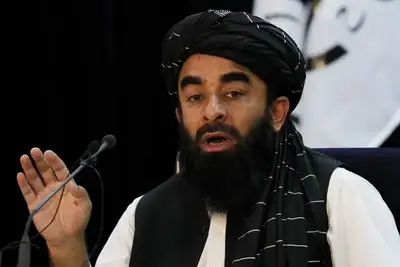

The Taliban said Pakistani airstrikes overnight killed nine children and one woman after hitting a residential home in Khost province. Taliban spokesperson Zabihullah Mujahid also said strikes were carried out in Kunar and Paktika, injuring four civilians.
In a post on X early Tuesday, 25 November, Mujahid said the strike occurred just after midnight in the Mughlagi area of Gurbuz district, Khost, and destroyed the home of a local resident. He published images showing the bodies of several children.
Strikes Reported in Kunar and Paktika
Local sources earlier told Afghanistan International that Pakistani fighter jets bombed the Saagi area of central Asadabad in Kunar province on Monday evening. The Taliban later confirmed that airstrikes had also taken place in Paktika.
According to Mujahid, the strikes in Kunar and Paktika wounded four people and destroyed two homes. Pakistani authorities have not yet commented.
The attacks came only hours after suicide assailants targeted a security facility in Peshawar. Pakistani media, citing officials, reported that the attackers were Afghan nationals. According to local accounts, one bomber detonated explosives at the compound entrance while others were killed in clashes with security forces. Pakistani officials confirmed that three security personnel were killed and several others injured.
Previous Strikes and Failed Talks
In October, two airstrikes attributed to Pakistan were reported inside Afghanistan. The first, on 10 October, struck parts of Kabul, Khost, Jalalabad and Paktika. A second strike followed on 11 October, again targeting Kabul.
Those incidents prompted talks between the two sides in Doha, resulting in a temporary ceasefire. Monday night’s strike in Kunar is believed to be the first since that truce. Pakistan and the Taliban later held two additional negotiation rounds in Istanbul aimed at reaching a broader agreement, but both ended without progress.
The Taliban have previously urged Pakistan to respect Afghanistan’s airspace.

The World Bank has reported that the Taliban allocated 49 percent of Afghanistan’s total budget to security sector in 2025.
The report said the group’s overall expenditure rose by 18.5 percent to 155.7 billion afghanis, with about 75.6 billion afghanis directed to security-related costs.
According to the assessment, security spending in the first seven months of Afghanistan’s 1404 fiscal year accounted for roughly half of all government expenditure. The World Bank also described Afghanistan’s economy as fragile, citing earthquakes, drought, the mass return of migrants, and disruptions to telecommunications services as factors heightening the country’s vulnerability.
The report noted that the Taliban administration’s domestic revenue in 2025 had increased by 16 percent compared with the same period last year.
The World Bank said that despite Pakistan’s closure of key border crossings, Afghanistan’s exports in October rose by 13 percent compared with the same month last year and by 3.7 percent compared with the previous year. Exports during this period reached 267 million dollars. Increased trade with India and Uzbekistan was cited as the main driver of this growth.
The report said exports had been “successfully redirected” to India and Uzbekistan despite the halt in trade with Pakistan due to border clashes. It added that the peak harvest season and relatively low domestic inflation strengthened competitiveness and helped offset losses from the disruption of trade routes through Pakistan.
Food exports reached 238.4 million dollars in October, an 8.6 percent rise from last year, indicating strong regional demand.
Trade and transit between Afghanistan and Pakistan have been suspended for more than a month following recent border clashes. Islamabad has set conditions for reopening crossings, while the Taliban have maintained that the closures have not negatively affected Afghanistan’s trade.
The Taliban Ministry of Finance said trade with neighbouring, regional, and global partners was continuing normally. Abdul Ghani Baradar, the Taliban’s deputy prime minister for economic affairs, urged Afghan traders to seek alternative routes for trade and transit.
Pakistani authorities have said security concerns were the reason for the border closures.

Three police officers were killed and two others injured in a suicide attack on a police compound in Peshawar early on Monday, 24 November, according to Pakistani authorities.
Security officials said a suicide bomber detonated himself at the main gate, after which two additional attackers attempted to storm the compound but were shot dead by police. The attack took place at around 8 a.m. local time.
Pakistani media, citing security sources, reported that three militants were involved. The government described the assailants as “Khawarij,” a term used by officials to refer to Tehreek-e-Taliban Pakistan (TTP).
Authorities said the casualty toll would likely have been far higher had the two gunmen succeeded in entering the building.
Prime Minister Shehbaz Sharif condemned the incident as a “terrorist attack” and praised the police response as “brave,” saying officers’ swift action prevented a larger loss of life.
No group has claimed responsibility for the attack.
The incident comes days after a powerful explosion in Islamabad killed at least 12 people and wounded 30 others. Following that blast, Pakistan’s Defence Minister Khawaja Asif warned that the country might launch military action inside Afghanistan.

A Taliban official in northern Afghanistan says Afghan coal will now be exported to Uzbekistan rather than Pakistan under new trade arrangements.
Haji Zaid, spokesperson for the Taliban-appointed governor of Balkh, said Uzbekistan will in return supply Afghanistan with high-quality cement and pharmaceuticals.
The shift comes as border closures and the suspension of trade with Pakistan push the Taliban to expand commercial ties with regional partners, particularly Iran and Uzbekistan. The Taliban have previously said Afghan agricultural products will be exported to Central Asia, South Asia and Europe via Uzbekistan through air corridors.
Earlier, the Taliban’s deputy prime minister for economic affairs urged Afghan traders to seek alternative routes for trade and transit.
The Taliban-run Ministry of Finance has claimed that the halt in trade with Pakistan has had “no negative impact” on Afghanistan’s overall trade volume and that customs revenues remain unaffected. The ministry said it would fully support traders in strengthening commercial links through alternative routes.
Following rising tensions between Kabul and Islamabad and the closure of key border crossings, Pakistan’s Dawn newspaper reported on 11 November that the month-long shutdown of the Torkham crossing had caused more than 4.5 billion dollars in losses to the economies of both countries.
Economist Reza Farzam said the Taliban’s assertion that the suspension of trade with Pakistan has had no impact on Afghanistan is misleading, arguing that the country currently has no immediate alternatives to its main trade routes.

Pakistan’s former special envoy for Afghanistan, Asif Durrani, says Afghanistan has become a base for more than 20 terrorist organisations. He said regional countries must take action because the Taliban lack the capacity to manage the growing threat.
In a post on X on Monday, Durrani wrote that rising tensions between Pakistan and the Taliban should be a matter of concern for the wider region.
Relations between Islamabad and the Taliban have deteriorated sharply in recent weeks. Three rounds of talks have ended without progress, with the Taliban refusing to meet Pakistan’s key demands regarding Tehreek-e-Taliban Pakistan (TTP).
Islamabad sought a written commitment from the Taliban to halt TTP attacks inside Pakistan, a religious decree condemning jihad in Pakistan, and the handover of TTP leaders. The Taliban rejected all three demands, insisting that the TTP issue is “Pakistan’s internal matter.”