Children Must Never Be Targeted In Conflict, Says UNICEF

UNICEF has said that children “are not and should never be a target,” following Monday night’s airstrikes in Afghanistan’s Khost and Kunar provinces that killed at least 10 civilians.
UNICEF has said that children “are not and should never be a target,” following Monday night’s airstrikes in Afghanistan’s Khost and Kunar provinces that killed at least 10 civilians.
The UN agency stressed that children must be protected from all forms of harm.
In a post on X on Wednesday, 26 November, UNICEF offered condolences to the families of the victims. According to UN reporting, at least 10 civilians were killed and six others wounded in the attacks.
The Taliban’s Minister of Industry and Commerce, Nooruddin Azizi, has travelled to Türkiye at the invitation of the Turkish government to attend a ministerial meeting of the Economic Cooperation Organization (ECO).
According to the Taliban, Azizi will also take part in the opening ceremony of the Halal Expo 2025 and is expected to hold discussions with members of Türkiye’s private sector. The meetings will focus on attracting investment to Afghanistan.
ECO is a regional organisation aimed at strengthening economic, trade, cultural and technical cooperation among its member states.
Azizi’s visit follows his recent and politically sensitive trip to India, during which he said agreements had been reached on the use of Iran’s Chabahar Port, the issuance of Indian medical visas and the resumption of cargo flights.
Pakistan’s military has said it does not distinguish between different Taliban factions, declaring that “there is no such thing as good or bad Taliban.”
The statement did not clarify whether the term “bad Taliban” referred to both the Afghan Taliban and Tehreek-e-Taliban Pakistan (TTP).
Army spokesperson Ahmed Sharif Chaudhry made the remarks on Tuesday, 25 November, during a press briefing in which he rejected Taliban claims that Pakistan carried out airstrikes in several Afghan provinces the previous night. He said Pakistan’s military did not differentiate between terrorist groups.
The phrase “good Taliban and bad Taliban” became widely used during the years of conflict in Afghanistan, as Afghan politicians repeatedly accused Pakistan of supporting certain Taliban factions while fighting others. Pakistan is now facing a sharp rise in domestic militancy and has struggled to contain Islamist insurgent groups.
For years, Afghan politicians and security officials including Hanif Atmar, Amrullah Saleh, and Rahmatullah Nabil warned that Pakistan’s “good Taliban, bad Taliban” approach was destabilising and fuelled regional mistrust.
This is the first time Pakistan’s military has publicly stated that such distinctions do not exist, and the remarks come amid heightened tensions between Islamabad and the Taliban authorities.
After a series of deadly clashes along the border in October, the two sides held talks in Doha that resulted in a temporary ceasefire. Pakistan and the Taliban later met for two additional rounds of negotiations in Istanbul in search of a broader agreement, but both rounds ended without progress.
Qatar’s new ambassador to Kabul, Mirdif Ali Al Qashouti, has presented his credentials to Taliban Foreign Minister Amir Khan Muttaqi, the Taliban’s Foreign Ministry said on Tuesday.
Upon receiving the credentials, Muttaqi described Afghanistan’s ties with Qatar as “historic” and called for expanding trade relations and accelerating the process of sending Afghan workers to Qatar.
Al Qashouti, who previously served as chargé d’affaires at the Qatari embassy in Kabul for three years, was appointed ambassador extraordinary and plenipotentiary by Qatar’s Emir, Sheikh Tamim bin Hamad Al Thani, on 21 October.
According to the Taliban statement, the new ambassador also referred to relations between Qatar and the Taliban authorities as historic and pledged to further strengthen bilateral engagement. He said Qatar was continuing its mediation efforts and working to enhance Afghanistan’s interaction with the international community.
Qatar has maintained close ties with the Taliban over the past four years and has frequently attempted to mediate between Kabul and international actors.
Muttaqi’s call to expedite the deployment of Afghan workers to Qatar aligns with a July announcement by the Taliban-run Ministry of Labour and Social Affairs, which said Afghan employment agencies had signed agreements with semi-governmental companies in Qatar.
At the time, the ministry said Qatar had offered 700 job opportunities for Afghan workers and that registration had begun. More than four months later, however, there have been no confirmed reports of Afghan workers being sent to Qatar.
Pakistan’s military has rejected Taliban claims that it carried out airstrikes in Khost, Paktika and Kunar on Monday night, saying that Pakistan publicly announces any operation it conducts.
Army spokesperson Ahmed Sharif Chaudhry said on Tuesday that Pakistan “never targets innocent civilians” and insisted that Islamabad officially confirms its actions whenever it launches an attack. He suggested the Taliban’s allegations may be linked to what he described as internal tensions within the group.
Chaudhry also said the Afghan Taliban must “behave like a state rather than a non-state actor” and shoulder the responsibilities expected of a governing authority.
His remarks came after the Taliban accused Pakistan of violating Afghanistan’s airspace in a series of strikes overnight on 24 November. The Taliban said the attacks killed 10 people, including nine children and a woman, in Khost, and wounded four civilians in Kunar and Paktika.
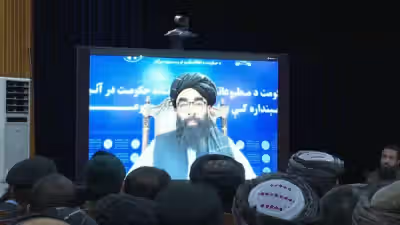
Earlier on Tuesday, Taliban spokesperson Zabihullah Mujahid said the strikes “would not go unanswered.”
The European Union Delegation in Afghanistan on Tuesday expressed solidarity with Afghan women as it joined the global “Orange the World” campaign.
In a message posted on X on 25 November, the EU commended Afghan women for what it described as their resilience in the face of ongoing challenges and their determination to build a peaceful and prosperous country.
The International Day for the Elimination of Violence Against Women is observed annually on 25 November to raise awareness of gender-based violence, strengthen support systems for women and promote a culture of prevention.
Human rights organisations continue to describe Taliban-controlled Afghanistan as one of the most repressive environments in the world for women. The exclusion of women from education, employment, public life and political participation, along with sweeping restrictions on their movement and presence in public spaces, remain defining features of life under Taliban rule.
Several governments, international bodies and women’s rights advocates have characterised the Taliban’s policies, including the systematic removal of women from social, cultural and political spheres, as amounting to “gender apartheid.”
The United Nations has previously reported that, four years into Taliban rule, Afghan women are living shorter and less healthy lives, with the group having issued nearly 100 edicts targeting women and girls, resulting in severe and lasting harm.