• العربية
  • پښتو
  • فارسی
Brand
  • Afghanistan
  • Sport
  • Markets
  • Afghanistan
  • Sport
  • Markets
  • Theme
  • Language
    • العربية
    • پښتو
    • فارسی
  • Afghanistan
  • Sport
  • Markets
All rights reserved for Volant Media UK Limited
volant media logo

Taliban Executes Man Convicted Of Murder In Khost Stadium

Dec 2, 2025, 10:08 GMT+0

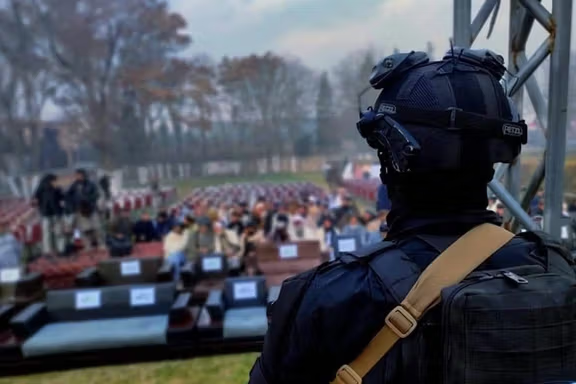
The Taliban’s Supreme Court said on Tuesday that a man convicted of murder was executed in a stadium in central Khost province, with local residents present. The man, identified as Mangal, was a resident of Khost.

According to the Taliban, he had been tried on charges of premeditated murder and was arrested in connection with the killing of Abdul Rahman, son of Zabit. The Supreme Court said the death sentence was upheld by Taliban leader Hibatullah Akhundzada after the case was reviewed by three courts.

The Taliban said the victim’s family had been asked to grant forgiveness and accept reconciliation, but they declined.

Atiqullah Darwish, chief of the Supreme Court’s Criminal Division, was quoted by the Taliban-appointed provincial governor’s spokesperson as saying on X that this was the eleventh execution carried out under Taliban rule. He added that two other individuals linked to the same case have also received death sentences, but their executions have been postponed due to the absence of the victim’s heirs. He said both would be executed once the heirs are present.

The United Nations has repeatedly urged the Taliban to halt executions in Afghanistan, but the group has rejected those calls, insisting on enforcing what it describes as Islamic law.

Human-rights organizations say the Taliban’s judicial system fails to meet basic legal standards and that defendants are denied due-process rights, including access to legal counsel. The Taliban continue to impose routine public floggings across several provinces. The group also summons crowds to witness executions and corporal punishments, a practice critics describe as psychological intimidation aimed at instilling fear among the population.

Most Viewed

Taliban Ignore Afghanistan’s Interests By Backing Militants, Says Pakistan Army Chief
1

Taliban Ignore Afghanistan’s Interests By Backing Militants, Says Pakistan Army Chief

2

United Nations Delivers Education Kits To Four Million Afghan Children

3

Taliban Renews Call For China To Launch Aynak Copper Mine

4

Taliban Leaders In South-West Hold Security Meet In Kandahar

5

Afghan Deportations Is Strategic Mistake, Says European Parliament Member

•
•
•

More Stories

AFF Targets Taliban Morality Police Patrol In Faryab, Claims Casualties

Dec 1, 2025, 15:43 GMT+0

The Afghanistan Freedom Front (AFF) says its fighters attacked the Taliban’s Ministry for the Promotion of Virtue and Prevention of Vice headquarters in Maimana, the capital of Faryab province, on Sunday evening.

The group says two Taliban members were killed, though a spokesperson for the ministry denied the claim and said the assault had been foiled.

In its statement, the AFF said the operation had been pre-planned and targeted a gathering of the Taliban’s morality police as they were leaving the building. It added that the fate of the head of the Taliban’s Vice and Virtue office in Maimana remained unclear.

The AFF accused the Taliban’s morality officers of assembling at the centre each day before patrolling the city in groups of three to five to harass residents, particularly women.

Meanwhile, the spokesperson for the Taliban’s Ministry for the Promotion of Virtue said in a post on X that an armed militant had attempted to attack employees of the Maimana office but was stopped before reaching his target. He gave no further details about the attacker or how the assault was prevented.

The AFF says it has previously targeted Taliban morality personnel in Kabul, Takhar, Kapisa and several other provinces.

Taliban to Carry Out Public Execution In Khost On Tuesday

Dec 1, 2025, 14:09 GMT+0

The Taliban media office in Khost province has announced that a man sentenced to death will be publicly executed on Tuesday in the provincial stadium. The United Nations has previously urged the Taliban to halt the use of capital punishment in Afghanistan.

Mostaghfar Gurbaz, spokesperson for the Taliban-appointed governor in Khost, called on the public not to bring smartphones, cameras or weapons to the execution site.

The Taliban did not disclose details of the case, saying only that it stemmed from a “tragic incident” in the Alisher and Terezi districts.

If carried out, the execution will be the twelfth conducted publicly by the Taliban since returning to power. Eleven others have been executed in Farah, Laghman, Ghazni, Jawzjan, Badghis and Nimroz provinces, often before large crowds.

Following the execution of four people in Farah, Badghis and Nimroz, the UN Assistance Mission in Afghanistan (UNAMA) said the Taliban’s actions violated the fundamental right to life and called for an immediate end to the death penalty.

The Taliban’s foreign ministry later rejected UNAMA’s appeal as an “audacious insult” to Islamic rulings and said capital punishment was a non-negotiable part of Islamic Sharia. It urged UNAMA to refrain from such criticism.

The Taliban’s use of public executions has drawn widespread condemnation from international organisations and several governments.

Taliban–Pakistan Talks In Saudi Arabia Collapse Without Agreement

Dec 1, 2025, 12:25 GMT+0

Sources have confirmed to Afghanistan International that a Taliban delegation travelled to Saudi Arabia for talks with Pakistani officials, but the negotiations ended without any breakthrough.

The delegation included Rahmatullah Najib, the Taliban’s deputy interior minister; Abdul Qahar Balkhi, the foreign ministry spokesperson; and Anas Haqqani, a senior Taliban figure. Saudi Arabia had earlier signalled its willingness to mediate between the two sides.

The Taliban have not commented publicly on the Saudi talks.

The discussions followed two failed rounds of talks in Istanbul, which also produced no results. Qatar and Türkiye, acting as mediators, previously hosted three rounds of Taliban–Pakistan negotiations in Doha and Istanbul. The first round in Doha resulted in an agreement on an immediate ceasefire.

Taliban spokesperson Zabihullah Mujahid had earlier acknowledged that the Istanbul talks had collapsed. In a post on X, he said the negotiations “had no result,” adding that certain elements within Pakistan’s intelligence services and military were obstructing the process and attempting to heighten tensions.

Five Killed In Cross-Border Attacks From Afghanistan, Says Tajikistan

Dec 1, 2025, 11:55 GMT+0

Tajikistan’s presidential press office said on Monday that two attacks launched from Afghan territory over the past week have killed five people and injured five others.

President Emomali Rahmon instructed security agencies to assess the situation and consider measures to reinforce border security.

According to the statement, Rahmon condemned what he called the illegal and provocative actions of Afghan citizens and directed authorities to take effective steps to resolve the issue and prevent further incidents.

Tajik officials have previously warned about drug traffickers and illegal gold miners operating in remote areas along the Afghan border.

Earlier, the Tajik Foreign Ministry said three Chinese workers were killed when assailants crossed from Afghanistan and attacked the staff compound of the “Shahín SM” gold-mining company in the Shamsiddin Shohin district of Khatlon province.

Local sources in Badakhshan told Afghanistan International that on Sunday evening, 30 November, two Chinese nationals were also attacked in the Shadak border area of Tajikistan from Razavi village in Maimay district. The sources said the attack appeared to involve Taliban border forces who had recently arrived in the area from other parts of Badakhshan.

Tajik authorities have not publicly named the perpetrators but have described the assailants as criminal groups operating from inside Afghanistan.

British Forces Committed ‘War Crimes’ In Afghanistan, Says Former UK Officer

Dec 1, 2025, 10:58 GMT+0

A former senior British officer has alleged that UK special forces committed “war crimes” in Afghanistan by carrying out the extrajudicial killing of detainees. He said that senior military officials were aware of the incidents but concealed them.

The comments emerged as part of a public inquiry launched by the UK Ministry of Defence after a BBC investigation reported that members of the Special Air Service (SAS) had killed 54 people under suspicious circumstances during a six-month deployment roughly a decade ago.

The inquiry is examining a series of night raids conducted between mid-2010 and mid-2013, when British forces were operating under the US-led coalition against the Taliban and other insurgents. Although British military police previously investigated allegations of wrongdoing including some involving the SAS, the Ministry of Defence has said those probes did not uncover sufficient evidence to prosecute.

The current inquiry is tasked with determining whether credible information about extrajudicial killings existed, whether military police investigations were properly conducted, and whether any unlawful killings were covered up.

Sir Charles Haddon-Cave, the inquiry’s chair and a senior judge, said it was essential both to hold accountable anyone who broke the law and to clear the names of those who did not.

In newly disclosed confidential testimony released on Monday, a former British officer who served as deputy chief of staff for UK special operations in Afghanistan said the number of enemy fighters reported killed in action consistently exceeded the number of weapons recovered. He said repeated claims that detainees had attempted to seize weapons or detonate grenades after being captured did not appear credible.

He told Oliver Glasgow, the inquiry’s lead counsel, that the incidents amounted to “war crimes,” describing detainees being taken back to raid sites and executed under the pretence that they had attacked British forces.

The officer said he raised his concerns at the time with the commander of UK special forces in Afghanistan, but instead of initiating an investigation, the commander ordered only a review of operational tactics.

He said he regretted not reporting the matter directly to military police, although he eventually did so in 2015. He also suggested the issue was not confined to a few soldiers but appeared more widespread, saying many within the special forces community seemed to know what was happening.

He added that the killing of detainees including, in some instances, toddlers shot in their beds was “not special, not elite, not what we stand for,” and that most personnel would not condone or cover up such actions.