US Suspends Immigration Processing For Applicants From 19 Countries
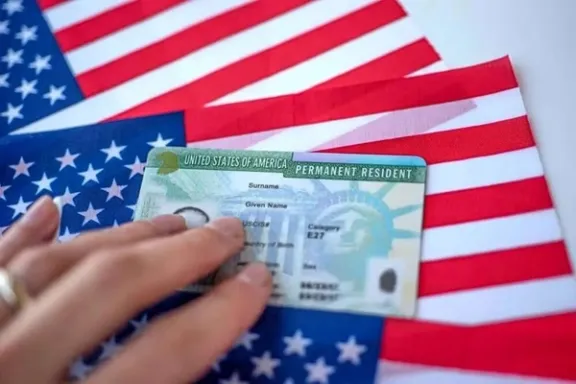
The United States has suspended all immigration applications including green card and citizenship requests from nationals of 19 countries, all of them outside Europe.
The United States has suspended all immigration applications including green card and citizenship requests from nationals of 19 countries, all of them outside Europe.
The affected countries are Afghanistan, Myanmar, Chad, the Republic of Congo, Equatorial Guinea, Eritrea, Haiti, Iran, Libya, Somalia, Sudan, Yemen, Cuba, Laos, Sierra Leone, Togo, Turkmenistan, and Venezuela.
An official memo outlining the Trump administration’s new policy linked the decision to last week’s attack on members of the US National Guard in Washington, in which an Afghan man was arrested as the suspected gunman. Officials identified the suspect as Rahmanullah Lakanwal, a 29-year-old Afghan who had been granted asylum in April.
Since returning to office in January, President Donald Trump has introduced a series of stringent immigration policies. Following the recent attack in Washington, the administration has intensified measures targeting migrants, particularly Afghans.
Uzbek media, citing the country’s Chamber of Commerce and Industry, reported on Wednesday that the Termez–Hairatan border crossing has reopened after four years.
Officials said the move is intended to ease the movement of travellers and strengthen bilateral trade with Afghanistan.
According to Uzbek outlets, reopening the land border forms part of a broader plan to increase exports to as much as $2.5 billion by 2026.
Uzbekistan closed its land border with Afghanistan in 2021 after the Taliban returned to power, citing security concerns. Under the new policy, citizens of both countries may now cross the border, although visa requirements remain in place.
The development comes as the Taliban, facing heightened tensions with Pakistan and the closure of multiple crossings, seek alternative trade routes.
Afghanistan and Uzbekistan maintain extensive economic ties, with frequent official visits exchanged over the past four years. According to data from Uzbekistan’s Statistics Committee, bilateral trade reached $1.3 billion from January to October this year, a 46.7 percent increase compared with the same period in 2023.
The Taliban governor’s spokesperson in Khost said on Tuesday that two sons of a man executed earlier that day have also been sentenced to death. Their executions, he said, have been postponed because the heir of the victims is not currently in Afghanistan.
Mostaghfer Gurbaz, spokesperson for the Taliban governor in Khost, also released details of the charges against the man executed on Tuesday, identified as Mangal. He said Mangal was accused of killing members of a family.
According to Gurbaz, Mangal and his two sons killed 13 members of a family ten months ago in the Ali Sher district of Khost. He wrote on X that the cases of Mangal and his sons were identical and that the same ruling of retribution had been issued for all three. However, he said the executions of the two sons were delayed because, under Islamic law, the victims’ heir, described as the family’s surviving young daughter, is abroad. He added that had the heir been present, the two sons would have been executed alongside their father.
On Monday, the Taliban issued a public call urging people to gather at the Khost stadium to witness the execution. The governor’s spokesperson later said that around 80,000 people were present, with images showing spectators even climbing trees to get a clearer view.
Taliban courts have issued death sentences for the man and his sons. The United Nations and human rights organizations consider public executions a violation of human dignity and an inhumane practice, and have repeatedly urged the Taliban to halt them. The Taliban, however, insist they will continue implementing what they describe as Islamic Sharia.
Kremlin spokesperson Dmitry Peskov said on Tuesday that Moscow believes dialogue with the Taliban must continue, stressing that Afghanistan remains critically important for regional stability. He also noted that Russian border guards are stationed in Tajikistan.
Speaking ahead of the Russia–India meeting in New Delhi, Peskov said Afghanistan is a key country in Central Asia and borders several former Soviet republics, including Tajikistan. He said Russia maintains relations with Afghanistan despite the Taliban being a de facto government, adding that it is an important country in the region.
Referring to the deployment of Russian border forces in Tajikistan, he said this underscores the need for continued engagement with the Taliban authorities. He added that Russia and India share a “full understanding” on the importance of maintaining dialogue.
His remarks came after Tajikistan’s presidential press office confirmed on Monday that two attacks launched from Afghan territory over the past week had killed five people and injured five others. Tajik President Emomali Rahmon has instructed security agencies to bolster border protection.
On Tuesday, Taliban Foreign Minister Amir Khan Muttaqi told his Tajik counterpart that the Taliban was prepared to help secure the frontier and take part in a joint investigation into the incident.
The Taliban governor’s spokesperson in Khost said on Tuesday that an estimated 80,000 people gathered at a stadium in the provincial centre to watch the public execution of a man convicted of premeditated murder. The Taliban had urged the public a day earlier to attend.
The Supreme Court said the man, identified as Mangal, a resident of Khost, was executed after Taliban leader Hibatullah Akhundzada upheld the death sentence following reviews by three courts. He had been convicted of killing Abdul Rahman, the son of Zabit.
According to the Taliban, the victim’s family was asked to offer “forgiveness and reconciliation” but declined.
Citing Atiqullah Darwish, head of the Supreme Court’s Criminal Division, the governor’s spokesperson wrote on X that this was the eleventh execution carried out under Taliban rule. He said two others convicted in the same case had also received death sentences, but their executions had been postponed due to the absence of the victim’s heirs. He said the executions would proceed once the heirs were present.
The United Nations has repeatedly called on the Taliban to halt executions in Afghanistan, but the group has dismissed such appeals, saying it is committed to implementing “Islamic law.”
Human-rights organisations say the Taliban’s judicial process fails to meet basic standards and that defendants are routinely denied due-process rights, including access to legal counsel. Public floggings remain widespread across multiple provinces.
The Taliban regularly summon crowds to witness executions and corporal punishment, a practice critics describe as a form of psychological coercion intended to instil fear among the population.
Authorities in Khost had banned smartphones at the execution site.
A senior Taliban official has claimed that no actor inside Afghanistan is able to “speak” except the Taliban, asserting that the group now has “complete control” over the country and that the press is the only sphere not yet fully subdued.
Abdul Mateen Qani, spokesperson for the Taliban’s interior ministry, made the comments on Monday during a virtual meeting with spokespersons for provincial governors and police commanders. He said a global “propaganda war” was underway and described the media as a fundamental pillar of modern societies, arguing that nations advance their wars and interests through information campaigns.
Speaking about the domestic situation, Qani said the Taliban now dominate Afghanistan after decades of instability and exercise absolute control over the entire territory. He said “no actor inside Afghanistan” remained capable of speaking independently.
Qani added that the only sector not yet fully under Taliban control was the press.
Since taking power, the Taliban have shut down independent media outlets and, over the past four years, have detained and imprisoned numerous journalists, cultural figures and civil society activists. The group has imposed extensive restrictions on freedom of expression and banned any form of criticism of its administration.
