• العربية
  • پښتو
  • فارسی
Brand
  • Afghanistan
  • Sport
  • Markets
  • Afghanistan
  • Sport
  • Markets
  • Theme
  • Language
    • العربية
    • پښتو
    • فارسی
  • Afghanistan
  • Sport
  • Markets
All rights reserved for Volant Media UK Limited
volant media logo

Tehran Urges Taliban & Pakistan To Return To Negotiating Table

Dec 15, 2025, 13:30 GMT+0

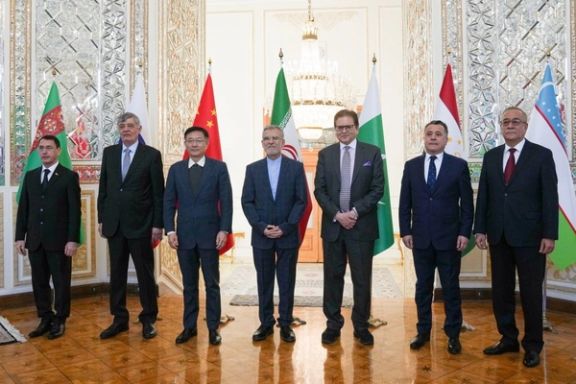
Iran said Afghanistan’s neighbouring countries and Russia, meeting in Tehran, have called on the Taliban and Pakistan to return to negotiations and resolve their differences through diplomatic means.

In a statement on the meeting, Iran’s Foreign Ministry said Afghanistan’s neighbours and Russia supported efforts to de-escalate tensions between the Taliban and Pakistan and expressed readiness to help strengthen those efforts.

The statement added that regional countries are prepared to assist in promoting stability in Afghanistan if requested by authorities in Kabul.

Iran’s Foreign Ministry said participants emphasised the need for greater regional convergence to address existing issues and challenges, including those related to Afghanistan. The statement, released on Monday, said Afghanistan’s neighbours also stressed the importance of integrating the country into regional political and economic processes.

According to the ministry, regional countries, while underscoring ongoing security threats, expressed readiness to assist Afghanistan in combating terrorism and drug trafficking.

The Tehran meeting was held on Sunday, with the participation of special representatives from China, Pakistan, Tajikistan, Uzbekistan and Turkmenistan. Despite Iran’s emphasis on consensus among Afghanistan’s neighbours and Russia, no joint statement has been issued so far.

The Iranian statement made no reference to human rights violations in Afghanistan, including restrictions on education and employment for women and girls, or the formation of an inclusive government.

Instead, participants stressed the need to strengthen economic and trade relations with Afghanistan to improve the livelihoods of the Afghan people. Tehran said countries at the meeting called on the international community to lift sanctions and release Afghanistan’s frozen assets.

The statement also urged countries considered responsible for Afghanistan’s current situation to assist in rebuilding the country and improving economic and living conditions without using aid as a political tool.

Participants further called on international organisations to support the return of Afghan refugees.

Iran’s Foreign Ministry said the second round of the meeting of special representatives of Afghanistan’s neighbouring countries and Russia is scheduled to be held in Islamabad in March next year.

Most Viewed

Taliban Ignore Afghanistan’s Interests By Backing Militants, Says Pakistan Army Chief
1

Taliban Ignore Afghanistan’s Interests By Backing Militants, Says Pakistan Army Chief

2

United Nations Delivers Education Kits To Four Million Afghan Children

3

Taliban Renews Call For China To Launch Aynak Copper Mine

4

Taliban Leaders In South-West Hold Security Meet In Kandahar

5

Afghan Deportations Is Strategic Mistake, Says European Parliament Member

•
•
•

More Stories

Pakistan Ulema Council Chief Urges Taliban To Act Against Extremism

Dec 15, 2025, 12:27 GMT+0

Tahir Mahmood Ashrafi, chairman of Pakistan’s Ulema Council, has urged the Taliban to take action against extremism in Afghanistan, welcoming a recent gathering of Taliban clerics in Kabul and calling for the implementation of its resolution.

The meeting of Taliban clerics was held amid heightened tensions between Afghanistan and Pakistan. In a statement issued after the gathering, clerics aligned with the Taliban declared the use of Afghan territory against other countries illegitimate and warned that action would be taken against those responsible.

Speaking on Sunday, 15 December, Ashrafi said: “It is now the responsibility of the Afghan interim government to ensure the implementation of the recent declaration issued by its scholars.” He described the statement as “a positive step in the right direction.”

Ashrafi said there was no difference between the positions of Afghan and Pakistani clerics on the issue, adding that attacks should not be carried out from Afghanistan against Pakistan, or from Pakistan against Afghanistan.

His remarks come as relations between the Taliban and Pakistan have sharply deteriorated. A surge in militant attacks inside Pakistan has contributed to rising tensions and clashes between Afghan Taliban forces and the Pakistani military.

In response, Pakistan’s military has carried out strikes on targets inside Afghanistan, including in Kabul. Following the escalation, the two sides engaged in several rounds of talks mediated by various countries, but the negotiations ended without a breakthrough.

Afghanistan Needs No ‘Crisis Management’, Says Taliban Foreign Ministry Official

Dec 15, 2025, 11:29 GMT+0

A senior official at the Taliban’s Foreign Ministry has criticised Iran’s portrayal of Afghanistan as a country in crisis, saying Taliban-ruled Afghanistan should no longer be treated as a crisis-management issue.

Zakir Jalali, head of the second political directorate at the Foreign Ministry, made the comments in response to a regional meeting of special envoys on Afghanistan held in Tehran. Writing on X on Sunday, Jalali said Afghanistan under Taliban control does not require crisis-management mechanisms.

He urged Iran and other regional countries to abandon what he described as a “security-oriented approach” towards Afghanistan and instead focus on expanding diplomatic relations, trade and economic cooperation.

In recent days, Iranian officials have expressed concern about the durability of stability in Afghanistan. Iran’s Foreign Minister Abbas Araghchi said on Sunday at the Tehran meeting that peace in Afghanistan would not be possible without cooperation from neighbouring countries.

Separately, Iran’s ambassador to the United Nations, Amir Saeid Iravani, told a UN Security Council meeting on 10 December that forming an inclusive government representing the Afghan people was essential to prevent a renewed outbreak of war.

In his remarks, Jalali said Afghanistan before 2021 had been a “serious and alarming problem” for the region due to the military presence of dozens of foreign countries and the interference of regional and other actors.

He said that, given what he described as the Taliban administration’s “good intentions and economy-centred foreign policy,” Afghanistan could now become an effective bridge linking Central Asia with West and South Asia.

Taliban officials have repeatedly claimed they have full control over Afghanistan’s territory, that security has been fully restored and that the country is ready for trade and investment from regional and international partners.

At the Tehran meeting, Pakistan raised concerns about the threat of terrorism emanating from Afghanistan, an issue previously echoed by Russia and China.

Pakistan’s special envoy for Afghanistan, Mohammad Sadiq Khan, said the shared assessment of countries participating in the meeting was that terrorism originating from Afghanistan poses a major challenge to the region. He urged the Taliban to take concrete steps to eliminate what he described as terrorist groups from the country.

The regional meeting on Afghanistan began on Sunday in Tehran with representatives from Russia, Pakistan, China, Tajikistan, Uzbekistan and Turkmenistan in attendance. Despite being invited by Iran, the Taliban declined to participate.

Zia Ahmad Takal, deputy spokesperson for the Taliban’s Foreign Ministry, said the decision not to attend was based on the view that Afghanistan already maintains active relations with regional countries through existing organisations and cooperation frameworks and has made what he described as significant progress in this regard.
Former Taliban Detainee Wins Qatar Emir’s Award

Dec 15, 2025, 10:46 GMT+0

Matiullah Wesa, a prominent activist for girls’ education and a former Taliban detainee, has won the Sheikh Tamim bin Hamad Al Thani International Anti-Corruption Award in the category of Youth Creativity and Participation.

Wesa attended the ninth edition of the award ceremony on Sunday, in Doha. The event was held in cooperation with the UN Office on Drugs and Crime.

Qatar’s Emir, Sheikh Tamim bin Hamad Al Thani, presented the awards to winners in several categories. Speaking at the ceremony, he said: “Combating corruption is a global responsibility that requires concerted efforts of international organisations and initiatives of individuals of integrity.”

The Sheikh Tamim bin Hamad Al Thani International Anti-Corruption Award has been held annually since 2016 to recognise individuals and innovative projects aimed at fighting corruption. Previous ceremonies have taken place in Vienna, Geneva, Malaysia, Rwanda, Tunisia, Qatar, Uzbekistan and Costa Rica.

Wesa received his award directly from the Emir of Qatar. He had been arrested by the Taliban’s intelligence agency in March 2023 and was released 215 days later.

Before his arrest, Wesa had been organising education programmes for girls. At the time, Taliban spokesperson Zabihullah Mujahid claimed Wesa was acting “unilaterally” and holding gatherings without informing the authorities.

Mujahid also alleged that Wesa maintained both covert and overt contacts with “foreign actors” and was receiving instructions from abroad.

No One Seeks To Replace Taliban Leader, Says Senior Official

Dec 14, 2025, 16:50 GMT+0

Rahmatullah Najib, the administrative deputy of the Taliban’s Ministry of Interior, has said there are no disagreements among the group’s leadership and that no senior figure seeks to replace Taliban leader Mullah Hibatullah Akhundzada.

Najib’s remarks appeared to respond to reactions within the Taliban following recent comments by Sirajuddin Haqqani, the group’s interior minister, which were widely interpreted as critical of the leadership’s governing approach.

Speaking on Sunday, 14 December, at a graduation ceremony for Taliban police in Maidan Wardak province, Najib said: “I have held private meetings with each of the leaders. There is no idea in their minds that someone else should replace the Amir al-Mumineen. The thought that another person should become amir does not exist at all.”

He said all senior Taliban officials continue to fight opponents of the system under the leadership of Hibatullah.

In another part of his speech, Najib said establishing a system based on democratic values in Afghanistan was impossible and lacked public support. “To those who chant slogans of democracy, I say it is not worth getting yourselves killed for it,” he said. “Democracy is not a formula for which you should suffer.”

Najib also called for firm action against those who act against what he described as the system.

His insistence on unity among Taliban leaders appeared aimed at clarifying or countering remarks made by Haqqani on Friday in Khost. In that speech, Haqqani criticised the Taliban’s style of governance and treatment of the population, implicitly acknowledging that the group relies on humiliation, violence and fear to maintain control.

Pakistan’s Envoy At Tehran Talks Criticises Taliban, Says Afghans Deserve Better

Dec 14, 2025, 15:23 GMT+0

Pakistan’s special representative for Afghanistan criticised conditions in the country under Taliban rule at a regional meeting in Tehran, saying the Afghan people deserve better.

Speaking at the Meeting of Special Representatives of Afghanistan’s Neighbouring Countries Plus Russia, Mohammad Sadiq Khan said participants shared the view that the threat of terrorism emanating from Afghanistan poses a major challenge to regional security.

He said that the people of Afghanistan have endured immense suffering and deserve better conditions.

He urged the Taliban to take practical steps to ease the hardship faced by Afghans, adding that the most important measure would be the complete and non-discriminatory elimination of all terrorist groups from Afghan territory.

The regional meeting on Afghanistan began on Sunday, in Tehran with the participation of representatives from Russia, Pakistan, China, Tajikistan, Uzbekistan and Turkmenistan. Although invited by Iran, the Taliban declined to attend.

Khan said Afghanistan would only be able to gain the trust of neighbouring and regional countries for meaningful engagement once it is free of terrorist groups. He added that such engagement could help revive Afghanistan’s economic potential and strengthen regional connectivity.

Pakistani officials have repeatedly raised security concerns and accused the Taliban of providing safe haven to Tehreek-e-Taliban Pakistan militants in Afghanistan. United Nations Security Council reports have confirmed the presence of the group. The Taliban have denied the allegations and accused Pakistan of failing to ensure its own security.