Taliban Signal Readiness To Deepen Ties After Pezeshkian Comments
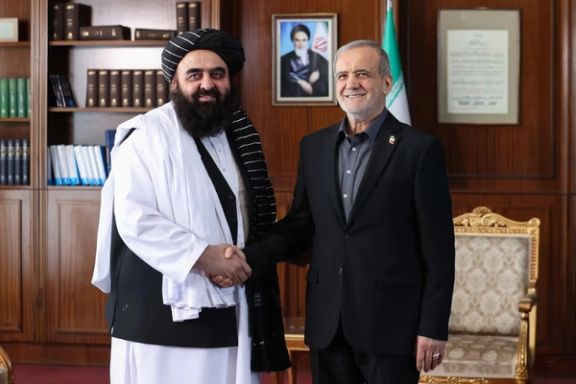
The Taliban on Saturday welcomed comments by Iran’s president about accelerating engagement with Afghanistan, saying they are working to build trust with Tehran.

The Taliban on Saturday welcomed comments by Iran’s president about accelerating engagement with Afghanistan, saying they are working to build trust with Tehran.
Hamdullah Fitrat, the Taliban’s deputy spokesperson, described President Masoud Pezeshkian’s remarks as positive and said the Taliban are seeking to foster confidence with Iran across all areas of cooperation.
Pezeshkian said Iran would make every effort to “strengthen and accelerate engagement with Afghanistan” in border regions. He made the remarks at the end of a visit to South Khorasan province, which borders Afghanistan.
The Iranian president said the governor of South Khorasan has been granted authority to speed up engagement with Afghanistan.
Iran is seeking to increase exports to Afghanistan as border crossings between Pakistan and Afghanistan remain closed. Trade between Iran and Afghanistan is estimated at about $4 billion. Officials expect trade with Iran to grow further following the disruption of Afghanistan’s commercial ties with Pakistan. The Taliban are also seeking to use Iran’s ports of Chabahar and Bandar Abbas as alternatives to Pakistani ports.
The comments come a week after Iran hosted a meeting in Tehran attended by representatives of Afghanistan’s neighbouring countries and Russia. The Taliban declined to send a representative to the meeting. Following the talks, a senior aide to Iran’s president travelled to Kabul and invited Taliban’s foreign minister to visit Iran.

The United Nations refugee agency says at least 2.8 million Afghan migrants were returned to Afghanistan in 2025 after being deported from Iran and Pakistan.
In its annual report released on Friday, the UN High Commissioner for Refugees said about 1.8 million Afghans were expelled from Iran and 930,000 from Pakistan. The agency said 67 percent of the returns were forced.
According to the report, deportations of Afghan migrants from the two countries increased by 62 percent compared with last year.
The highest number of returns was recorded in July, at the height of deportations from Iran, when about 373,000 Afghans were expelled.
UNHCR again voiced concern that many returnees particularly women and girls face “serious protection risks” given the current human rights situation in Taliban-ruled Afghanistan.
The report added that despite protection concerns, deportations of Afghans from Tajikistan also continued this year, with at least 1,700 migrants expelled from that country.
The agency warned that large-scale forced returns are placing additional pressure on Afghanistan’s already fragile humanitarian situation.

Uzbek President Shavkat Mirziyoyev said joint regional and international cooperation can help stabilise Afghanistan and improve the lives of its people. He was speaking during the first Central Asia–Japan summit in Tokyo.
The two-day summit, held on Friday and Saturday, December 19 and 20, brought together Japan and the five Central Asian states including Uzbekistan, Kazakhstan, Kyrgyzstan, Tajikistan and Turkmenistan for multilateral talks aimed at expanding cooperation and addressing shared regional challenges.
Regional security and stability, enhanced coordination, and efforts to combat terrorism and organised crime were among the main items on the agenda.
Mirziyoyev said uniting efforts to preserve peace and strengthen stability is particularly important, adding that Afghanistan remains a key area for cooperation. He said he hopes to see Afghanistan peaceful, stable and focused on constructive development.
The Uzbek president also praised Japan’s assistance to Afghanistan, saying Uzbekistan highly values Tokyo’s consistent position. He noted that for many years Japan has been among the leading donors and partners supporting the Afghan people.
Mirziyoyev said he is confident that joint actions and partnerships will help improve living conditions, promote socio-economic and infrastructure development, and support Afghanistan’s active participation in regional economic projects.
Japan’s embassy in Afghanistan said on Wednesday that Tokyo has allocated $19.5 million in humanitarian aid for people in need in the country, expressing hope that the assistance will make a tangible difference for vulnerable Afghans.
Although Uzbekistan, like most countries, has not formally recognised the Taliban administration, it maintains broad diplomatic and economic relations with it. Mirziyoyev has frequently highlighted Afghanistan in regional and international forums, describing stability in the country as being in the interest of Central Asia as a whole.

Russia’s state news agency has reported that those responsible for last year’s deadly attack on the Crocus City Hall concert venue near Moscow received specialised training outside Russia, including in Türkiye and Afghanistan.
According to the report, published on Friday the attackers underwent professional training and demonstrated advanced weapons skills. The information was confirmed to TASS by a source at the Second Western District Military Court.
A person involved in the judicial proceedings said all of the defendants had received training and possessed professional-level proficiency in the use of firearms. The source said one of the accused, Shamsidin Fariduni, displayed a high level of marksmanship during questioning in court.
The source also suggested that two separate operational groups had been prepared for the attack and later merged. The defendants have denied this claim.
According to the TASS report, Fariduni had initially been expected to travel via mountainous routes from a base in Türkiye to Afghanistan to join Islamic State Khorasan Province. However, because those routes were closed during the winter, he was allegedly instructed instead to take part in the Crocus City Hall attack.
Based on court information cited in the report, Fariduni was tasked with recruiting accomplices inside Russia, conducting reconnaissance at the Crocus City Hall, purchasing a vehicle to transport the attackers and obtaining weapons. During initial interrogations, he reportedly said the group did not intend to kill children, though Russian judicial authorities said the evidence does not support that assertion.
The report added that the organisers of the attack promised the perpetrators a payment of one million roubles. After carrying out the assault, the attackers reportedly headed toward Ukraine, where the money was to be paid.
The attack took place on March 22, 2024, in the Moscow suburbs. Four armed assailants opened fire on the crowd shortly before a concert began and then set the venue on fire. At least 149 people were killed and more than 600 others wounded in what was one of the deadliest terrorist attacks in Russia in recent decades.
The Islamic State claimed responsibility for the attack. Court proceedings against the suspects began in the summer, with the four main defendants appearing in court after being arrested shortly after the assault.

Taliban officials in western Afghanistan have confirmed the deaths of several Afghan migrants while attempting to cross the border into Iran, following reports by Afghanistan International.
Mohammad Yousuf Saeedi, spokesperson for the Taliban governor in Herat, said three Afghan nationals died near the Kahsan border area while attempting what he described as “illegal migration to Iran.” He told the Taliban-run Bakhtar News Agency on Friday that investigations are under way and that local authorities and emergency teams have been deployed to assist those affected.
Earlier, local sources in Herat told Afghanistan International that a group of Afghan migrants had died inside Iranian territory after being exposed to severe cold while travelling toward Iran. According to those sources, the bodies of at least 15 people were transferred to Kahsan and Adraskan districts in Herat province.
However, Afghanistan International also spoke with an Afghan migrant who had visited the morgues at the Shuhada Cemetery and Taybad Hospital in Iran’s Razavi Khorasan province. That individual said the number of Afghan migrants who died could exceed 40.
Sources further reported that several Afghan migrants have gone missing along the Iran border. In recent days, hundreds of Afghans are said to have headed toward the border in an attempt to reach Iran, but encountered extreme cold weather en route.
According to these accounts, the migrants were trying to enter Iran through unofficial and smuggling routes from Islam Qala toward Taybad. Weather conditions in the border areas have been reported as snowy, rainy and extremely cold. Families of the victims are reportedly searching for the bodies of their relatives.
The exact number of casualties remains unclear.
In recent months, the Taliban have reported the arrest of hundreds of Afghans accused of attempting to migrate illegally to Iran. Following mass deportations of Afghan migrants from Iran and tighter visa restrictions, many Afghans have resorted to dangerous and irregular routes in an effort to return to Iran.

A group of Afghan migrants travelling to Iran have died inside Iranian territory after encountering severe cold weather, sources in Herat province told Afghanistan International.
According to the sources, the bodies of at least 15 migrants have been transferred to the Kohsan and Adraskan districts of Herat. Some sources said the death toll could be in the dozens, though the figures have not been officially confirmed.
Afghanistan International spoke with an Afghan migrant who visited morgues at the Shuhada Cemetery and at Taybad Hospital in Iran’s Razavi Khorasan province. He said more than 40 Afghan migrants had died.
Many Afghan migrants are also reported missing along the Iran–Afghanistan border, the sources said.
In recent days, hundreds of migrants are believed to have set out for Iran and encountered a wave of extreme cold along the route. The severe weather is continuing.
Sources said the migrants were attempting to enter Iran via an unofficial route from Islam Qala towards Taybad. Weather conditions along the border were described as snowy, rainy and extremely cold.
Families of the migrants are reported to be searching for the bodies of their relatives.
Iranian authorities and the Taliban have so far made no public comment on the incident.
This is a developing story.
