Taliban Publicly Flog Man In Balkh Province
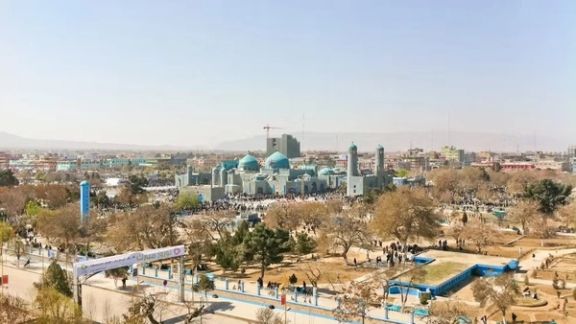
The Taliban’s Supreme Court said on Thursday that a man in northern Balkh province was publicly flogged with 39 lashes after being convicted of selling alcoholic beverages.
The Taliban’s Supreme Court said on Thursday that a man in northern Balkh province was publicly flogged with 39 lashes after being convicted of selling alcoholic beverages.
According to the court, a primary court in Balkh also sentenced the man to one year and 10 months in prison.
The Taliban describes public flogging as the “implementation of sharia” law and routinely carries out corporal punishment against individuals convicted by its courts.
A recent report by the United Nations found that over a three-month period between August 1 and October 31, 2025, the Taliban publicly flogged at least 215 people across several provinces. Those punished included 44 women and 171 men.
Despite sustained opposition from international organisations to corporal punishment, torture and intimidation, the Taliban have continued to enforce public floggings since returning to power.

The US State Department has said that Zalmay Khalilzad does not represent the United States, following his recent meeting with Taliban Foreign Minister Amir Khan Muttaqi in Kabul.
In comments to Afghanistan International on Wednesday, the department said Khalilzad is not a US government employee and that his recent activities are carried out in a personal capacity.
The Taliban’s Ministry of Foreign Affairs said on Sunday that Khalilzad, the former US special envoy for Afghanistan, had arrived in Kabul and met Muttaqi.
After the meeting, Muttaqi said that engagement between the Taliban and the United States had effectively entered a new phase following the withdrawal of foreign forces and the end of the war in Afghanistan.
The Taliban’s decision to receive Khalilzad at the level of foreign minister suggested the group views him as a potential intermediary, relying on his experience and contacts to help improve relations between the Taliban and Washington.
However, the US State Department dismissed such assumptions. Speaking to Tajuddin Soroush, a reporter for Afghanistan International, a spokesperson said Zalmay Khalilzad is not an employee of the US government and therefore does not represent it.
The spokesperson added that all of his activities are undertaken in a personal capacity.
Khalilzad has previously travelled to Afghanistan with US officials to help secure the release of American prisoners held by the Taliban.
According to the Taliban, Muttaqi told Khalilzad that opportunities exist in several areas to expand relations between the two sides and that sustained dialogue could help advance those efforts.
The Taliban’s Committee for the Prevention of Land Grabbing has ordered the cancellation of all lease and investment contracts linked to Mohammad Mirza Katawazai, a former deputy speaker of Afghanistan’s House of Representatives.
According to documents obtained by Afghanistan International, the order, issued by the Taliban commission, targets contracts held by Katawazai and his business partners and marks the latest move by the authorities against figures associated with the former Afghan government.
The letter, dated December 31 and signed by Abdul Hakim Sharae, head of the Taliban’s Commission for the Prevention of Land Grabbing, accuses Katawazai of corruption, land grabbing, and involvement in drug, gold and foreign currency smuggling.
The document instructs the Oil and Gas Directorate to immediately cancel all lease and investment contracts with Katawazai and his partners and to submit a report on the actions taken to the commission. It further states that all Taliban departments are required to cooperate fully in implementing the order.
According to the letter, all contracts concluded with Katawazai, as well as those involving his sons, brothers, cousins and other partners, must be annulled. It also says an arrest warrant has been issued for Katawazai and that he is now under judicial pursuit.
Last year, the Taliban arrested 20 associates of Katawazai on charges of “forging land documents,” according to sources. They said the arrests were carried out on the orders of the Taliban’s justice minister and that the individuals were transferred to prison.
Reports indicate that Katawazai has close ties to Sirajuddin Haqqani, the Taliban’s interior minister, and to figures linked to that faction within the Taliban. Abdul Hakim Sharae is regarded as an opponent of Haqqani and is believed to have sought to curb the financial networks and influence associated with him.
Several Afghan passengers have accused officials at Islamabad International Airport of extortion, saying they were denied entry into Pakistan despite holding valid visas and airline tickets unless they paid additional fees.
Passengers told Afghanistan International that although they had already paid large sums for Pakistani visas and air tickets, airport officials demanded an extra $150 per person to allow them to leave the airport. Those who refused to pay were sent back to Kabul.
According to the passengers, eight Afghans arrived from Kabul on a flight to Islamabad on Tuesday, December 30. Despite possessing valid documents, they were barred from exiting the airport. The group said each passenger had spent about $1,200 to obtain a Pakistani “medical visa,” while the market price of a non-urgent return ticket to Pakistan is about $500.
They said ticket agents also demanded about $150 per passenger as an “airport pass” to permit exit from the terminal. Because they did not pay this amount, the passengers were held for several hours and ultimately returned to Kabul on Wednesday morning.
The passengers said they arrived at the airport at about 1 p.m. on Tuesday, but officials later declared their medical documents “not genuine” and refused them entry. During their time at the airport, they said they were not allowed to buy food or water.
Passengers said dozens of Afghans holding medical visas are reportedly turned back from Islamabad airport each day after document checks. Those affected alleged that Pakistani officials were engaging in extortion, arguing that only passengers who paid the additional fee were allowed to exit the airport.
They also questioned why the Pakistani embassy in Kabul had issued medical visas if their hospital documents were deemed invalid, a question they said airport officials ignored.
Women and children were among the eight passengers returned to Kabul. One Afghan family of three said they had spent about $5,500 on plane tickets and visas but were still denied entry and sent back.
Other passengers reported that the cost of an urgent Pakistani visa and ticket can reach nearly $2,000. One Afghan man undergoing cancer treatment said he paid $720 for an urgent Kabul–Islamabad ticket to secure a seat within four days, compared with a normal waiting period of at least three weeks. He said he also paid $160 to exit the airport.
A passenger who was returned to Kabul on Wednesday said Pakistani officials treated the group in a “humiliating” manner and dismissed their explanations. He added that many passengers carry similar hospital documents, but only those who pay the so-called airport pass are permitted to enter Pakistan.
The allegations come despite tourist visas for Afghans being officially listed as free of charge on the Pakistani embassy’s website in Kabul. Passengers said, however, that this option is effectively inaccessible, forcing applicants to rely on travel agencies that charge what they described as exorbitant fees.
The Taliban administration has set the official price of a Kabul–Islamabad flight ticket at $140 and has said it will take legal action against violators. Passengers, however, said Taliban authorities are aware of the soaring ticket prices for flights to Pakistan but have taken no effective action.
The flight from Kabul to Islamabad takes about 40 minutes. Passengers said fares on the route now exceed the cost of some flights between Afghanistan and Europe.
The Special Trust Fund for Afghanistan said it assisted at least one million Afghans in 2025, with women and girls accounting for about 40 percent of those reached.
In a statement released on Wednesday to mark the end of the calendar year, the Special Trust Fund for Afghanistan said it received $24.7 million in donor contributions during 2025, describing the year as one of hope and resilience.
The fund said that, in addition to its work in 2025, it has over the past four years supported Afghans through the creation of economic opportunities, the delivery of essential services and efforts to strengthen resilience to climate change. It added that increased donor contributions have expanded its capacity to assist people in need across the country.
According to the statement, the fund plans to broaden its programmes in livelihood development, health services and climate-change adaptation across northern, eastern, southeastern, southern and western Afghanistan.
Anwar ul Haq Ahadi, a member of the trust fund, told Afghanistan International on November 17 that the fund has generated more than $500 million in profits to date. He said its liquidity, which previously stood at $3.5 billion, has risen to $4.02 billion.
After the Taliban returned to power, the United States transferred $3.5 billion of Afghanistan’s central bank assets to a trust fund in Switzerland to support the Afghan economy. As the year ended, the Trust Fund for Afghanistan also marked the fourth anniversary of its establishment.
The United Nations spent about $2.5 billion in 2025 to address the needs of Afghan migrants and returnees, a senior UN official said during talks with Taliban authorities.
Indrika Ratwatte, deputy head of the United Nations Assistance Mission in Afghanistan (UNAMA), told a meeting with Abdul Kabir, the Taliban’s minister of refugees and repatriation, that the large-scale return of migrants had increased Afghanistan’s population by about 10 percent in a short period.
In a statement issued on Wednesday, the Taliban Ministry of Refugees and Repatriation said Ratwatte reaffirmed the United Nations’ commitment to assisting Afghans in need. He said UN agencies focused in 2025 on preventing a deepening humanitarian crisis by providing aid to returnees and other vulnerable groups.
Ratwatte, who also oversees humanitarian coordination, stressed the need for stronger cooperation with Taliban-run institutions to address the challenges facing returnees and internally displaced people. According to the ministry, he proposed measures to facilitate the transfer of humanitarian assistance through Afghanistan–Pakistan border crossings and said coordination would continue with the Ministry of Refugees and other Taliban bodies to assess needs in the coming year.
Abdul Kabir thanked the United Nations for its support in 2025 and said an emergency winter assistance plan for returnees had been prepared. He also called for increased UN aid, adding that his ministry, with support from traders and charitable individuals, has launched programmes to assist those returning to Afghanistan.
Separately, the United Nations High Commissioner for Refugees (UNHCR) has said at least 1.8 million Afghan migrants returned to the country in 2025, warning that returnees from Iran and Pakistan face “distinct and unique challenges” once back in Afghanistan.