Taliban Leader Reshuffles Two Cabinet Ministers

The Taliban leader has reshuffled two senior Taliban cabinet ministers and made several other senior appointments, the group’s spokesperson said on Thursday.

The Taliban leader has reshuffled two senior Taliban cabinet ministers and made several other senior appointments, the group’s spokesperson said on Thursday.
Zabihullah Mujahid said Hibatullah Akhundzada appointed Abdul Latif Mansoor, previously minister of energy and water, as minister of rural rehabilitation and development. Under the same decree, Mohammad Younus Akhundzada, who had served as minister of rural rehabilitation and development, was named minister of energy and water.
Mujahid also said Abdul Bari Omar, head of Afghanistan’s state electricity company, Da Afghanistan Breshna Sherkat, was appointed as head of protocol at the Taliban Ministry of Foreign Affairs.
According to the decree, Mullah Abdul Haq Himmat, a deputy minister at the Ministry of Public Works, was appointed as the new chief executive of Da Afghanistan Breshna Sherkat.
Mujahid added that Mohammad Younus Rashid, deputy minister for youth affairs at the Ministry of Information and Culture, was appointed as deputy minister for finance and administration at the Ministry of Public Works.
The latest changes come amid a broader reshuffle by the Taliban leader in recent days, which has included the reassignment of several provincial governors, corps commanders and senior police officials.
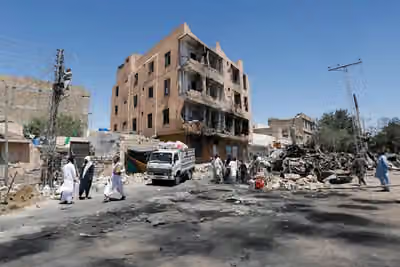
Iran has announced the opening of a new land route at the Milak border crossing with Afghanistan, a move aimed at increasing trade and easing the flow of goods between the two countries.
In a statement posted on X on Wednesday, January 7, the Embassy of the Islamic Republic of Iran in Kabul said the new route at the Milak crossing would double the movement of cargo trucks transporting goods between Iran and Afghanistan.
The Milak–Zaranj border crossing links Iran’s Sistan and Baluchestan province with Afghanistan’s Nimruz province and is one of the main corridors for the export of Iranian fuel and commercial goods to Afghanistan.
In November, Nooruddin Azizi, the Taliban’s minister of industry and trade, visited the Milak border with an Iranian delegation. Following the visit, Iranian officials announced an agreement with the Taliban to construct a second land route at the crossing.
Azizi described the project as beneficial to both sides, saying it would increase the volume of bilateral trade.
Mansour Bijar, the governor of Sistan and Baluchestan, said the new route could create a daily transit capacity of about 1,000 vehicles. He added that the development would reinforce a significant portion of Iran–Taliban economic agreements valued at roughly $10 billion.
Iran has expanded economic engagement with Afghanistan since the Taliban returned to power in 2021, with border trade and transit routes playing a central role in bilateral relations.

The Trump administration’s attack on Venezuela has alarmed leaders of countries hostile to the United States. The question now being raised is: which country and which leader will be next?
In Afghanistan, many opponents of the Taliban expect Trump to adopt an aggressive approach toward the group.
Will Hibatullah Akhundzada also be placed on the target list of US Delta Force commandos?
Following the arrest of Nicolás Maduro, supporters of regime change in countries such as the Islamic Republic of Iran have also become active, appearing to encourage Trump to carry out a similar operation in Tehran.
US Senator Lindsey Graham posted a photo of himself with Donald Trump, holding a cap bearing the slogan “Make Iran Great Again.”
The cap and slogan are derived from Trump’s US presidential campaign motto, but they also serve as a signal for regime change in Iran. This raises the question of whether influential senators or politicians in Washington are now thinking about “making Afghanistan great again.”
Trump and his supporters in the United States and Iran believe that Iran without the Islamic Republic would be a wealthy, prosperous country and a friend of the West and Israel in the Middle East. In Iran’s neighbourhood, Mullah Hibatullah Akhundzada is seen as the Afghan equivalent of Ali Khamenei, the leader of the Islamic Republic.
Akhundzada heads a regime that shelters several terrorist groups. His policies have turned Afghanistan into one of the most isolated countries in the world. Domestically, the rights of half the population have been completely stripped away, and aside from a small Taliban-affiliated minority, Afghans have been deprived of their basic rights.
Although Afghanistan during two decades of republican rule was far from ideal in terms of development and security indicators, it nevertheless had a normal, internationally recognised government. Elections were held, women had the right to study and work, and there were no political or religious prisoners.
Earlier, during the 1960s, Afghanistan had a moderate monarchy and, for a decade, a parliament and a constitutional system. The security and calm of the era of Mohammad Zahir Shah later became a source of nostalgia after the Soviet invasion and civil war.
Not long ago, Afghanistan was a destination for famous tourists and well-known politicians from the region and the world.
Former finance minister Omar Zakhilwal once told the author that Nawaz Sharif, a prominent Pakistani politician, had spent his honeymoon in Kabul.
Sharif reportedly recalled during a visit by a former Afghan president to Islamabad that he had travelled to Kabul with his wife in his youth and enjoyed good days there. He mentioned the intercontinental Hotel, Qargha resort and Paghman, which were once frequented by many tourists.
Zakhilwal also recounted that the Japanese emperor, in a meeting with them, recalled his visit to Afghanistan and said he had spent a night with his family near the Buddha statues of Bamiyan.
Today, however, that country has turned into a place of mourning, gripped by poverty and a severe humanitarian crisis.
Afghan political forces hope that, under external pressure and internal resistance, the Taliban regime will collapse, allowing Afghanistan to emerge from a “Stone Age” and form a civil, democratic government that is friendly with region and globally.
The question now is: will Donald Trump in 2026 be George Bush in 2001?
Trump and China
Many observers believe Afghanistan has little intrinsic strategic importance for the United States. However, since returning to power, Trump has repeatedly criticised the US withdrawal from Afghanistan and emphasised reclaiming American weapons from the Taliban and returning to the strategic Bagram Air Base. From Trump’s perspective, Bagram allows monitoring of China’s nuclear and military facilities. If democracy and human rights in Afghanistan mattered to Bush, having a base near China matters to Trump.
After the operation against Maduro, US Secretary of State Marco Rubio said Trump is a president of action, not words, and that his statements should be taken seriously.
Previously, many had dismissed Trump’s remarks about annexing Greenland, reclaiming US weapons from the Taliban and returning to Bagram as political bluster.
In Trump’s second term, the United States has adopted an aggressive foreign policy. The White House has acted through both diplomacy and force. In some regions, Trump has pursued conflict resolution through diplomacy, such as mediating peace between India and Pakistan, facilitating an agreement between Armenia and Azerbaijan, and supporting a ceasefire in Gaza. In other cases, he has resorted to military force.
If the Trump administration takes competition with China seriously, Afghanistan will re-enter its focus. For now, US priorities are largely concentrated on South America, the Ukraine crisis and tensions with Iran. But if Washington achieves its objectives in these three arenas, it is not unlikely that the long-forgotten Afghanistan will again draw attention.
A Leader in Hiding
Akhundzada, the Taliban leader, remains hidden from public view, and according to reports, heavy security measures surround his residence in Kandahar. Still, the examples of Osama bin Laden in Pakistan and Maduro in Caracas show that US intelligence agencies and commandos have been successful in locating the hideouts of leaders of hostile states and terrorist organisations.
Akhundzada is also vulnerable to US special operations. His advantage, however, is that unlike Khamenei and Maduro, he has not adopted an overtly hostile anti-American policy. He rarely addresses Taliban foreign policy in his speeches.
Iran and Venezuela have threatened US regional interests, whereas the Taliban have called on Washington to reopen its embassy in Kabul. Taliban officials have adopted a conciliatory tone toward the United States and speak with an eye toward the future. US and Taliban intelligence services have at least cooperated on intelligence matters related to ISIS.
Following the detention of Venezuela’s president and threats against Iran, Cuba and Colombia, there is little doubt that Taliban leaders are concerned about Akhundzada’s safety and the fate of their regime. Unlike Democratic presidents, Trump has pursued an aggressive, national-security-based foreign policy and has shown willingness to use military force to impose his demands.
After the US withdrawal, rival countries such as China and Iran filled the vacuum left in Afghanistan. At the same time, part of Washington’s actions in Latin America are aimed precisely at reducing the influence of those same countries.
The Taliban have taken Trump’s threats seriously. They view Pakistan’s actions as part of a broader US strategy on Afghanistan. Referring to Washington’s efforts to return to Bagram, a Taliban spokesperson said Pakistan is tasked with implementing US projects in the region and in Afghanistan.
Nevertheless, the Taliban have exercised restraint toward Trump and have not reacted to recent US actions in Venezuela.
“Restoring Afghanistan’s Greatness”
In Trump’s politics, restoring greatness means fundamentally changing regimes and political institutions at home and abroad and aligning countries with US interests. This approach seeks to re-establish America’s position as a regional and global hegemon.
If the Taliban fail to properly understand this new, greatness-driven US approach, they could face an uncertain fate.
Domestic Afghan political forces have openly expressed hope for Washington’s interventionist policies. These forces, mostly living in exile, currently lack the military capacity to challenge the Taliban.
If anti-Taliban lobbying convinces Washington to act against the ruling group in Afghanistan, domestic political forces have pledged to restore the rights and freedoms Afghans gained over the past two decades.
During two decades of US presence and support, Afghanistan made remarkable, historically unprecedented progress. Literacy rates rose significantly, and millions of girls gained access to education for the first time, with student numbers exceeding nine million. Women achieved historic participation: about 30 percent of civil servants were women, and in some provinces such as Herat and Jowzjan, women’s participation in local administration nearly matched that of men. Politically, 25 percent of parliamentary seats were reserved for women.
Freedom of expression reached levels widely praised in the region, and a nascent civil society challenged power.
Presidential, parliamentary and provincial council elections were held with public participation. Ethnic and religious groups saw themselves as part of the power structure, and religious and social freedoms were practised in tangible ways.
Internationally, Afghanistan emerged from years of isolation, attracted global attention and actively participated in international organisations.

The Taliban’s Supreme Court said it publicly flogged three people, including one woman and two men, in Maidan Wardak province on charges described as “illicit relations”.
In a statement issued on Thursday, the court said the punishments were carried out by the Maidan Wardak city primary court. The individuals received between 30 and 39 lashes each and were also sentenced to prison terms ranging from four months to 12 years.
The Taliban Supreme Court said the floggings took place in the presence of local officials, court staff, visitors and members of the public.
The statement added that Taliban courts have publicly flogged at least 39 people across Afghanistan over the past week on various charges.
Since returning to power in August 2021, the Taliban have reinstated public corporal punishment, including floggings and executions, a practice widely condemned by human rights organisations and the international community but defended by the group as enforcement of its interpretation of Islamic law.

An Iranian lawmaker said a suspect has been arrested in connection with the killing of a former Afghan military officer in Tehran.
Fada Hossein Maleki, a member of Iran’s parliament and its National Security and Foreign Policy Committee, told Avash News Agency that the suspect in the assassination of Genenral Ikramuddin Sari had been detained in the Iranian capital. He said Iran would not allow Afghanistan’s security problems to spill over into Tehran or Mashhad.
Maleki said several Iranian institutions have investigated the killing of Sari and of Mohammad Amin Almas, another former Afghan military officer, stressing that Iran’s Interior Ministry is treating the case with particular sensitivity.
Maleki said that the assassinations of Taliban-opposed commanders in Tehran and Mashhad are regrettable and added that the cases are being “seriously pursued” by parliament’s National Security Committee and Iran’s security agencies.
Referring to the arrest, he said: “According to the latest information we have received, the perpetrator has been detained, but further details must be announced by the Interior Ministry.”
Sari, a former police chief of Takhar province under Afghanistan’s previous government, and Almas were shot dead on December 24, 2025, in Tehran’s Vali-e Asr district, near their office. The killings prompted strong reactions from Taliban opposition groups.
The National Resistance Front of Afghanistan, Jamiat-e Islami and the Afghanistan Freedom Front accused the Taliban of carrying out the assassinations on Iranian soil. The groups urged Tehran to conduct a “serious and transparent” investigation and to hold those responsible accountable.
Maleki said “most indications suggest the incident was directed from outside Iran”, adding that he found it unlikely the suspect acted on personal motives. He said reports from Mashhad suggested the operation involved planning and coordination. He did not comment directly on allegations of Taliban involvement.
Iranian officials have previously voiced concern over similar incidents. On September 13 last year, former Afghan commander Marouf Gholami, who was close to former jihadi leader Ismail Khan, was shot dead in his office in Mashhad.
Maleki warned that Afghanistan-related conflicts should not be allowed to be transferred onto Iranian territory, calling for heightened vigilance by security agencies.

The Taliban have suspended the operations of a gold mining company in Chah Ab district of Takhar province and detained two people on suspicion of murder following deadly clashes with local residents, a Taliban official said.
Abdul Mateen Qani, spokesperson for the Taliban’s Interior Ministry, told media that mining activities were halted after violence erupted between residents and company personnel. He said one local resident and one company official had been arrested in connection with the killings.
Qani said three local residents and one company employee were killed in the clashes. He added that security forces have brought the situation under control and that all mining operations in the area have been suspended.
He also said the Taliban’s deputy governor of Takhar, Mohammad Nader Haqjo, had been sent to the district to investigate the incident.
However, sources told Afghanistan International that following Monday’s clashes, Taliban forces detained several local residents and that others were reported missing. The sources said Haqjo travelled to Chah Ab on Tuesday, and issued threats to protesters during a meeting.
No official details have been released regarding the number of detainees or the whereabouts of those reported missing.
The Taliban had earlier confirmed that a delegation was dispatched to investigate the clashes, saying the violence resulted in casualties and financial damage but without providing exact figures.
Local sources previously told Afghanistan International that at least three residents and one Taliban member were killed and 16 others wounded during confrontations between Chah Ab residents and Taliban-linked companies. Protesters reportedly set fire to mining equipment, prompting company officials to leave the area.
Former Taliban commander criticises corruption
Separately, Salahuddin Salar, a former deputy intelligence chief at the Taliban Defence Ministry, issued a sharp critique of the group’s governance in a post on Facebook.
Salar accused Taliban officials of “corruption, ethnic favouritism and prioritising personal and tribal interests over justice and the public good”. He said the concentration of wealth and national resources in the hands of a small group had widened the gap between the public and those in power, undermining the legitimacy of authority.
He warned that governments often collapse when “greed and personal interest replace wisdom and concern for the public interest”, adding that only justice, accountability and respect for human dignity could prevent such an outcome.
Residents of Chah Ab say their protests were triggered by what they describe as excessive gold mining, severe environmental damage and water shortages caused by excavation by Taliban-linked companies. Despite the dispatch of a Taliban delegation, locals say tensions in the area remain high.