Taliban Confirms Casualties In Explosion At Hotel In Kabul

Taliban authorities have confirmed that an explosion in Kabul’s Shahr-e Naw area on Monday caused casualties.

Taliban authorities have confirmed that an explosion in Kabul’s Shahr-e Naw area on Monday caused casualties.
Khalid Zadran, spokesperson for the Taliban police command in Kabul, said the blast occurred in a hotel in Gulforoshi Alley and that investigations are under way to determine the number and nature of the casualties.
Earlier, at least five eyewitnesses told Afghanistan International that Chinese nationals were the apparent target of the explosion.
Video obtained by Afghanistan International shows damage to a signboard and parts of the Chinese restaurant China Lanzhou Beef Noodle in Shahr-e Naw.
Witnesses said both Chinese nationals and Afghan civilians were injured in the blast. Some also reported that the explosion may have been carried out by a suicide attacker.
Residents of Kabul reported hearing a powerful explosion on Monday. Images shared with Afghanistan International showed a column of smoke rising from the area, injured people on the ground and civilians fleeing the scene.
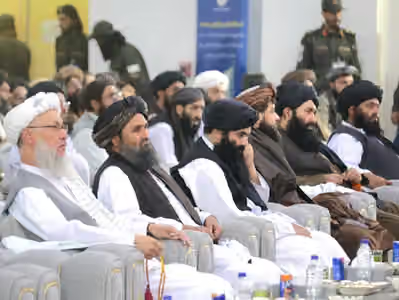
Abdul Kabir, the Taliban’s minister for refugees, has met with Kenichi Masamoto, Japan’s newly appointed ambassador in Kabul, to discuss humanitarian assistance and future cooperation, according to a Taliban statement.
The Taliban Ministry of Refugees said the Japanese ambassador told the meeting that Tokyo had provided about $550 million in aid to Afghanistan through United Nations agencies since the Taliban returned to power, up to last year.
In a statement released on Monday, the ministry said the funding has been used for humanitarian assistance, support for refugees, alternative livelihoods, healthcare, water supply, women’s empowerment and other sectors.
According to the statement, the Japanese ambassador pledged that Tokyo would continue its cooperation with Afghanistan and would not interfere in the country’s internal affairs.
The statement added that the ambassador also announced new assistance for Afghanistan, saying the Japanese government has approved a further $19.5 million aid package to support refugee-related and humanitarian programmes.
Abdul Kabir thanked Japan for its continued assistance and called for expanded cooperation. He said Afghanistan is facing serious challenges due to climate change and what he described as the effects of “foreign occupation,” and requires sustained international support.
He added that millions of Afghans have returned to the country over the past four years and are in urgent need of humanitarian assistance.

Ali Ahmad Jalali, Afghanistan’s former interior minister, says efforts to shape the country’s future must begin with the establishment of a legitimate government.
He argued that debates over constitutions and state structures are meaningless without political legitimacy.
Speaking online at a two-day conference titled Future Outlook: Political System, Social Justice, Sustainable Development, and Afghanistan’s Position in the Region and the World, Jalali said Afghanistan’s crisis has reached such depth that politicians, academics and the public must first pursue fundamental political change.
He said the legitimacy of institutions flows from the legitimacy of the state itself, stressing that Afghans must be able to form a system grounded in the will of the people.
Jalali described Afghanistan as being ruled by a totalitarian system that, he said, derives its authority not from popular consent but from its own interpretations and definitions imposed on society.
The academic conference, organised by the Trust and Stability Movement of Afghanistan, was held over two days, January 17–18, in Frankfurt.
Mohammad Asif Zaeefi, head of the Trust and Stability Movement of Afghanistan, said the conference aimed to diagnose the country’s political, economic and social crises, as well as Afghanistan’s position in the region and the wider world.
Zaeefi said the movement has developed a four-stage roadmap focused on achieving national consensus, followed by regional and international consensus, and ultimately a transition toward state-building. He said Afghanistan currently suffers from deep conceptual and definitional ambiguity, both domestically and in its relations with the international system.
Parviz Arzu, a member of the movement’s executive committee, said neutrality could help remove Afghanistan from regional and global rivalries, benefiting both the country and the wider region.
He said such a process must begin with domestic consensus and then be pursued through diplomatic engagement with regional states and major powers, with the involvement of the UN Security Council.
Conference organisers said the aim of the gathering was to provide space for dialogue and academic reflection on Afghanistan’s future political system, social justice, sustainable development, and regional and global standing.
They added that a plan for Afghanistan’s future was presented at the conclusion of the conference, noting that imported models of governance had failed in the past and that any viable solution must be rooted in the country’s domestic realities.

The World Food Programme on Sunday warned of a sharp deterioration in Afghanistan’s hunger crisis, saying food insecurity and malnutrition are spreading across the country at an alarming pace.
Earlier, John Aylieff, the WFP’s country director in Afghanistan, told Agence France-Presse that 2025 had already seen the highest surge in child malnutrition recorded in the country since the start of the 21st century.
He said the number of malnourished children could rise to four million this year, a figure the agency has previously highlighted as a looming crisis. “These children will die if they’re not treated,” Aylieff warned.
The WFP said it needs about $390 million over the next six months to provide food assistance to six million Afghans. Aylieff cautioned, however, that the prospects of securing the required funding are “very low” amid declining international support.
According to WFP data, around five million mothers and children in Afghanistan are currently suffering from malnutrition. The country ranks fourth globally for acute child malnutrition.
The agency has also warned that more than 17 million Afghans face severe food insecurity, particularly during the winter months, with the crisis compounded by widespread acute malnutrition.
Figures show hunger is worsening compared with last year, with an additional three million Afghans at risk of acute hunger in 2026, underscoring what the WFP has described as one of the world’s most severe humanitarian emergencies.

Jim Risch, a Republican US senator, said the Senate Foreign Relations Committee will review legislation later this month to prevent US taxpayer money from reaching terrorist groups, stressing that no American funds should go to the Taliban.
“We must do all we can to ensure no US money is going to the Taliban,” Risch said in a post on X.
He said the US Senate Foreign Relations Committee will take up the issue at its first working session of 2026, scheduled for January 29.
Risch, a senior conservative figure in the US Senate, plays a prominent role on the foreign relations committee.
Concerns about US funds reaching the Taliban have been raised repeatedly by lawmakers. In 2024, Tim Burchett, a member of the US House of Representatives, said in a formal memo that allowing even a single cent of US taxpayer money to reach the Taliban or other terrorist groups would be unacceptable.

A two-day conference bringing together dozens of Afghan political figures and academics opened Saturday in Frankfurt, focusing on debates over Afghanistan’s future.
The conference, titled Future Outlook: Political System, Social Justice, Sustainable Development, and Afghanistan’s Position in the Region and the World, aims to assess the country’s current situation and explore possible scenarios for the years ahead.
Organisers said the gathering is intended to create space for dialogue and academic reflection on Afghanistan’s political system, social justice, sustainable development, and its regional and global role.
Masoud Tarashtawal, one of the organisers, told Afghanistan International that the main objective is to provide an in-depth, academic and expert analysis of the most pressing challenges and prospects facing Afghanistan. He said he hoped the outcomes would serve as a reference point for future state-building and nation-building efforts.
Tarashtawal stressed that decisions about Afghanistan’s future must be shaped through dialogue and acceptance of differing views. He said the expression of the people’s will through elections is fundamental and that, without elections and a constitution, it is not possible to speak of a functioning state.
He added that a proposed plan for Afghanistan’s future would be presented at the conclusion of the conference, noting that imported models had failed to resolve the country’s challenges in the past and that any new approach must be grounded in Afghanistan’s realities.
Also addressing the conference, Mohammad Asif Zaeefi, head of the Afghanistan Trust and Stability movement, said the main purpose of the meeting was to reach a shared understanding of past failures, assess the current situation and chart a course for Afghanistan’s future.