Elon Musk Questions Global Silence Over Taliban Ban On Girls’ Education
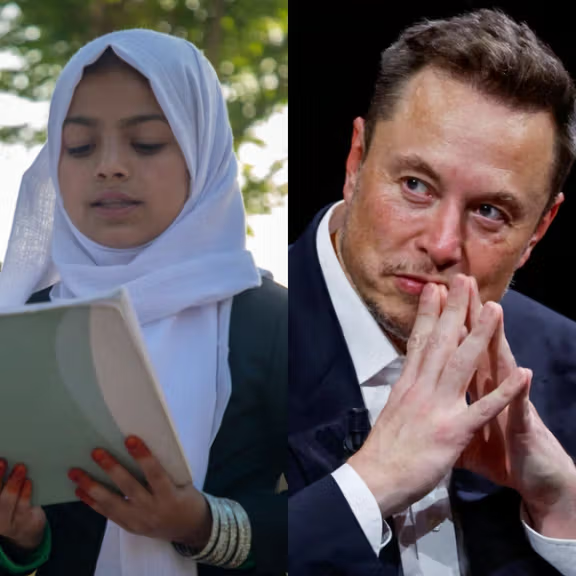
Elon Musk has criticised what he described as a lack of international protest over the Taliban’s ban on girls’ education in Afghanistan.

Elon Musk has criticised what he described as a lack of international protest over the Taliban’s ban on girls’ education in Afghanistan.
Musk shared remarks attributed to the Taliban’s higher education minister, Neda Mohammad Nadeem, who said at a press conference last year that even asking questions about the suspension of girls’ education was prohibited until further notice. Musk wrote on X: “Where are the protests about this?”
The Taliban have barred girls from education beyond the sixth grade. Nadeem, who is considered close to Taliban leader Hibatullah Akhundzada, said that just as women’s education is suspended, questions about it are also suspended until further notice.
British far-right activist Tommy Robinson described the stance as “very progressive” after reposting a video of Nadeem’s remarks that circulated widely on social media. Musk also reposted the video, which has drawn tens of millions of views.
The renewed attention has highlighted the continued deprivation of education for girls and women in Afghanistan. Human rights organisations, as well as feminist and rights activists worldwide, have repeatedly condemned the restrictions.
Some right-wing figures, including Robinson and Musk, have also used the issue to criticise left-wing and feminist groups over what they describe as muted reactions.
Musk previously reshared another post on X that criticised what the user described as global silence over the Taliban administration’s policies, including allegations related to human rights abuses.

Amrullah Saleh, Afghanistan’s former vice president, has claimed the United States paid the Taliban $45 million in cash on January 13 and has pledged to provide a further $90 million later this month.
Writing on X on Tuesday, January 27, Saleh said the Taliban had not yet fully spent the previous tranche of funds. He criticised what he described as US policy, saying the administration of President Donald Trump was imposing tariffs on Canada while “generously sponsoring the Taliban”.
Saleh suggested the Taliban were acting as a US proxy force in Afghanistan, writing: “Don’t you think something is being architected in which the Taliban, as an ugly proxy, has a job to do?”
In mid-January 2026, the US State Department confirmed to the Special Inspector General for Afghanistan Reconstruction that it was sending $80 million in cash to Taliban-controlled Afghanistan every 10 to 14 days.
Amid growing criticism over cash transfers to Afghanistan under Taliban rule, Washington has stopped publicly disclosing the delivery of $40 million cash shipments after May 2023.

Some child labourers detained by Taliban authorities have been subjected to sexual harassment and abuse while in custody, according to a report by Afghan broadcaster Amu TV, which cited accounts from several children.
One child, identified under the pseudonym Mohammad for security reasons, said he had been arrested three times by Taliban forces and was sexually abused while held at Badam Bagh prison in Kabul.
He told the broadcaster that he and others were detained and held for 11 days in poor conditions, given inadequate food and beaten in an effort to force them to stop working. He said they were subjected to repeated obscene remarks and inappropriate touching. After their release, he said, they worked elsewhere as apprentices but continued to face physical harassment from guards.
According to the report, some children said Taliban members detained them from the streets and transferred them to the group’s Dar-ul-Hifaz centres under what they described as false promises of assistance.
A child identified as Nawid, who sells bags with his two brothers and is his family’s main breadwinner, said he fled from a Taliban-run Dar-ul-Hifaz centre but was later rearrested and taken back by force.
“They said they would help us and gave us 100 afghanis per week, but that stopped,” he said, according to Amu TV. “I escaped one morning during prayers. The next day, when I was working again, they tried to put me in a vehicle. I jumped out and got injured, but they caught me again.”
The report said some children stated they were given religious and jihad-related instruction at the centres and were encouraged to take part in jihad in the future.
Several children said they were beaten while in Taliban detention and were told not to work. They said they were promised assistance but received no support after their release.
The Taliban administration has not responded to the allegations. Similar claims of abuse in Taliban-run detention facilities have been reported previously.
Since returning to power, the Taliban have promoted their religious ideology among young people and expanded religious schools across the country, institutions that some human rights organisations say can serve as recruitment grounds.
Child labourers are among the most vulnerable groups in Afghanistan. Decades of war and widespread poverty have forced millions of children into street work, exposing them to multiple risks.
According to UNICEF, at least one in five children in Afghanistan is engaged in labour. The agency has also said that about 2.5 million Afghan children between the ages of 5 and 17 are involved in hazardous work that threatens their health and future.

The Taliban administration spent about 96.9 billion afghanis on security in the first nine months of the 2025 fiscal year, according to a new World Bank report.
Development expenditure totalled 15.7 billion afghanis, while more than 106 billion afghanis were allocated to civilian sectors and public services, the report said.
Afghanistan recorded a budget deficit of about 2 billion afghanis in the first nine months of 2025, as total revenues of 200.9 billion afghanis fell slightly short of total expenditures of 202.9 billion afghanis.
In its December update on Afghanistan’s economy, the World Bank said the country remains under pressure from large-scale migrant returns and the continued closure of borders with Pakistan. Despite low inflation and a relative rise in government revenues, weak investment has hindered sustainable growth and productivity gains.
Per capita income is projected to decline by about 4 percent in the 2025 fiscal year, with widespread poverty persisting, the report said. At the same time, the afghani strengthened in December, but the trade deficit widened by 19 percent due to higher imports and transport costs.
On trade, Afghanistan’s exports to Pakistan continued to fall, with Pakistan’s share dropping to 2.9 percent in December. India became Afghanistan’s largest export destination, accounting for more than 61 percent of total exports that month. Uzbekistan’s share also rose to 7.7 percent overall in the current fiscal year.
Despite economic pressures and trade restrictions, the government’s fiscal position and the relative stability of the foreign exchange market have been maintained, the World Bank said.

The Taliban’s prison administration said a representative of the International Committee of the Red Cross met a senior official in Kabul, where the authorities requested assistance for prisoners, particularly women.
In a statement issued Monday, the administration said an ICRC representative in Afghanistan, met Mohammad Bilal Fateh, deputy head of the Taliban’s prison authority. The official asked the ICRC to help provide adequate nutrition, medical equipment and health facilities, recruit specialist doctors, supply educational materials for female prisoners and ensure essential hygiene items.
According to the Taliban statement, the ICRC delegation said it would cooperate in these areas.
In 2025, the Taliban administration said between 10,000 and 11,000 inmates were being held in prisons nationwide, including about 1,000 women and nearly 900 detainees under 18.
Since returning to power, the Taliban have also detained women for protesting against the group’s policies and for not wearing the form of hijab mandated by the authorities.

Tajmir Jawad, described as a deputy intelligence chief and a key architect of Taliban suicide attacks, on Sunday praised the group’s cultural and media activists during a ceremony.
He said that they played a decisive role in shaping public opinion, legitimising the Taliban’s war and highlighting its attacks.
Speaking at a gathering at the Taliban Prime Minister office in Kabul, Jawad, a senior figure associated with the Haqqani network, said the Taliban leadership places strong emphasis on what he called the group’s “cultural and written struggle”. He said activists in this field had made a valuable contribution to justifying the Taliban’s war and exposing the actions of its enemies.
Jawad urged writers and intellectuals affiliated with the Taliban to use modern language and new technologies to advance what he described as the group’s cultural campaign and to promote its policies and activities.
Media organisations were among the targets of Taliban suicide attacks during the previous Afghan government. In January 2016, a Taliban suicide bomber drove a car packed with explosives into a minibus carrying employees of Tolo TV and the Moby Group, killing seven people and wounding 25 others.
At the time, Taliban spokesperson Zabihullah Mujahid claimed responsibility for the attack, saying it was carried out in retaliation for what he described as false accusations by Tolo TV during the battle for Kunduz.
Jawad is regarded as a secretive figure within the Taliban. At the ceremony, photographs of other speakers were released, but his image was not published.
The 2016 attack was not the last time Tolo and other private media outlets lost colleagues in suicide bombings. In 2018, journalist Samim Faramarz and cameraman Ramiz Ahmadi of Tolo News were killed in a suicide attack in Kabul’s Dasht-e-Barchi area.
Several Taliban cabinet ministers and senior officials also attended the meeting at the Prime Minister office. Amir Khan Muttaqi, the Taliban’s foreign minister, stressed the importance of cultural and written campaigns for the group.
However, Muttaqi cautioned members of the Taliban’s propaganda network, saying that “people pay more attention to your actions”.
Sources told Afghanistan International that key Taliban officials in Kabul have recruited dozens of people to promote the group and criticise opponents on social media. The Taliban’s defence and interior ministers, as well as its intelligence chief, are said to operate multiple online groups.
Afghanistan International’s Pashto service, citing multiple sources, has identified three cyber groups, Badri Virtual Devotees, Emarati Ababil and Omari Defenders, which it says are linked to Sirajuddin Haqqani, Mohammad Yaqub Mujahid and Abdul Haq Wasiq, respectively.
Members of these groups use Facebook and X, two of the most popular platforms among Afghan users, to post content defending Taliban officials, rejecting criticism and promoting material against the group’s opponents.
The ceremony honouring Taliban cultural circles took place amid widespread restrictions on independent media activity in Afghanistan, where many media workers are unable to operate freely.
The Taliban has also barred the printing, publication and sale of books that contradict its views and policies, repeatedly banning various works.
Media outlets in Afghanistan now operate under Taliban control and are often compelled to align their content with the group’s policies and interests.
