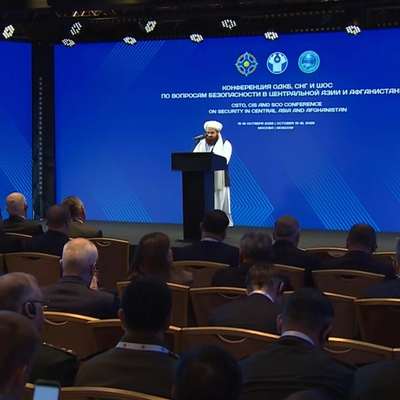
He said that they played a decisive role in shaping public opinion, legitimising the Taliban’s war and highlighting its attacks.
Speaking at a gathering at the Taliban Prime Minister office in Kabul, Jawad, a senior figure associated with the Haqqani network, said the Taliban leadership places strong emphasis on what he called the group’s “cultural and written struggle”. He said activists in this field had made a valuable contribution to justifying the Taliban’s war and exposing the actions of its enemies.
Jawad urged writers and intellectuals affiliated with the Taliban to use modern language and new technologies to advance what he described as the group’s cultural campaign and to promote its policies and activities.
Media organisations were among the targets of Taliban suicide attacks during the previous Afghan government. In January 2016, a Taliban suicide bomber drove a car packed with explosives into a minibus carrying employees of Tolo TV and the Moby Group, killing seven people and wounding 25 others.
At the time, Taliban spokesperson Zabihullah Mujahid claimed responsibility for the attack, saying it was carried out in retaliation for what he described as false accusations by Tolo TV during the battle for Kunduz.
Jawad is regarded as a secretive figure within the Taliban. At the ceremony, photographs of other speakers were released, but his image was not published.
The 2016 attack was not the last time Tolo and other private media outlets lost colleagues in suicide bombings. In 2018, journalist Samim Faramarz and cameraman Ramiz Ahmadi of Tolo News were killed in a suicide attack in Kabul’s Dasht-e-Barchi area.
Several Taliban cabinet ministers and senior officials also attended the meeting at the Prime Minister office. Amir Khan Muttaqi, the Taliban’s foreign minister, stressed the importance of cultural and written campaigns for the group.
However, Muttaqi cautioned members of the Taliban’s propaganda network, saying that “people pay more attention to your actions”.
Sources told Afghanistan International that key Taliban officials in Kabul have recruited dozens of people to promote the group and criticise opponents on social media. The Taliban’s defence and interior ministers, as well as its intelligence chief, are said to operate multiple online groups.
Afghanistan International’s Pashto service, citing multiple sources, has identified three cyber groups, Badri Virtual Devotees, Emarati Ababil and Omari Defenders, which it says are linked to Sirajuddin Haqqani, Mohammad Yaqub Mujahid and Abdul Haq Wasiq, respectively.
Members of these groups use Facebook and X, two of the most popular platforms among Afghan users, to post content defending Taliban officials, rejecting criticism and promoting material against the group’s opponents.
The ceremony honouring Taliban cultural circles took place amid widespread restrictions on independent media activity in Afghanistan, where many media workers are unable to operate freely.
The Taliban has also barred the printing, publication and sale of books that contradict its views and policies, repeatedly banning various works.
Media outlets in Afghanistan now operate under Taliban control and are often compelled to align their content with the group’s policies and interests.