Taliban Hand Down Floggings, Prison Terms To 40 In Kabul & Faryab

Taliban courts flogged 40 people in Kabul and Faryab province on various charges, according to statements from the group’s judicial authorities.

Taliban courts flogged 40 people in Kabul and Faryab province on various charges, according to statements from the group’s judicial authorities.
Primary courts in Kabul sentenced 37 people to between 10 and 39 lashes on charges including the sale and trafficking of narcotic tablets, crystal meth, alcohol, cannabis and theft. They were also given prison terms ranging from seven months to three years.
In Shirin Tagab district of Faryab province, three people were publicly flogged with 39 lashes each on charges of producing, selling and drinking alcohol, the Taliban Supreme Court said in a statement issued Monday, February 2. The court said each of them was also sentenced to two years in prison.
Despite repeated calls from international and human rights organisations to abolish corporal punishment and uphold the dignity of defendants, the Taliban has continued the practice of public floggings.
Taliban authorities say flogging is part of their interpretation of Islamic law within the judicial system.
The development comes as the Taliban’s new penal code outlines punishments based in part on an individual’s social status. Under the code, if a religious scholar commits an offence, the response is limited to advice.
By contrast, the same offence committed by someone described as middle class is punishable by imprisonment, while those from lower social classes may face corporal punishment in addition to prison terms.
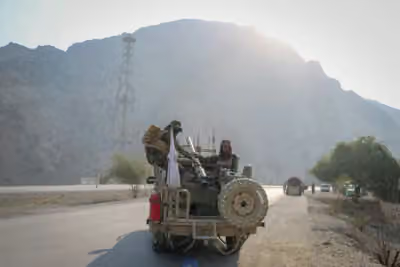

The Taliban’s Supreme Court said Monday that at least 36 people were publicly flogged in Khost province in a single day.
According to a court statement, those punished received between 10 and 39 lashes and were also sentenced to prison terms ranging from one to two years. A primary court in Khost carried out the punishments in public on charges including the buying and selling of narcotics, extramarital relations and sexual relations between men.
On January 23, the Supreme Court said courts under its authority had flogged at least 31 people across the country over the previous week on various charges. Those punishments took place in Kabul, Faryab, Balkh, Nangarhar and Herat provinces.
The Taliban authorities have previously said that in 2025 they executed at least six people and flogged 1,118 others on various charges across Afghanistan.
The Taliban describes the flogging of individuals found guilty by its courts as the implementation of Islamic Sharia law.
Despite strong opposition from international organisations to corporal punishment and the mistreatment of detainees, the group has continued to carry out public floggings.
Human rights organisations say the Taliban’s judicial system falls short of international standards and that defendants are denied basic fair trial guarantees, including access to a defence lawyer.
The Taliban has also recently published a document titled “Penal Procedure Regulations of the Courts”, which sets out procedures based on the group’s strict interpretation of Islamic law.

The human rights organisation Rawadari says the Taliban have failed to fully criminalise the beating of children under their criminal courts’ code of procedure.
According to the organisation, Article 30 of the code prohibits only certain forms of physical violence that result in “bone fractures” or “tearing of the skin”.
The code does not explicitly ban other forms of physical, psychological or sexual violence against children. Article 48 states that a father may punish his 10-year-old son for actions such as neglecting prayers.
Taliban Code Recognises Slavery
Rawadari says the Taliban’s criminal code recognises slavery by repeatedly using the term “slave”. Articles 15 and 4 of the code refer to slavery and related rights.
Slavery is absolutely prohibited under international law in all its forms.
One provision states: “For any crime for which no fixed ‘hudud’ punishment is prescribed, discretionary punishment shall be imposed, whether the offender is free or a slave.”
Taliban Courts’ Code Prescribes Death for Opponents
According to the Taliban courts’ code, one copy of which has been obtained by Afghanistan International, the Taliban have issued death sentences for individuals described as “rebels”. The code states that the harm caused by a “rebel” is public in nature and cannot be remedied without killing.
This provision grants judicial bodies the authority to sentence opponents and critics to death. Article 4, Clause 6, allows citizens to personally punish individuals if they witness a “sin” being committed.
The code states: “Any Muslim who sees a person committing a sin has the right to punish them.”
Another provision says: “Anyone who witnesses or becomes aware of subversive meetings by opponents of the system but fails to inform the relevant authorities is considered a criminal and shall be sentenced to two years in prison.”
Under this article, all citizens are required to report the activities of Taliban opponents to authorities or face punishment themselves.
Rawadari says these measures violate international human rights standards, fundamental freedoms and the principles of fair trial.
Society Divided by Class
Rawadari says the Taliban code divides society into four classes: religious scholars, elites, the middle class and the lower class.
Under the code, the type and severity of punishment depend on a person’s social status
Citing the code, Rawadari said: “If a crime is committed by a religious scholar, only advice is given; for elites, summons and advice; for the middle class, imprisonment; and for the lower class, imprisonment plus corporal punishment.”
Dancing Criminalised
Article 59 of the Taliban criminal code criminalises “dancing” and “watching dance” without providing a clear definition.
Rawadari says this ambiguity enables arbitrary arrests and punishments, including for traditional and local dances.
The organisation added that by defining “rebels” as “agents of corruption”, the Taliban have given their institutions broad powers to arbitrarily punish or even kill opponents and critics without fair trials.
Under Article 13, the destruction of “places of immorality” is permitted without defining what constitutes “immorality”. Rawadari warned this could lead to the demolition of places such as barbershops and beauty salons and the arbitrary punishment of their owners.
According to Rawadari, the code also criminalises participation in “gatherings of immorality” without defining the term.
Religious Discrimination Institutionalised
Rawadari says the document institutionalises religious discrimination and violates citizens’ freedoms.
The Taliban recognise followers of the Hanafi school as Muslims and describe followers of other sects as “heretics”.
In a statement released on Wednesday, January 21, Rawadari said the Taliban criminal code was sent to provinces for implementation in judicial institutions after being signed by Hibatullah Akhundzada.
Article 8 of the code describes followers of sects and beliefs outside Sunni Islam as “innovators”, which Rawadari says is a clear violation of the principle of non-discrimination based on religion or belief.
Another article prescribes a two-year prison sentence for “mockery or ridicule of Islamic rulings”.
Under Article 26, followers of the Hanafi school are not permitted to abandon their sect, and if proven to have done so, they face a two-year prison sentence.
The code consists of three parts, 10 chapters and 119 articles. Rawadari said its content is in clear contradiction with international human rights standards and the fundamental principles of a fair trial.

The Taliban Supreme Court said it publicly flogged five people, including one woman, in Ghazni province on charges described as theft, “illicit relations” and “moral corruption”.
In separate statements issued on Wednesday, the court said the punishments were carried out in the districts of Jaghori and Deh Yak. The individuals received between 10 and 35 lashes and were sentenced to prison terms ranging from six months to one year.
According to the statements, the punishments were implemented by Taliban primary courts in Jaghori and Deh Yak after approval by the Supreme Court, and were carried out in the presence of local officials, court staff and visitors, security personnel and members of the public.
Over the past 10 days, the Taliban have publicly flogged at least 37 people across Afghanistan on various charges, according to official statements.
Despite repeated condemnation by international organisations of corporal punishment and the torture of detainees, the Taliban have continued to carry out public floggings. The group describes such punishments as the implementation of “Islamic sharia”.
The Taliban Supreme Court has previously said that in 2025 it executed at least six people and flogged 1,118 others. Human rights groups say the Taliban justice system lacks basic fair trial guarantees, including access to legal representation and independent courts.

The Taliban Supreme Court says more than 1,000 people were sentenced to prison by its military courts over a three-month period this year.
According to the court, 1,163 individuals were jailed in the last three months. Taliban military courts handle cases involving personnel serving in military roles within the Taliban administration.
The figures were published in a report by the security and executive directorate of the Taliban Supreme Court. The report did not specify the alleged crimes, charges, length of sentences, identities of those imprisoned or the locations where they are being held.
The report said Taliban military courts also issued thousands of summonses, with some individuals reportedly contacted by telephone and ordered to appear before Taliban military and judicial authorities.
Taliban military courts have jurisdiction over cases involving employees of the ministries of defence, interior and intelligence.
In previous years, Taliban courts have tried cases involving allegations such as kidnapping, document forgery, murder and abuse of authority. In many cases, however, the Taliban have released little information about defendants, their positions, judicial proceedings or the rulings issued.

China has opposed a resolution adopted by the UN Human Rights Council to establish an independent investigative mechanism into human rights violations in Afghanistan.
The country’s representative argued that the measure overlooks progress made under Taliban rule and lacks balance.
Speaking in Geneva on Monday, China’s representative said the resolution ignored Afghanistan’s positive developments and failed to take an impartial approach. Beijing contended that creating a new investigative body runs counter to the Council’s reform goals of improving efficiency and was adopted without its consent.
The Chinese envoy said Afghanistan had taken various measures to promote stability, drive economic growth, and improve people’s livelihoods, and that such progress should be recognized and encouraged by the international community.
At the same time, he acknowledged that Afghanistan continues to face significant challenges, including a worsening humanitarian crisis, persistent terrorist threats, and restrictions on women’s and girls’ rights.
China’s representative expressed hope that the Taliban authorities would strengthen protections for women and other vulnerable groups while calling on the international community to engage constructively rather than impose external pressure.