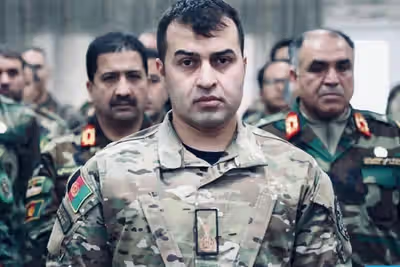
An investigation by Afghanistan International Pashto has found that nine members of the Taliban cabinet who use titles such as Sheikh al-Hadith, Sheikh and Mufti do not possess specialised religious education.
The spokesperson for Darul Uloom Haqqania in Akora Khattak, Pakistan, said Mawlawi Abdul Kabir, Noor Mohammad Saqib, Abdul Hakim Sharai, Amir Khan Muttaqi, Abdul Latif Mansoor and Shahabuddin Delawar are graduates of religious seminaries but did not complete advanced stages of religious scholarship.
Maulana Yousuf Shah, spokesperson for Darul Uloom Haqqania, told Afghanistan International that several Taliban ministers and senior officials present themselves as “Mufti” and “Sheikh al-Hadith”, titles that signify high academic standing in religious sciences, despite lacking the necessary scholarly qualifications.
According to him, cabinet members including Mawlawi Abdul Kabir, Abdul Hakim Sharai, Amir Khan Muttaqi, Abdul Latif Mansoor, Noor Mohammad Saqib and Shahabuddin Delawar are ordinary seminary graduates.
Abdul Hakim Sharaei
On the Taliban Ministry of Justice website, the religious academic rank of Justice Minister Abdul Hakim Sharaei is listed as Sheikh al-Hadith. However, according to the Haqqania seminary spokesperson, Sharai only graduated from the institution.
Abdul Hakim Sharaei
His biography states that after completing primary education, he travelled to Darul Uloom Haqqania in Akora Khattak, Khyber Pakhtunkhwa, Pakistan, to complete the advanced course, graduating in 1989.
Based on this description, he did not specialise in Hadith studies and therefore should not be referred to as Sheikh al-Hadith.
A former member of the Ulama Council under Afghanistan’s previous government, speaking anonymously, said religious titles such as Mufti and Sheikh al-Hadith require specific academic criteria, including completing studies in jurisprudence, legal principles, Hadith sciences, teaching experience and formal certification by recognised scholars.
Without completing these stages, he said, a student cannot claim such titles.
Noor Mohammad Saqib
Noor Mohammad Saqib, the Taliban minister of Hajj and Religious Affairs, is referred to as Sheikh al-Hadith, and Doctor on official platforms.
Noor Mohammad Saqib
The ministry website identifies him as: “Minister of Hajj and Religious Affairs Sheikh al-Hadith Qazawat-Poh Doctor Mawlawi Noor Mohammad Saqib.”
The Haqqania seminary spokesperson said Saqib only completed the senior seminary course and does not qualify for the title Sheikh al-Hadith.
The ministry states that the Taliban administration awarded him an honorary doctorate in 1999 for religious education. However, his highest level of education was completion of a senior course at Akora Khattak.
According to the ministry, the doctorate is honorary, but under academic standards in Afghanistan and internationally, an honorary doctorate is not considered an academic qualification.
Shahabuddin Delawar
The Afghanistan Red Crescent Society website refers to Shahabuddin Delawar as Sheikh al-Hadith. The Haqqania seminary spokesperson said Delawar completed a senior course but did not specialise in Hadith.
Shahabuddin Delawar
His biography states that he received primary education from his father in Logar before studying at Darul Uloom Haqqania.
A source within the Red Crescent Society told Afghanistan International that Delawar’s chief of staff instructed staff to address him as “Sheikh Sahib”.
Amir Khan Muttaqi
Amir Khan Muttaqi, the Taliban foreign minister, visited Darul Uloom Deoband in India in October. During the visit, the foreign ministry’s protocol team introduced him to students as Sheikh al-Hadith, although he does not meet the requirements.
Amir Khan Muttaqi
The Haqqania seminary spokesperson said Muttaqi studied at the seminary but did not specialise in jurisprudence or Hadith.
The Taliban foreign ministry website provides no details about his education, although state media programmes have used the title Sheikh al-Hadith for him.
Abdul Latif Mansoor
Abdul Latif Mansoor, the Taliban minister of water and energy, also studied at Haqqania seminary. He has been referred to as a Mufti at official events, despite lacking specialised training in jurisprudence.
Abdul Latif Mansoor
The seminary confirmed his studies but said he does not have the qualifications required to be considered a mufti.
Abdul Baqi Haqqani
Abdul Baqi Haqqani, the former Taliban higher education minister, is introduced as Sheikh al-Quran and Doctor, although he does not have specialised training in Quranic or jurisprudential studies.
Abdul Baqi Haqqani
The Haqqania seminary confirmed he completed only the senior course. His honorary doctorate was awarded by Nangarhar University in 2022 and does not carry academic equivalence to a doctoral degree.
Neda Mohammad Nadeem
Neda Mohammad Nadeem, the Taliban higher education minister, is also referred to as Sheikh al-Hadith. He completed advanced seminary studies at Jamia Al-Islamia in Pakistan but did not specialise in Hadith.
Former instructor Maulana Rafiq Madani said: “When Mullah Nadeem was a student at our seminary, I taught there. He completed the senior course but did not specialise in Hadith, or jurisprudence. Therefore, he should not be called Sheikh al-Hadith.”
Abdul Kabir
Mawlawi Abdul Kabir, the Taliban minister for refugees, sometimes referred to as Sheikh al-Quran, studied at Haqqania seminary.
The seminary confirmed his attendance but did not confirm completion of the senior course.
A former teacher at Najm-ul-Madaris in Nangarhar said Kabir did not complete the senior religious studies programme.
“When someone does not complete the senior course, he cannot even be called Mawlawi, let alone Sheikh al-Quran or Sheikh al-Hadith,” the teacher said.
He added that many senior Taliban officials studied with him at Haqqania but left their studies unfinished and now use senior religious titles.
Noorullah Munir
The Taliban Ministry of Education website refers to former minister Noorullah Munir as Sheikh al-Quran and Sheikh al-Hadith.
Noorullah Munir
Munir completed lower-level religious studies in Ghazni and the senior course at Imdad-ul-Uloom seminary in Peshawar under Maulana Hassan Jan. Based on this, only the title Mawlawi applies to him.
Mawlawi Shukrullah Arbab, a teacher at Bab-ul-Uloom seminary in Peshawar, said he studied alongside Munir and confirmed Munir did not specialise in Hadith or Quranic studies.
Concerns Over Misuse of Religious Titles
An Islamic studies researcher at the Afghanistan Academy of Sciences, speaking anonymously, said misuse of religious titles undermines the credibility of religious education.
He said the title Sheikh al-Hadith requires two years of specialisation in Hadith after completion of the senior course, while Sheikh al-Quran requires two years of specialised Quranic studies and more than ten years of teaching experience.
He added that many Taliban leaders have adopted religious titles arbitrarily without scholarly or religious justification.
Afghanistan International sought comment from the Taliban spokesperson and the ministers of higher education, education, refugees, energy and foreign affairs but received no response.
A justice ministry official, speaking anonymously, said staff members are not permitted to discuss the matter with the media.