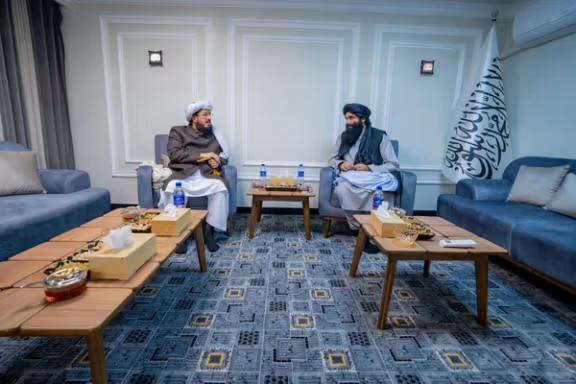
A senior member of Pakistan’s Jamiat Ulema-e-Islam (JUI) party met the Taliban’s interior minister, Sirajuddin Haqqani, during a visit to Kabul, according to reports.
Salahuddin Ayubi, described as the party’s finance chief, discussed bilateral relations, border issues and the broader regional situation with Haqqani, the reports said.
Neither the Taliban’s Ministry of Interior nor Jamiat Ulema-e-Islam has released official details of the meeting.
Relations between the Afghan Taliban and Islamabad have deteriorated in recent months. However, Jamiat Ulema-e-Islam has consistently urged Pakistan’s federal government to resolve its differences with the Taliban through dialogue.
Earlier, Maulana Fazlur Rehman, leader of Jamiat Ulema-e-Islam, called on the Pakistani government and the Afghan Taliban to resume negotiations. He has repeatedly criticised Islamabad’s policy towards the Taliban authorities in Afghanistan.
In January 2024, Fazlur Rehman travelled to Kabul in an effort to help ease tensions between the Taliban administration and Pakistan.

Taliban spokesperson Zabihullah Mujahid has responded to comments by Don Brown, the US chargé d’affaires for Afghanistan, who accused the Taliban of using detained American citizens as leverage in negotiations.
Mujahid said the Taliban are engaged in talks with Washington regarding the fate of American detainees in Afghanistan and are seeking a resolution to the issue.
Brown said on Wednesday that the Taliban had detained US citizens and were using them as tools of pressure and bargaining in discussions with the United States. He described the practice as “deplorable” and called on the international community to increase pressure on the Taliban.
Previously, the US deputy ambassador to the United Nations told the Security Council that the Taliban were using detainees as leverage in negotiations with Washington and other countries.
According to reports, at least three US citizens, including Dennis Walter Coyle and Mahmood Shah Habibi, are currently being held by the Taliban.
The Taliban have denied detaining Habibi and have reportedly demanded the release of an Afghan al-Qaeda member from the Guantanamo Bay detention facility in exchange for Coyle’s freedom.
The group is said to be seeking the release of Mohammad Rahim, who has been held at Guantanamo since 2008 and is accused of cooperating with Osama bin Laden within the al-Qaeda network.
Since 2024, the Taliban have released at least five American detainees, including Amir Amiri, Faye Hall, Ryan Corbett, William McKenty and George Glezmann.
Corbett and McKenty were freed in early 2025 in exchange for the release of a Taliban prisoner. Earlier, Adam Boehler, President Donald Trump’s envoy for hostage affairs, travelled to Kabul for talks with the Taliban over American detainees.
The Taliban’s supreme leader, Hibatullah Akhundzada, has approved the deployment of 1,000 fighters to protect gold mining operations in Badakhshan province, according to the Taliban-appointed governor.
Ismail Ghaznawi, the Taliban governor of Badakhshan, said the force would be sent to the province with Akhundzada’s authorisation to safeguard gold extraction companies. He said the unit was being formed to protect investments and regulate the mining process.
In an interview, Ghaznawi said investment in Badakhshan’s mines required security and organised management, and that he had proposed the creation of a special force to ensure the safety of mining sites.
He added that the force is expected to begin operations soon and that technical preparations are under way.
Some local residents have expressed dissatisfaction over what they describe as a lack of transparency and environmental damage caused by intensive gold extraction.
Ghaznawi said revenues generated from the mines belong to the Taliban but would be spent on public welfare projects, particularly in Badakhshan.
In recent months, clashes have occurred between local residents and Taliban-linked mining companies in the province.
The Taliban have significantly expanded underground mining, especially gold extraction, in the northern provinces of Takhar and Badakhshan. Hundreds of companies are currently engaged in mining activities across northern Afghanistan.
The Taliban’s Ministry of Mines and Petroleum says 100,000 people are employed, directly and indirectly, in gold mining in Badakhshan.
According to the ministry, mining activities are under way in the districts of Shahr-e Bozorg, Yawan, Kohistan, Raghistan, Khwahan and Arghanjkhwa.
Pakistan’s Foreign Ministry summoned the Taliban’s deputy ambassador in Islamabad following a deadly attack in the Bajaur district, delivering a formal note of protest over what it described as the alleged use of Afghan territory in the assault.
In a statement, the ministry said it had expressed serious concern to the Taliban representative and told him that Islamabad reserves the right to respond.
Eleven Pakistani soldiers were killed in the 16 February attack in Bajaur.
The Foreign Ministry said it had conveyed its concern that the leadership of Tehreek-e-Taliban Pakistan (TTP) is based in Afghanistan and operates from Afghan soil with impunity.
It urged the Taliban authorities to take immediate, concrete and verifiable action against all militant groups operating from Afghanistan.
The statement said the Afghan Taliban authorities had been firmly informed that Pakistan reserves the right to act against what it described as “Khawariji” wherever they may be, in order to ensure the security of its soldiers, civilians and borders.
Earlier, Pakistan’s Defence Minister Khawaja Asif warned that if the Taliban failed to curb militant groups, Islamabad would not hesitate to carry out further airstrikes inside Afghanistan.
Pakistan’s Defence Minister Khawaja Asif has again urged the Taliban to rein in militant groups operating from Afghan territory, warning that Islamabad would not hesitate to carry out further airstrikes inside Afghanistan if no action is taken.
Speaking to France 24, Asif alleged that attacks inside Pakistan are carried out with Taliban support.
Asked about Pakistan’s airstrikes in Afghanistan last year and whether such action remains an option, he said: “We always have that option and we can exercise that option. There is absolutely no hesitation.”
He added that if authorities in Kabul could guarantee peace, there would be no hostility, but accused them of continuing to “patronise” militants and acting as “co-conspirators”.
According to Asif, the East Turkestan Islamic Movement, Tehreek-e-Taliban Pakistan and the Islamic State group, among others, are present in Afghanistan. He alleged that the Taliban have provided safe havens for these groups.
The Pakistani defence minister also claimed that India, together with the Taliban and militant groups active in Afghanistan, is operating on the same front.
In a separate interview with Deutsche Welle, Asif said Pakistan has lost influence in Afghanistan to other regional countries.
His remarks come amid a surge in deadly militant attacks in Pakistan in recent weeks. In one of the latest incidents, a suicide bombing in Islamabad killed 33 worshippers and wounded 69 others.
Taliban authorities in Parwan province say they have burned about 500 musical instruments collected from across the province, while officials in neighbouring Laghman reported destroying more than 100 instruments.
Afghanistan’s National Television, a broadcaster controlled by the Taliban, reported on Tuesday that morality police in Parwan had gathered the instruments over the past year from the provincial centre and surrounding districts. The report said a Taliban committee later set the items on fire.
Abdul Mojib Hanafi, a Taliban morality official in Parwan, said the instruments included harmoniums, tablas, tombaks, dafs, loudspeakers and other audio equipment. He added that hundreds of musical instruments had previously been destroyed in the province.
Since returning to power in August 2021, the Taliban have banned the production and listening of music. Over the past four years, authorities have detained dozens of people accused of producing, broadcasting or listening to music and have destroyed thousands of musical instruments and sound systems.
Taliban officials have also warned hotel owners across Afghanistan to prevent music from being played at social gatherings. The group considers music production and performance to be forbidden and has removed fine arts faculties from the education system.