Taliban Urges Regional Powers To Press Pakistan For Peace

Hamdullah Fitrat, deputy spokesperson for the Taliban, said on Tuesday that Russia, China, the European Union and the United Kingdom had contacted the group in efforts to end the war.

Hamdullah Fitrat, deputy spokesperson for the Taliban, said on Tuesday that Russia, China, the European Union and the United Kingdom had contacted the group in efforts to end the war.
Fitrat warned, however, that as long as Pakistan continues its attacks on Afghan territory, Taliban operations would also continue.
He described Pakistan as the initiator of the conflict, saying the war was not the Taliban’s choice and that Pakistan had begun the aggression.
Fitrat said regional countries should press Pakistan to bring the war to an end.
He also called on international human rights organisations to condemn Pakistan’s military strikes.
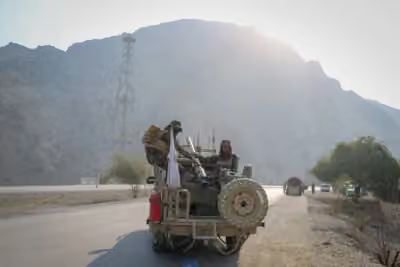
On the fifth day of fighting between the Taliban and Pakistan, both sides reported heavy casualties. The Taliban claimed that more than 100 Pakistani personnel had been killed since the start of the conflict.
Pakistan, in turn, said 415 Taliban and Tehreek-e-Taliban Pakistan members had been killed. The Taliban said the fighting was ongoing.
Taliban spokesperson Zabihullah Mujahid confirmed that Pakistani fighter jets bombed areas in Paktika, Paktia, Khost and Kunar provinces on the fifth day of fighting.
Sources told Afghanistan International that a Taliban border brigade near Jalalabad in Nangarhar Province was targeted in an airstrike.
The Taliban also confirmed that Pakistani jets entered the airspace of Kabul and that their forces opened fire at them.
The Taliban’s Defence Ministry said it had destroyed a Pakistani armoured tank in the Shkin district of Paktika. The ministry also claimed to have targeted a Pakistani military commissariat in Dand-e-Patan district of Paktia.
Hamdullah Fitrat, a deputy spokesperson for the Taliban, said that three children were killed and three others wounded in a Pakistani strike on a refugee camp in Khas Kunar. Pakistan has not commented on the allegation.
For the third consecutive night, residents in Panjshir, and Kapisa provinces reported hearing aircraft and explosions.
Late on Monday night, Pakistani fighter jets again bombed a Taliban border brigade near Jalalabad.
The Taliban’s Defence Ministry also said Taliban and Pakistani forces clashed late at night in Spin Boldak, claiming three Pakistani soldiers were killed, one captured and a border post seized.
Russia offered to mediate between the Taliban and Pakistan, while China called on both sides to exercise restraint.
United Kingdom, in talks with Taliban officials, stressed that war is not a solution and that disputes should be resolved through negotiations.
The United Nations called for an immediate halt to the violence and the protection of civilians.
Asif Ali Zardari told parliament that the Taliban had crossed a “red line” and that Islamabad had delivered a clear message in response.
Ishaq Dar, Pakistan's foreign minister, said that after negotiations failed, Pakistan was compelled to launch a military operation named “Ghazb lil Haq.”
A hacker group has claimed responsibility for breaching several Pakistani government websites, including sites linked to the prime minister’s office, financial institutions, ministries and regulatory authorities.
According to a statement attributed to the group, a list of targeted web addresses was also released.
A review by Afghanistan International found that among the websites the group claimed to have hacked, only the site of the Prime Minister's Office of Pakistan remained accessible, while the others appeared to be offline.
The claim follows an earlier incident in which a message critical of the Pakistan Army and another attributed to Israel’s Mossad were broadcast on the screen of Geo News.
The broadcaster later told viewers that attempts had been made over the previous 24 hours to hack and disrupt its transmissions. Geo News called on Pakistani authorities to investigate the matter thoroughly, take immediate action and hold those responsible accountable.
The Afghanistan Green Trend, led by former Afghan vice-president Amrullah Saleh, said Pakistan is pursuing a multi-track policy against the Taliban and consulting opposition forces about a post-Taliban political arrangement.
In a statement posted on X on Monday, 2 March, the political group said Islamabad is advancing five parallel strategies within what it described as a unified policy. It said Pakistan has made its trade and economic relations with the Taliban conditional on the security and political situation and has kept key border crossings closed, increasing the Taliban’s reliance on northern routes and Iran.
The group also claimed that Pakistan has asserted control over Afghan airspace and is conducting selective strikes, while the Taliban lack effective air defences and international legitimacy.
It added that Pakistan has secured domestic consensus and broad political backing for its actions in Afghanistan and is seeking international support for what it described as an anti-Taliban campaign.
According to the Afghanistan Green Trend, Pakistan is again presenting itself as a Western-backed hegemon in Afghanistan, aiming to dismantle infrastructure and equipment left behind by the NATO and the United States.
The group said no country has provided meaningful support to the Taliban and that the group lacks both domestic legitimacy and international recognition. It said Afghanistan under Taliban rule resembles a territory without an effective state rather than a modern government.
The Afghanistan Green Trend warned that by persisting in what it described as arrogance and political short-sightedness, the Taliban have missed the opportunity to advance a genuinely Afghan-led solution and that it may now be too late for meaningful reform.
The latest wave of clashes between the Taliban and Pakistan has entered a fifth day, with fighting continuing along the Durand Line.
Evening of 24 February
Taliban forces launched what they described as large-scale retaliatory attacks on Pakistani border posts and positions along the frontier, mainly in eastern and south-eastern Afghanistan.
The Taliban said the operation was in response to earlier Pakistani airstrikes, particularly those carried out on 21 February, which Islamabad said targeted sanctuaries of Tehreek-e-Taliban Pakistan inside Afghanistan. The United Nations confirmed that civilians were among the casualties.
Pakistan described the Taliban’s attacks as unjustified and a miscalculation and responded with what it called an immediate and forceful reply.
Early Morning of 25 February
Pakistan’s armed forces launched extensive air operations against Taliban positions inside Afghanistan.
The strikes, carried out mainly by fighter jets and drones, targeted what Pakistan described as Taliban military sites from Kabul to Kandahar, the group’s traditional stronghold.
In Kabul, areas in the west and around the city, including ammunition depots and Taliban facilities in Darulaman and Pul-e-Charkhi, were reportedly struck.
Kandahar, home to Taliban leader Hibatullah Akhundzada, was also hit, along with other border provinces.
Pakistan named the operation “Ghazb lil Haq” and described it as a direct response to Taliban attacks. Khawaja Muhammad Asif, Pakistan's defense minister, declared what he called an open war against the Taliban, saying Pakistan’s patience had run out and accusing the group of acting as a proxy for India.
Taliban spokesperson Zabihullah Mujahid confirmed that Pakistan had bombed sites in Kabul, Kandahar and Paktia Province. The Taliban said they had launched retaliatory operations along the Kandahar and Helmand Province axes and in eastern border areas, claiming to have seized or destroyed several Pakistani posts and inflicted heavy losses.
The Taliban later said they were ready for negotiations while continuing to resist.
26 February
Taliban forces resumed intensified attacks along the Durand Line, particularly in Khost, Nangarhar, Paktika and Kunar Provinces.
A Taliban official in Khost said attacks had begun on Pakistani posts in the districts of Zazi Maidan, Ali Sher and Terezai, claiming several posts were captured or destroyed.
Pakistan responded with air and artillery strikes on Taliban positions in border areas. Reports indicated renewed bombardment in Nangarhar and around Kabul, though less intense than the previous day.
The United Nations and Russia urged both sides to implement an immediate ceasefire and turn to diplomacy, as concerns mounted over civilian harm.
In the following days, exchanges of fire and retaliatory strikes continued along the frontier. Pakistan said it had inflicted heavy casualties on Taliban forces and destroyed dozens of their bases. The Taliban made similar claims regarding Pakistani forces.
On March 2, Kabul residents again reported Pakistani aircraft overhead and reciprocal Taliban fire. The situation remains fragile, with many border crossings closed and diplomatic efforts by regional and international actors ongoing to prevent further escalation.
Disputes over casualty figures and damage have made independent verification of the full extent of the fighting difficult.
Local sources in Herat Province told Afghanistan International that fighter aircraft were seen patrolling the skies over the province on Sunday night.
At the same time, a Taliban official reported an attack on Pakistani positions at the Angoor Ada border crossing in the Barmal district of Paktika Province.
Ahmadullah Muttaqi, head of information and culture for the Taliban in Herat, posted a video on X that he said showed the group’s forces attacking Pakistani positions at Angoor Ada. The footage appears to show Taliban fighters using heavy weapons at night against what were described as Pakistani military posts.
Residents of Herat said drones remained in the province’s airspace and that gunfire was heard for several minutes.
A source near the Islam Qala crossing said at least two explosions were heard following the aircraft activity. Taliban authorities have not commented on the identity of the aircraft or the cause of the reported gunfire in the province.