Afghanistan Flood Death Toll Rises To 51

The Taliban disaster authority says at least three people have died and 16 were injured in flooding over the past 24 hours, bringing the death toll from four days of floods across Afghanistan to 51.
The Taliban disaster authority says at least three people have died and 16 were injured in flooding over the past 24 hours, bringing the death toll from four days of floods across Afghanistan to 51.
Yousuf Hammad, spokesperson for the Taliban’s disaster management authority, said on Thursday, April 2, in a video that heavy rain and flooding had continued over the past 24 hours in 18 provinces.
He said the rainfall had caused floods that completely destroyed 348 homes, while a further 798 houses were damaged.
Flooding also damaged 244 kilometres of roads and 3,048 hectares of agricultural land across various provinces. According to the authority, 201 families have been displaced.
The provinces affected include Kabul, Panjshir, Paktika, Khost, Logar, Maidan Wardak, Ghazni, Kandahar, Zabul, Uruzgan, Herat, Faryab, Badghis, Jawzjan, Baghlan, Badakhshan, Nangarhar and Laghman.
The conflict between Afghanistan and Pakistan has entered a dangerous new phase since late February, raising serious concerns about regional stability.
Pakistan has carried out multiple airstrikes in the provinces of Kabul, Kandahar, Paktia, Paktika and Nangarhar, while the Taliban have responded with ground assaults and drone attacks.
The United Nations said 143 people were killed in a Pakistani airstrike on a drug treatment centre in Kabul, although the Taliban put the death toll at as many as 400.
The UN Assistance Mission in Afghanistan, or UNAMA, reported that from late February to the present, between 75 and 212 Afghan civilians have been killed, with hundreds more wounded.
A key question remains: if civilians are being hit, why is Pakistan not targeting the Taliban’s senior leadership?
What is Pakistan’s Calculated Approach to War?
Based on strategies previously used against leadership figures in Iran, the Tehreek-e-Taliban Pakistan, or TTP, and al-Qaida, eliminating leaders in ideologically driven militant groups often leads to the rapid emergence of successors who may be even more radical and harder to contain.
Retired Pakistani General Inam-ul-Haq said Islamabad is not pursuing an all-out war against the Taliban, but is instead applying what he described as “calibrated” pressure. According to him, Pakistan is deliberately avoiding direct strikes on Taliban leaders and is not cutting ties with the ruling authorities. Instead, it is focusing on weapons depots, mid-level commanders and border posts in an effort to keep the Taliban under sustained pressure.
Haq said Pakistan does not want to cross a “red line” that could turn the conflict into a full-scale crisis.
He said one of Islamabad’s concerns is that killing senior Taliban leaders could create a power vacuum in Afghanistan, widen the conflict and further destabilise Khyber Pakhtunkhwa and Balochistan, making both provinces harder to control.
Pakistan’s assessment, he said, is that the Taliban do not have a well-organised replacement leadership, and that the loss of top figures could endanger the wider region. Foreign militant groups now operating under Taliban influence could expand their activities into China, Central Asia and Pakistan itself if the Taliban leadership were removed.
For that reason, one option for Islamabad is to seek co-operation from within the Taliban and among aligned groups.
Haq said Pakistan is also monitoring networks of influence inside the Taliban. Groups such as the Haqqani network are viewed as relatively close, while greater pressure is being applied to other factions that have more limited co-ordination with Pakistan. Most of the areas targeted in Pakistani airstrikes lie outside Haqqani Network’s influence, he said.
Local sources say many Taliban fighters deployed along the Durand Line are from Kandahar and aligned with Mullah Hibatullah Akhundzada, with little involvement from the Haqqani network. One reason, they say, is that Hibatullah has appointed many loyalists in districts in south-western Afghanistan to military and government posts.
Haq views this distribution of power within the Taliban as part of an “internal balance” policy that helps preserve the group’s structure.
Several Afghan analysts share a similar assessment, interpreting Pakistan’s decision to spare the Taliban leadership as a deliberate choice.
Military Analysts’ Perspective
Azim Rahimi, a former professor at Kabul University and an expert in military affairs, said targeting the Taliban leadership remains an option for Pakistan, but one that is neither used constantly nor immediately.
“Pakistan will only use this option when there is a ‘need’ and a ‘political and security calculation’,” he said. “At this time, Pakistan does not genuinely seek the fall of the Taliban regime, but is instead applying limited pressure.”
He added that regional experience from past wars in Iraq and Afghanistan shows that toppling a ruling system can create long-term crises.
Why Are TTP Leaders Not Being Targeted?
From February 27 to March 13, Pakistan’s airstrikes in Afghanistan primarily targeted Taliban border posts, brigades, battalions, and arms and ammunition centres.
Retired Pakistani Brigadier Mahmood Shah said the main driver of Pakistan’s conflict with the Taliban is the activity of Tehreek-e-Taliban Pakistan, or TTP. After the Taliban returned to power, he said, attacks in Pakistan’s tribal areas increased, including assaults on military bases and police, as well as attempts to seize border posts, deepening Islamabad’s concerns.
He said Pakistan initially tried to negotiate with the Taliban, but turned to airstrikes after those efforts failed.
However, Pakistani Taliban leaders, whose presence Islamabad has used to justify its operations, have not been targeted, or at least no evidence of such strikes has been shared with the media.
Sources in Afghanistan and Pakistan’s tribal areas told Afghanistan International that some TTP leaders returned to their areas of influence in Pakistan at the same time as the attacks in Afghanistan. They also said signs of TTP activity and influence have increased near cities including Peshawar, Bannu, Lakki Marwat and Mardan.
That has raised further questions about the true targets of Pakistan’s airstrikes.
If Pakistani militants were the main target, why were strikes carried out at Bagram Airfield, in Kabul, and against Afghan brigades where there is no known TTP presence and no confirmed bases?
Many analysts believe Islamabad is seeking to destroy American weapons in Afghanistan, a goal they say aligns with joint US-Pakistan interests.
US Weapons In Afghanistan
Official US reports show that from 2004 to 2016, the United States supplied the Afghan National Army and police with 599,690 firearms, including light and heavy weapons. Most were light arms, including 358,530 rifles such as M16s, M4s and sniper rifles.
During the same period, 16,191 support devices were also delivered, including night-vision goggles, communication monitors, small reconnaissance drones such as the ScanEagle, and surveillance balloons. The overwhelming majority were night-vision goggles, totalling 16,035 units.
In aviation, a total of 208 aircraft were delivered to Afghan security forces between 2004 and 2016. They included 110 MI-17 and MD-530 helicopters, 60 transport aircraft, including the C-208, C-128, C-130, T-182, G-222 and AN-32, 20 A-29 attack aircraft and 18 PC-12 reconnaissance planes.
In addition, the US supplied 75,898 vehicles, including Rangers, Humvees, lorries and tanks. Of those, 42,604 were Rangers and 22,174 were Humvees, making them the most widely used. Some of the vehicles later became inoperable because of explosives, suicide attacks or prolonged use.
Over the past five years, Pakistan has repeatedly complained to the UN Security Council about US weapons left behind by Afghan forces and the United States, saying some of them ended up in the hands of TTP fighters.
Taliban Mediation And Relations With Pakistan
The Taliban government has officially acknowledged mediating negotiations twice between Tehreek-e-Taliban Pakistan and Pakistan, saying the process had reached 90 percent progress. However, it said changes in Pakistan’s military leadership and the fall of Imran Khan’s government disrupted those efforts.
A significant faction within the Taliban sees Pakistan’s top military leadership as an obstacle to relations, referring to them as the “special circle”. Members of that faction believe the new Pakistani military leadership opposes talks with armed Pakistani groups and instead pushes them towards taking up arms.
Those uncertainties, combined with the fact that neither TTP leaders nor Taliban leaders have been targeted, have fuelled conspiracy theories about the Taliban-Pakistan conflict.
Political analyst Roshan Karwar described the crisis as a “manufactured war”, arguing that external threats can sometimes help strengthen states. He said Pakistani airstrikes on Kabul gave the Taliban an opportunity to build public support. He added that the fact TTP and Taliban leaders have been spared lends weight to the theory of an engineered conflict.
Pakistan’s Recent Approach
Mohammad Fayyaz, a professor at Lahore University, described Pakistan’s foreign policy over the past two years as “co-ordinated and systematic”.
He said Pakistan does not want to trigger a new domestic or regional crisis, and is instead prioritising border security, economic support and avoiding steps that could threaten the survival of the Taliban regime.
He said expanding the war against the Taliban would fuel new waves of radicalisation. In his view, Islamabad is seeking to contain Tehreek-e-Taliban Pakistan, or TTP, as an immediate threat without challenging the Taliban’s overall hold on power.
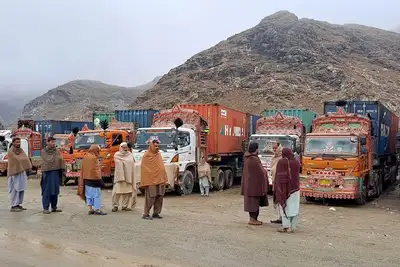
Since the conflict began, however, trade routes between Afghanistan and Pakistan have been closed. The Taliban have shifted their trade focus towards Central Asia and India, while the border between the two countries has been marked by violence and disruption.
Pakistan’s Foreign Minister Ishaq Dar said the operations are part of Islamabad’s counterterrorism strategy. Analysts, however, say the actual targets remain unclear.
Although the strikes are publicly framed as an effort to contain the TTP threat, TTP leaders have not been targeted in practice, their Taliban supporters have been spared, civilian casualties have mounted, and tens of thousands of people have been displaced on both sides of the Durand Line.
The movement of residents out of the area, along with tightened security measures, could leave the border exposed to new waves of insecurity.
Analysts suggest several possible explanations. One is that Pakistan has not yet finalised its strategy and is still testing pressure tactics. Another is that its real objectives are more complex, and more concealed, than officially stated.