Taliban Agriculture Minister Meets Indian Deputy Foreign Minister in New Delhi
Taliban Agriculture Minister Attaullah Omari met India’s Minister of State for External Affairs, Pabitra Margherita, in New Delhi on Wednesday for talks on bilateral relations and development cooperation.
Following the meeting, Margherita said the two sides had held positive discussions on relations between India and Afghanistan.
In a post on X, he said the talks focused on ongoing cooperation for welfare and development of the people of Afghanistan.
Omari arrived in New Delhi on Tuesday at the head of a delegation. The visit is part of the Taliban’s efforts to expand relations with India.
Taliban ministers of foreign affairs, commerce and public health have previously travelled separately to India and met Indian officials.
The visits come as the Taliban’s relations with Pakistan, its former ally, have become severely strained. The two sides have faced serious border and security tensions in recent months.
India has not recognised the Taliban administration, but it has increased its diplomatic and economic presence in Afghanistan.
Nearly five years after taking power, the Taliban are seeking to transform their fighters into a regular army by finding new ways to equip armoured units, artillery, an air force and logistical networks.
As part of this effort, on May 27, during the Moscow International Security Meeting, Taliban Defence Minister Mohammad Yaqoob Mujahid signed a military-technical cooperation agreement with Sergei Shoigu, Secretary of Russia’s Security Council. Under the deal, Moscow will refurbish Soviet-era military equipment currently in the Taliban’s possession.
The agreement comes as relations between the Taliban and Pakistan have remained strained since January, with Pakistani aircraft repeatedly striking Kabul and Afghanistan’s border provinces.
According to findings by Afghanistan International, the Taliban has asked Moscow to help restore weapons, armoured vehicles, air defence systems and even repair and reactivate fighter jets and military helicopters under the new agreement.
Reviving the Soviet Legacy
According to multiple sources in the Taliban’s Defence Ministry, Administrative Affairs Office, General Directorate of Intelligence and Foreign Ministry, the military-technical agreement covers five main areas: troop training, technical support for weapons, intelligence cooperation, operations against armed groups Russia considers a threat, and logistical cooperation.
Sources said the main focus of the partnership is combating the Islamic State Khorasan Province (ISIS-K), which Moscow regards as a serious threat to Russia and Central Asia.
Russia has pledged to repair and supply small arms to strengthen Taliban outposts along the Durand Line and the borders with Central Asian states.
However, Taliban requests extend well beyond that.
A source in the Taliban Administrative Affairs Office’s Defence and Security Directorate told Afghanistan International that the group is seeking direct ties with Russia’s military-industrial complex to facilitate both the purchase and maintenance of weapons.
The Taliban has prepared a list of 14,803 rifles from the AK family for refurbishment, with Russia expected to repair the weapons and provide ammunition. The list includes AK-47, AKM, AKMS and AK-74 assault rifles, commonly known in Afghanistan as Kalashnikovs.
It also includes 8,632 AKS-74U (Krinkov) carbines, SKS semi-automatic rifles and SVD Dragunov sniper rifles requiring repairs. In addition, the Taliban has requested the refurbishment of 21,032 Makarov, TT-33 and Stechkin automatic pistols.
Military analysts say many of these weapons entered Afghanistan during the Soviet-backed governments and through decades of conflict.
Although the US-made weapons currently held by the Taliban are more advanced than Soviet designs, their use has declined steadily because of limited access to spare parts, ammunition and maintenance services.
The Taliban has also identified heavy weapons for repair, including 765, DShK heavy machine guns, PKM machine guns, ZU anti-aircraft guns, KPV heavy machine guns and RPK light machine guns. These weapons remain important for battlefield operations and defending military outposts.
In the anti-armour category, the Taliban has requested not only RPG-7 rocket launchers, SPG-9 and B-10 recoilless guns, but also guided anti-tank missiles such as the 9M14 Malyutka and 9K111 Fagot.
The Malyutka and Fagot are Soviet-designed anti-tank missiles regarded as among the most lethal weapons against heavily armoured targets. The first-generation Malyutka is manually guided with a joystick and can engage tanks at ranges of up to three kilometres. The second-generation Fagot is more advanced, launched from a tube and guided semi-automatically through an optical sight.
Sources said the Taliban’s Defence Ministry has listed these systems as requested equipment because their current availability has not been confirmed.
According to the sources, the Taliban has also specifically requested shoulder-fired air defence systems such as the Strela and Igla. These Soviet- and Russian-made missiles use infrared guidance to track the heat signature of aircraft engines.
The systems are primarily designed to shoot down low-flying aircraft, including helicopters, military transport planes and some fighter aircraft.
The request comes as analysts argue that Afghanistan’s airspace remains insecure, with repeated reports of unidentified drones flying over the country.
Taliban Seek to Restore Soviet-Era Tanks and Armoured Vehicles
The Afghan Defence Ministry’s inventory includes 76 BTR-60 and BTR-70 eight-wheeled armoured personnel carriers, BMP-1 and BMP-2 infantry fighting vehicles, and T-55 and T-62 tanks. Previous estimates suggested the fleet once totalled around 460 vehicles.
Sources within the Taliban Defence Ministry told Afghanistan International that these vehicles are also on the refurbishment list. Only 21 are currently operational, while the remainder require extensive repairs.
During the Soviet-Afghan War (1979–1989), BMP-1 and BMP-2 infantry fighting vehicles played a significant role in Soviet military operations. Combat experience exposed serious shortcomings in the BMP-1’s design, accelerating the deployment of the improved BMP-2.
Military analysts say the BMP-1, originally designed for combat on Europe’s open plains, struggled in Afghanistan’s mountainous terrain. Its 73mm gun proved less effective against Mujahideen positions at high altitudes, while its armour was vulnerable to RPG-7 rockets and heavy machine-gun fire. Many of these weaknesses were addressed in the BMP-2.
The Taliban has also requested repairs to 31 self-propelled 152mm artillery systems and 27 multiple rocket launchers.
According to the sources, the Taliban-controlled Defence Ministry also possesses 3,020 Russian-made KamAZ trucks, artillery transporters, trailers and specialised tank transporters, although it remains unclear how many require refurbishment.
The issue of KamAZ vehicles was also discussed during the Kazan Economic Forum in May between Taliban representatives and officials from Russia and Tatarstan.
Will the “Devil’s Chariot” Fly Again?
Perhaps the most significant Taliban request concerns the air force.
The group has asked Russia to repair 11 Mi-8 and Mi-17 transport helicopters, along with four Mi-24 attack helicopters. The Mi-24, known in Afghanistan as the “Devil’s Chariot”, is widely used for close air support missions.
The Taliban has also requested repairs to 12 Soviet-era combat aircraft, including MiG-21 and MiG-23 fighters, as well as Su-22 and Su-25 ground attack aircraft.
These aircraft are currently stored in hangars at Kabul, Herat, Jalalabad, Khost, Bagram and Kandahar airports.
Recent Taliban changes in Badakhshan, from reshuffling local officials to deploying a 1,000-strong special force, point to a growing struggle over control of the province’s lucrative gold mines.
According to several Taliban members from Badakhshan, these measures are linked to efforts by the group’s leadership to wrest control of gold and precious-stone mines from local commanders and place them under the authority of the Taliban’s central leadership in Kandahar.
An Afghanistan International investigation indicates that the Taliban leadership has launched a coordinated campaign in recent months to curb the growing influence of local commanders in Badakhshan. The measures include dismissing, arresting and transferring influential local figures, replacing them with individuals trusted by Taliban leader Hibatullah Akhundzada and his inner circle, and deploying a newly formed 1,000-member military unit to the province.
Sources within the local Taliban told Afghanistan International that the moves reflect increasing concern among the leadership about the growing economic and military power of Badakhshani commanders. According to these sources, control of mining operations has provided some commanders with substantial financial resources, enabling them to independently finance projects worth up to one million dollars.
A 1,000-strong force to guard mines or suppress dissent?
Around two months ago, Taliban governor Ismail Ghaznavi reportedly requested that Hibatullah Akhundzada send a special 1,000-member force to Badakhshan. The unit has since arrived.
While the governor said the force was intended to protect gold mines, residents argue its real mission is to curb the influence of local commanders and strengthen Kandahar’s direct control over the province’s mineral wealth.
Some Badakhshani Taliban members describe the move as part of a broader effort to Kandahar fraction control of Badakhshan’s mines, aimed at consolidating Akhundzada’s authority over the province’s strategic resources.
Removal, Dismissal and Exile Of Local Taliban
Recent developments suggest the campaign extends beyond administrative changes and has taken on political and security dimensions.
In the latest move, the Taliban removed Shafiqullah Hafizi as head of Badakhshan’s mining department.
Hafizi, a native of Yeftal district in Badakhshan, was replaced by Abdul Matin Rahimzai from Logar province.
Hafizi had previously played a key role in managing mining operations in Shahri Buzurg and Shewa districts. Attempts to remove him had been made last year, but he retained his position with the backing of former Taliban governor Qari Ayub Khalid.
Sources say his replacement forms part of a wider effort to transfer control of the mining sector to figures closer to the Kandahar leadership.
Transfer Of Juma Khan Fateh
One of the most notable cases is the removal of Juma Khan Fateh, an influential Taliban figure in the Darwaz districts. He was dismissed as district governor of Nusay and appointed deputy governor of Zabul province.
Sources told Afghanistan International that Fateh was deeply dissatisfied with the transfer and refused to report to Zabul for about a month.
Over recent years, he reportedly sought to strengthen his position by cultivating support from senior Taliban figures, including Deputy Prime Minister Abdul Ghani Baradar.
Despite his transfer, local sources say Fateh continues to exercise influence over mines in Nusay, Shekay and Khwahan through an associate known as Musa Kaka and hundreds of armed followers. They claim he earns millions of afghanis from these operations.
Sources in Shekay district said individuals loyal to Fateh have even obstructed official mining officials from collecting revenues.
Arrest Of District Governor
Abdul Khabir Nezami, the Taliban district governor of Argo and a figure linked to the Shewa mining area, was arrested following an armed confrontation with Taliban forces in Arghanj Khwa district.
Sources said forces loyal to the provincial governor entered the Shewa area to limit his influence. Following the clash, Nezami was summoned to the governor’s office in Faizabad and arrested by the special unit.
He is currently being held in Kunduz prison awaiting a ruling from a Taliban military court.
Former Mining Chief Imprisoned
Sources also identified Abdul Rahman Ammar, a former head of Badakhshan’s mining department and an influential figure in Shahri Buzurg, as another target of the campaign.
He was arrested in October 2025 after opposing the presence of non-local Taliban members and companies associated with them in Shahri Buzurg.
One of the Taliban’s largest gold extraction projects is located there, where mining reportedly continues around the clock with Chinese involvement.
Local sources said Ammar abandoned plans for armed resistance after mediation by Qari Fasihuddin the Taliban army chief and surrendered, but he is now serving a prison sentence in Kunduz under a ruling from a Taliban military court.
100,000 People Work In Badakhshan Gold projects
Badakhshan is one of Afghanistan’s most important mining regions, with rich deposits of gold, lapis lazuli and other precious stones.
The Taliban Ministry of Mines and Petroleum says 100,000 people are employed in gold extraction projects across the province.
Major mining operations are underway in Shahri Buzurg, Yawan, Kohistan, Raghistan, Khwahan and Arghanjkhwa districts.
Critics, however, argue that these projects lack transparency and accountability and violate Afghan law as well as international standards.
Former Afghan president Ashraf Ghani has previously said that mining contracts signed secretly by the Taliban lack international legitimacy and that there is little transparency about how long resources are being leased or where the revenues are being spent.
Analysts say events in Badakhshan reflect more than an administrative dispute. They are part of a broader struggle over wealth, authority and control of gold resources within the Taliban itself.
While the Taliban leadership in Kandahar seeks to bring strategic revenue sources under direct control, some local commanders in Badakhshan, who built independent power bases during years of conflict, view the process as a threat to their influence.
The deployment of forces, arrests of commanders and management changes may all signal an effort to contain these tensions before they evolve into a larger challenge to Taliban unity.
Badakhshan, it appears, has become more than a battleground for administrative control; it is emerging as a testing ground in a growing struggle over gold and power.
The conflict between Afghanistan and Pakistan has entered a dangerous new phase since late February, raising serious concerns about regional stability.
Pakistan has carried out multiple airstrikes in the provinces of Kabul, Kandahar, Paktia, Paktika and Nangarhar, while the Taliban have responded with ground assaults and drone attacks.
The United Nations said 143 people were killed in a Pakistani airstrike on a drug treatment centre in Kabul, although the Taliban put the death toll at as many as 400.
The UN Assistance Mission in Afghanistan, or UNAMA, reported that from late February to the present, between 75 and 212 Afghan civilians have been killed, with hundreds more wounded.
A key question remains: if civilians are being hit, why is Pakistan not targeting the Taliban’s senior leadership?
What is Pakistan’s Calculated Approach to War?
Based on strategies previously used against leadership figures in Iran, the Tehreek-e-Taliban Pakistan, or TTP, and al-Qaida, eliminating leaders in ideologically driven militant groups often leads to the rapid emergence of successors who may be even more radical and harder to contain.
Retired Pakistani General Inam-ul-Haq said Islamabad is not pursuing an all-out war against the Taliban, but is instead applying what he described as “calibrated” pressure. According to him, Pakistan is deliberately avoiding direct strikes on Taliban leaders and is not cutting ties with the ruling authorities. Instead, it is focusing on weapons depots, mid-level commanders and border posts in an effort to keep the Taliban under sustained pressure.
Haq said Pakistan does not want to cross a “red line” that could turn the conflict into a full-scale crisis.
He said one of Islamabad’s concerns is that killing senior Taliban leaders could create a power vacuum in Afghanistan, widen the conflict and further destabilise Khyber Pakhtunkhwa and Balochistan, making both provinces harder to control.
Pakistan’s assessment, he said, is that the Taliban do not have a well-organised replacement leadership, and that the loss of top figures could endanger the wider region. Foreign militant groups now operating under Taliban influence could expand their activities into China, Central Asia and Pakistan itself if the Taliban leadership were removed.
For that reason, one option for Islamabad is to seek co-operation from within the Taliban and among aligned groups.
Haq said Pakistan is also monitoring networks of influence inside the Taliban. Groups such as the Haqqani network are viewed as relatively close, while greater pressure is being applied to other factions that have more limited co-ordination with Pakistan. Most of the areas targeted in Pakistani airstrikes lie outside Haqqani Network’s influence, he said.
Local sources say many Taliban fighters deployed along the Durand Line are from Kandahar and aligned with Mullah Hibatullah Akhundzada, with little involvement from the Haqqani network. One reason, they say, is that Hibatullah has appointed many loyalists in districts in south-western Afghanistan to military and government posts.
Haq views this distribution of power within the Taliban as part of an “internal balance” policy that helps preserve the group’s structure.
Several Afghan analysts share a similar assessment, interpreting Pakistan’s decision to spare the Taliban leadership as a deliberate choice.
Military Analysts’ Perspective
Azim Rahimi, a former professor at Kabul University and an expert in military affairs, said targeting the Taliban leadership remains an option for Pakistan, but one that is neither used constantly nor immediately.
“Pakistan will only use this option when there is a ‘need’ and a ‘political and security calculation’,” he said. “At this time, Pakistan does not genuinely seek the fall of the Taliban regime, but is instead applying limited pressure.”
He added that regional experience from past wars in Iraq and Afghanistan shows that toppling a ruling system can create long-term crises.
Why Are TTP Leaders Not Being Targeted?
From February 27 to March 13, Pakistan’s airstrikes in Afghanistan primarily targeted Taliban border posts, brigades, battalions, and arms and ammunition centres.
Retired Pakistani Brigadier Mahmood Shah said the main driver of Pakistan’s conflict with the Taliban is the activity of Tehreek-e-Taliban Pakistan, or TTP. After the Taliban returned to power, he said, attacks in Pakistan’s tribal areas increased, including assaults on military bases and police, as well as attempts to seize border posts, deepening Islamabad’s concerns.
He said Pakistan initially tried to negotiate with the Taliban, but turned to airstrikes after those efforts failed.
However, Pakistani Taliban leaders, whose presence Islamabad has used to justify its operations, have not been targeted, or at least no evidence of such strikes has been shared with the media.
Sources in Afghanistan and Pakistan’s tribal areas told Afghanistan International that some TTP leaders returned to their areas of influence in Pakistan at the same time as the attacks in Afghanistan. They also said signs of TTP activity and influence have increased near cities including Peshawar, Bannu, Lakki Marwat and Mardan.
That has raised further questions about the true targets of Pakistan’s airstrikes.
If Pakistani militants were the main target, why were strikes carried out at Bagram Airfield, in Kabul, and against Afghan brigades where there is no known TTP presence and no confirmed bases?
Many analysts believe Islamabad is seeking to destroy American weapons in Afghanistan, a goal they say aligns with joint US-Pakistan interests.
US Weapons In Afghanistan
Official US reports show that from 2004 to 2016, the United States supplied the Afghan National Army and police with 599,690 firearms, including light and heavy weapons. Most were light arms, including 358,530 rifles such as M16s, M4s and sniper rifles.
During the same period, 16,191 support devices were also delivered, including night-vision goggles, communication monitors, small reconnaissance drones such as the ScanEagle, and surveillance balloons. The overwhelming majority were night-vision goggles, totalling 16,035 units.
In aviation, a total of 208 aircraft were delivered to Afghan security forces between 2004 and 2016. They included 110 MI-17 and MD-530 helicopters, 60 transport aircraft, including the C-208, C-128, C-130, T-182, G-222 and AN-32, 20 A-29 attack aircraft and 18 PC-12 reconnaissance planes.
In addition, the US supplied 75,898 vehicles, including Rangers, Humvees, lorries and tanks. Of those, 42,604 were Rangers and 22,174 were Humvees, making them the most widely used. Some of the vehicles later became inoperable because of explosives, suicide attacks or prolonged use.
Over the past five years, Pakistan has repeatedly complained to the UN Security Council about US weapons left behind by Afghan forces and the United States, saying some of them ended up in the hands of TTP fighters.
Taliban Mediation And Relations With Pakistan
The Taliban government has officially acknowledged mediating negotiations twice between Tehreek-e-Taliban Pakistan and Pakistan, saying the process had reached 90 percent progress. However, it said changes in Pakistan’s military leadership and the fall of Imran Khan’s government disrupted those efforts.
A significant faction within the Taliban sees Pakistan’s top military leadership as an obstacle to relations, referring to them as the “special circle”. Members of that faction believe the new Pakistani military leadership opposes talks with armed Pakistani groups and instead pushes them towards taking up arms.
Those uncertainties, combined with the fact that neither TTP leaders nor Taliban leaders have been targeted, have fuelled conspiracy theories about the Taliban-Pakistan conflict.
Political analyst Roshan Karwar described the crisis as a “manufactured war”, arguing that external threats can sometimes help strengthen states. He said Pakistani airstrikes on Kabul gave the Taliban an opportunity to build public support. He added that the fact TTP and Taliban leaders have been spared lends weight to the theory of an engineered conflict.
Pakistan’s Recent Approach
Mohammad Fayyaz, a professor at Lahore University, described Pakistan’s foreign policy over the past two years as “co-ordinated and systematic”.
He said Pakistan does not want to trigger a new domestic or regional crisis, and is instead prioritising border security, economic support and avoiding steps that could threaten the survival of the Taliban regime.
He said expanding the war against the Taliban would fuel new waves of radicalisation. In his view, Islamabad is seeking to contain Tehreek-e-Taliban Pakistan, or TTP, as an immediate threat without challenging the Taliban’s overall hold on power.
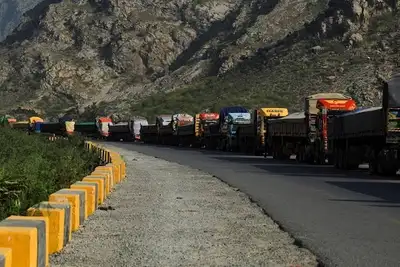
Since the conflict began, however, trade routes between Afghanistan and Pakistan have been closed. The Taliban have shifted their trade focus towards Central Asia and India, while the border between the two countries has been marked by violence and disruption.
Pakistan’s Foreign Minister Ishaq Dar said the operations are part of Islamabad’s counterterrorism strategy. Analysts, however, say the actual targets remain unclear.
Although the strikes are publicly framed as an effort to contain the TTP threat, TTP leaders have not been targeted in practice, their Taliban supporters have been spared, civilian casualties have mounted, and tens of thousands of people have been displaced on both sides of the Durand Line.
The movement of residents out of the area, along with tightened security measures, could leave the border exposed to new waves of insecurity.
Analysts suggest several possible explanations. One is that Pakistan has not yet finalised its strategy and is still testing pressure tactics. Another is that its real objectives are more complex, and more concealed, than officially stated.