At Least 10 People Still Missing After Nuristan Floods, Says Taliban

Faisal Mukhtar, the Taliban’s deputy governor in Nuristan, says the death toll from last week’s devastating floods has exceeded 30, with the bodies of 20 victims recovered so far.
Faisal Mukhtar, the Taliban’s deputy governor in Nuristan, says the death toll from last week’s devastating floods has exceeded 30, with the bodies of 20 victims recovered so far.
He added that at least 10 others remain missing and that search operations are continuing.
The deadly floods struck parts of Nuristan on Monday, 20 July, following heavy rainfall, killing residents and affecting hundreds of families.
According to the Taliban deputy governor, the floods caused extensive damage to infrastructure.
He said around 10 markets containing more than 90 shops were destroyed in the provincial capital, while seven houses were completely demolished and another 82 were damaged.
The UN Office for the Coordination of Humanitarian Affairs had earlier said the floods affected thousands of people and created urgent needs for shelter, food, drinking water, healthcare and sanitation.
The United Nations also warned that flood-affected communities in Nuristan faced severe shortages of medical services, medicines, safe drinking water and sanitation facilities.
Nuristan is a mountainous and difficult-to-reach province. Aid officials say limited access to many affected areas has hampered search operations, emergency assistance and the delivery of humanitarian aid.
Afghanistan is among the countries most vulnerable to the effects of climate change.
In recent years, flash floods, droughts and extreme weather events have become more frequent across the country, repeatedly causing deaths and extensive economic damage.
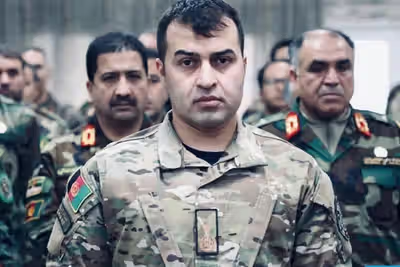
Sources from the Afghanistan Freedom Front told Afghanistan International that its fighters shot down two Taliban drones in Zebak district of Badakhshan around midday on Saturday.
Afghanistan International has seen images from the incident showing pieces of the downed drones in a mountainous area.
The Afghanistan Freedom Front, which has been fighting Taliban forces in Zebak for the past three days, has not yet officially commented on the reported downing of the drones.
According to reports, clashes between armed opposition fighters and Taliban forces have continued in Zebak district of Badakhshan for three days.
On Friday, the second day of the fighting, the Afghanistan Freedom Front said it had killed at least 21 Taliban fighters, including several commanders, in attacks on Taliban positions in Zebak. The front said another 37 Taliban members were wounded.
The front said it had seized Taliban bases and positions in the highlands surrounding the Zebak border battalion and forced Taliban forces to retreat.
Officials from the Taliban’s 219 Omar-e-Salis Division confirmed the opposition attack in Zebak district on Friday night.
In a statement, the division said five opposition fighters had been killed and several others wounded in clashes with troops from the Taliban’s 15th Border Brigade. The Taliban has not officially disclosed casualties among its own forces.
Informed sources told Afghanistan International on the first day of the fighting, Thursday, 23 July, that the Taliban had deployed commandos to the area by helicopter and sent additional reinforcements overland.
According to the sources, some wounded Taliban fighters were also flown by helicopter to Faizabad city.
The fighting in Zebak comes days after the newly established Sepah-e Mihan Front attacked Yaftali Sufla district in Badakhshan.
On 17 July, the front’s fighters briefly took control of the district administration building, police headquarters and Taliban intelligence office in Yaftal, and raised their flag over the district building.
Following the intense clashes between Taliban and opposition forces in Zebak, Daoud Naji, head of the Afghanistan Freedom Front’s political committee, said the fight against the Taliban had entered a new phase.
Naji confirmed that the front had launched attacks against Taliban forces in Zebak district of Badakhshan.
Writing on X on Friday, Naji said the decisive battle for liberation has entered a new phase. A battle whose end will be freedom, with the people of Afghanistan as the true winners.
Richard Bennett, the UN special rapporteur on Afghanistan, has warned against renewed military conflict between the United States and Iran, highlighting the precarious situation of Afghan refugees in Iran.
In a post on X on Saturday, 25 July, Bennett wrote that Afghan refugees in Iran were among the most vulnerable groups and often continued to be overlooked. He also expressed regret over continuing executions in Iran, particularly those involving Afghan migrants.
Earlier, Bennett and a group of independent United Nations human rights experts issued a statement condemning the resumption of military hostilities between Washington and Tehran and the risk of the conflict spreading to other areas.
The UN experts warned that abandoning agreed commitments to end the war would undermine prospects for peace, harm the rights of war victims and destroy the mutual trust needed for a lasting end to the conflict.
They stressed that civilians must not bear the cost of the fighting and that all parties must comply with international human rights and humanitarian law, particularly the principles of distinction between military and civilian targets, proportionality in attacks and precautionary measures to protect civilians.
Concerns Over Damage to Civilian Infrastructure
The UN experts said military attacks and counter-attacks between the United States and Iran on the nights of 12 and 13 July had marked a new phase in the escalation of the crisis and raised fears that the conflict could spread further across the region.
They expressed concern over reports of damage to civilian infrastructure in Iran, including ports, energy networks, transport routes and public service facilities, warning that such attacks could disrupt access to food, medicine and essential services.
People Caught Between Foreign Attacks and Domestic Repression
The statement said that during war and domestic repression, vulnerable groups, including women, children, people with disabilities, minorities, refugees and those living in poverty, suffer disproportionately and are often left unheard.
The UN human rights experts also expressed concern over continuing executions, mass arrests, torture and reports of enforced disappearances in Iran, saying that people in the country were trapped between the consequences of foreign attacks and domestic repression.
They called on all parties to immediately de-escalate tensions, prioritise the protection of civilians and return to dialogue and negotiations to resolve their disputes.
Pakistan’s Prime Minister Shehbaz Sharif has again urged the Taliban to prevent Afghan soil from being used for attacks against Pakistan. He said that Islamabad wants good relations but expects armed groups to be denied sanctuary.
Speaking at the Balochistan National Workshop in Islamabad on Friday, Sharif said: “We share a 2,000-kilometre border with Afghanistan. We are neighbours and have to live together, but we continue to urge the Afghan interim government not to allow its soil to be used for terrorism against Pakistan.”
His remarks come as Islamabad has repeatedly accused the Taliban in recent months of sheltering members of Tehreek-e-Taliban Pakistan and other armed groups. The Taliban have rejected the allegations, saying they will not allow Afghan territory to be used against any country.
Referring to a renewed rise in militant attacks in Pakistan, Sharif said more than 90,000 Pakistani civilians, soldiers and security personnel had lost their lives in the fight against terrorism. He also accused India of supporting terrorist groups but provided no evidence for the claim.
Sharif said Pakistan had largely brought terrorism under control by 2017 and 2018, but that the country must now examine how the threat had re-emerged and expanded.
He also expressed sorrow over Thursday’s attack in Mastung, Balochistan, which killed court judge Abdul Hakeem Kakar and his security guard, saying Pakistan’s security forces and civilians had paid a heavy price to ensure the country’s security.
In another part of his remarks, the prime minister stressed the importance of Balochistan’s development, saying Pakistan could progress only if all of its provinces developed simultaneously.
He announced a 300 billion rupee project for the Karachi-Chaman highway, saying the route, known as the “bloody road” because of its high number of traffic deaths, was expected to be completed within the next two years. Sharif also announced 50 billion rupees in funding to convert about 27,000 agricultural wells in Balochistan to solar power.
Meanwhile, Pakistan’s President Asif Ali Zardari, during a meeting with several Balochistan provincial ministers, called for faster implementation of development projects and stronger coordination between government and security institutions to improve the province’s security and economic situation.
Sources told Afghanistan International on Friday that fighting between Taliban forces and armed opponents is continuing in Zebak district of Badakhshan, where the Taliban reportedly failed to retake positions lost overnight.
According to the sources, the Taliban launched a large-scale assault last night to recapture positions in the Topkhana area of Zebak district, but the attack was repelled by opposition forces.
Anti-Taliban fighters had earlier attacked several Taliban posts in the Topkhana area and, according to the sources, seized several positions. The Taliban then launched a clearing operation.
The sources said dozens of anti-Taliban fighters are involved in the clashes. No group or movement has officially claimed responsibility for the attack.
Sources said three local Taliban commanders were killed in the fighting.
Faridullah Wahdat, commander of one of the Taliban’s border post units, was among those killed. Afghanistan International has also received an image of his body.
At the same time, sources said the anti-Taliban forces also suffered casualties, although no details are available about their losses.
The Taliban has not yet commented on casualties among its forces or on the continuing clashes in Zebak district.
The fighting in the Topkhana area began around midday on Thursday. Sources had earlier told Afghanistan International that anti-Taliban forces attacked several Taliban posts and that the group sent a large number of reinforcements to the area.
The Taliban deployed commandos by helicopter and sent additional forces overland to the site of the clashes. Sources said some wounded Taliban fighters were flown by helicopter to Faizabad city.
Sources said the Taliban shut down telecommunications towers in the area after opposition forces attacked its positions.
Unlike previous sporadic clashes, forces from both sides are now directly engaged on several fronts. Sources say anti-Taliban fighters are positioned in the highlands of Zebak district.
The fighting comes days after the newly formed Sepah-e Mihan Front attacked Yaftali Sufla district in Badakhshan.
On 17 July, fighters from the front briefly took control of the district administration building, police headquarters and Taliban intelligence office in Yaftal, and raised their flag over the district administration building.
The Pakistani military rejected Amnesty International’s report on an air strike on a treatment centre in Kabul that killed civilians, accusing the Taliban of using hospitals and medical facilities as blind spots for terrorist activity.
The Pakistani military on Thursday, 23 July, described Amnesty International’s report as baseless.
Amnesty International said on Wednesday that a Pakistani air strike on the Omid Treatment and Rehabilitation Centre in Kabul on 16 March 2026, which killed at least 269 civilians, should be investigated as a possible war crime.
The organisation said it had found no evidence supporting the Pakistani military’s claim that the centre was being used to store weapons, ammunition or for other military purposes.
Pakistan Rejects Amnesty’s Findings and Questions UNAMA’s Access
The Pakistani military questioned the credibility of investigations conducted by Amnesty International and the UN Assistance Mission in Afghanistan (UNAMA).
It said claims that a 2,000-bed facility containing more than 4,000 patients, attendants and staff had been struck were inconsistent with conditions on the ground.
The military told Afghanistan International that if an incident of such scale and with such a high casualty toll had taken place, hundreds of videos and images should have emerged from patients and residents using mobile phones or CCTV cameras.
It said the absence of even a single piece of footage or image from the site was the strongest evidence against Amnesty International’s account.
The military also argued that Amnesty International’s review of only 60 photographs and 11 interviews was statistically unreliable for a facility of that size.
It further said Amnesty International’s report relied on UNAMA findings, while claiming that UNAMA’s work had been severely restricted by Taliban-imposed limitations.
Pakistan Accuses Amnesty’s South Asia Office of Indian Influence
The Pakistani military described Isabelle Lassee’s role as acting deputy regional director for South Asia at Amnesty International as a deceptive manoeuvre and alleged that the office was effectively led by Smriti Singh, an Indian national.
Amnesty International has not responded to the allegation.
The Pakistani military alleged that Singh had previously worked with media linked to Indian intelligence and, because of what it described as ties to networks connected to India’s Defence Ministry, used Lassee’s name to publish a commissioned report against Pakistan.
Pakistan accused staff at Amnesty International’s South Asia office of favouring the Indian government’s narrative and said the organisation was whitewashing Taliban bias and crimes.
Isabelle Lassee, Amnesty International’s Acting Regional Director for South Asia, said in a statement that Pakistan’s attack on the treatment facility in Kabul constituted a serious violation of international humanitarian law and called on Pakistan to carry out a transparent, independent and impartial investigation and make the findings public.
She said: “The attack on the Omid Centre constitutes a serious violation of international humanitarian law – possibly amounting to a war crime”. She added that because the site had been known as a medical facility for more than a decade, the strike pointed to a serious failure in Pakistan’s military planning that resulted in significant civilian deaths.
Pakistan Foreign Ministry Responds
Pakistan’s Foreign Ministry spokesman Tahir Andrabi said at a press briefing on Thursday, 23 July, that no responsible state can remain indifferent to the continued targeting of its civilians and security forces.
Andrabi said all Pakistani military operations carried out in self-defence had been based on necessity and used only as a last resort.
He said the strikes had been directed solely and exclusively at terrorists and their support bases inside Afghanistan.
The spokesman said Pakistan’s response had been proportionate to the level of threat and that the principles of distinction, precaution and proportionality had been carefully observed.
Andrabi urged Amnesty International and the international community to focus their scrutiny on what he described as the Taliban regime’s continued support for terrorist groups.
He said Islamabad wanted the international community to hold the Taliban accountable for failing to meet its obligations under relevant UN Security Council resolutions, the Doha Agreement and other commitments to prevent Afghan territory from being used as a base for terrorism.
He added that Pakistan reserved the right to take all necessary measures to protect its sovereignty, territorial integrity, and the security and safety of its citizens.