• العربية
  • پښتو
  • فارسی
Brand
  • Afghanistan
  • Sport
  • Markets
  • Afghanistan
  • Sport
  • Markets
  • Theme
  • Language
    • العربية
    • پښتو
    • فارسی
  • Afghanistan
  • Sport
  • Markets
All rights reserved for Volant Media UK Limited
volant media logo

Taliban Leader Reshuffles 21 Officials Across Key Institutions

Jul 30, 2026, 15:09 GMT+1

Taliban leader Hibatullah Akhundzada has reshuffled 21 officials across the group’s judicial, financial, economic, security and religious institutions, according to Taliban spokesperson Zabihullah Mujahid.

Mujahid announced the appointments on Thursday, 30 July.

The changes affect senior positions in the Supreme Court, the Finance Ministry, the Ministry of Mines and Petroleum, the Ministry for the Propagation of Virtue and Prevention of Vice, the Central Darul Ifta and several provincial institutions.

Mohammad Gul Sayad, formerly head of the Kandahar zone military court, was appointed deputy chief justice for military affairs of the Supreme Court.

Sardar Mohammad Abul Faizan, the former deputy chief justice for military affairs, was named director-general of the Central Darul Ifta, the Taliban body responsible for issuing religious rulings.

Khair Jan Khairkhah, the former head of the Central Darul Ifta, was appointed deputy minister for military affairs at the Ministry for the Propagation of Virtue and Prevention of Vice.

Nematullah Hassan, previously technical and professional deputy at the General Directorate for Municipal Affairs, was named deputy finance minister for revenue and customs.

Several senior appointments were also made at the Ministry of Mines and Petroleum.

Mohammad Ishaq Sahibzada, the former deputy minister of public works was appointed deputy minister for finance and administration.

Abdul Matin Saeed, previously deputy finance minister for revenue and customs, was named deputy minister for geological surveys.

Mahmoud Shah Zahid, the former deputy at the General Directorate of State-Owned Companies, was appointed technical deputy minister.

Hesamuddin Sabiri, a former deputy minister at the Ministry of Mines and Petroleum, was transferred to the General Directorate for Municipal Affairs as a deputy director for technical and professional affairs.

Mohammad Sadiq Enqelabi, the former deputy governor of Kandahar, was appointed head of security at the Ministry of Mines and Petroleum.

Akhundzada also appointed Azizur Rahman Sharif, the former head of public works in Kandahar, as head of the Oil and Gas Operations Company.

Abdullah Mutasim, previously commercial director of the state-owned oil and gas company, was named the company’s deputy director for financial affairs.

Saifuddin Taib, the former deputy for coordinating government affairs at the Administrative Office of prime minister, was appointed deputy governor of Kandahar.

Further changes were made within the Central Darul Ifta and the Supreme Court.

Saeed Ahmed Shahidkhel, the former military affairs deputy minister at the Ministry for the Propagation of Virtue and Prevention of Vice, was appointed deputy head of the Central Darul Ifta.

Sheikh Abdul Zahir, previously a deputy director at the Central Darul Ifta, was named a member of the directorate.

Abdul Rashid Saeed, the former director-general of the Supreme Court secretariat, was appointed administrative affairs head of the Central Darul Ifta.

Rahmatullah, formerly an administrative official at the Central Darul Ifta, was named head of the Supreme Court secretariat.

As part of the judicial reshuffle, the former intelligence-section judge at the Kabul zone military court was appointed head of the Kandahar zone military court.

The former judge of Shahrak district in Ghor was named judge of the intelligence section at the Kabul zone military court.

The Taliban also appointed the former head of the department responsible for monitoring decrees and orders in Kandahar as chancellor of Paktika University.

A former member of the Kandahar Ulema Council was named head of that monitoring department, while Abdul Ghaffar Maiwandi was appointed its deputy.

Most Viewed

Taliban Prepares for ‘Large-Scale Operation’ Against Opponents in Badakhshan
1

Taliban Prepares for ‘Large-Scale Operation’ Against Opponents in Badakhshan

2

Seven Civilians Detained By Taliban In Badakhshan’s Yaftal District, Say Sources

3

Taliban Leader Reshuffles 21 Officials Across Key Institutions

4
ANALYSIS

The Indus Water Treaty Suspension: A Growing Threat To Regional Security

5

32 Militants Killed in Operations Across Two Provinces, Says Pakistan

•
•
•

More Stories

The Indus Water Treaty Suspension: A Growing Threat To Regional Security

Jul 30, 2026, 12:56 GMT+1
•
Mohammad Ishaq Rahman, Ph.D.
100%

The recent suspension of the Indus Waters Treaty by India following the Pahagram incident in April 2025 marks a dangerous turning point in South Asian water governance.

This 1960 treaty, brokered by the World Bank, has long served as a cornerstone of stability between India and Pakistan, surviving multiple wars and decades of political hostility. However, the current abeyance phase has fundamentally transformed water from a shared resource into a strategic weapon, creating unprecedented threats to regional security that demand urgent attention.

The Breakdown of Institutional Mechanisms

The suspension has systematically dismantled the treaty's operational architecture. The Permanent Indus Commission, which previously provided a formal channel for communication and data exchange, has seen its functioning severely weakened. This breakdown has eliminated critical tools for flood forecasting, irrigation planning, and agricultural scheduling. Pakistan, as a downstream nation, now operates with limited visibility into upstream conditions, creating dangerous uncertainty across its water-dependent systems.

The dispute resolution mechanism, once a layered system allowing technical disagreements to proceed to Neutral Experts and legal disputes to escalate to Courts of Arbitration, has effectively stalled. This legal vacuum means disagreements accumulate without resolution, inevitably pushing technical issues into political domains where they become more complex and less amenable to structured settlement. The absence of active engagement through established channels significantly raises the risk of escalation between the two nuclear-armed neighbors.

Hydrological Infrastructure as Strategic Leverage

Perhaps the most alarming development is the transformation of hydropower infrastructure into instruments of strategic pressure. Post-suspension, India has accelerated construction across multiple projects in Indian-occupied Jammu and Kashmir, including Pakal Dul (1000 MW), Ratle (850 MW), Kiru (624 MW), Kwar (540 MW), and the massive Sawalkot project (approximately 1856 MW). These projects collectively represent a dramatic expansion of upstream control over the Chenab and Jhelum river systems.

These installations do not function as neutral development initiatives. The coordinated management of dams, tunnels, and reservoirs enables synchronized flow modulation across multiple installations simultaneously. This capability allows India to regulate discharge timing and seasonal flow patterns, transforming water infrastructure into what experts describe as a "strategic pressure architecture." The timing of water releases has become more influential than total volume, with controlled flows during critical agricultural periods capable of disrupting downstream planting and harvesting cycles without requiring permanent river diversion.

The Weaponization of Water

The suspension has introduced a new dimension of coercive pressure through hydrological management. Operational decisions in river management now carry explicit strategic meaning, with each adjustment in flow or storage communicating intent within the broader bilateral relationship. This shift has reduced the separation between technical water management and political decision-making, making water governance an instrument of geopolitical competition.

The control over flow timing has emerged as the decisive factor shaping agricultural cycles, hydropower generation, and flood-risk exposure in Pakistan. This temporal authority turns river governance into a tool of influence, where scheduling decisions can reshape downstream stability and redefine water as an instrument of strategic power rather than a shared resource. The system now operates within a "hybrid coercion environment" where hydrological management carries strategic intent alongside technical function.

Environmental Vulnerability and Climate Stress

The security implications are compounded by environmental pressures that the treaty was never designed to address. Glacier retreat and shifting monsoon patterns have altered the timing and volume of river flows, while the suspension reduces capacity for joint adaptation to these shared challenges. This fragmentation weakens overall resilience and increases the likelihood of mismanagement during extreme events, such as floods or droughts, which could trigger humanitarian crises and further destabilize the region.

Legal and Diplomatic Dimensions

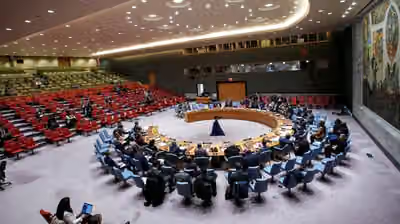
Pakistan has responded by elevating the issue to the United Nations Security Council, emphasizing the humanitarian and security risks emerging from disruption in treaty implementation. The absence of hydrological coordination undermines flood preparedness, irrigation planning, and agricultural scheduling, creating systemic risks that extend beyond technical inconvenience to affect national stability.

The legal framework of the treaty still exists, but its effectiveness now depends on sustained political commitment to cooperative interpretation and procedural discipline. The unilateral suspension without mutual consent challenges the fundamental international legal principle of pacta sunt servanda, which requires states to implement treaties in good faith. This creates dangerous precedents for international water law and regional stability.

Conclusion

The Indus Waters Treaty no longer operates as a neutral technical framework separated from political contestation. The post-2025 abeyance phase has transformed water governance into a charged strategic environment where infrastructure expansion and security calculations intersect directly. The treaty once functioned as a buffer against escalation; its weakening now exposes the basin to heightened risk and uncertainty.

Without adaptive reform and renewed commitment to transparency, the treaty risks evolving from a mechanism of cooperation into a recurring source of strategic contestation across South Asia. The future of regional stability depends on whether both states can prioritize restraint and institutional continuity over strategic leverage, or whether water governance becomes the next flashpoint in an already volatile bilateral relationship.

Seven Civilians Detained By Taliban In Badakhshan’s Yaftal District, Say Sources

Jul 30, 2026, 12:35 GMT+1
100%

Local sources in Badakhshan say the Taliban has detained seven residents of Yaftal-e Payeen aka Yaftali Sufla for allegedly cooperating with or knowing about the activities of the Sepah-e Mihan Front.

Residents said the Taliban imposed strict security measures and began searching homes after regaining control of the district.

According to local residents, Taliban intelligence forces have taken control of the district centre and villages in Yaftal-e Payeen and are conducting house-to-house searches at night.

Some residents said the heavy Taliban presence and repeated searches had caused widespread harassment and disrupted daily life in the area.

Informed sources said on Thursday, 30 July, that the Taliban had detained at least seven residents of Yaftal-e Payeen on Tuesday and Wednesday on suspicion of cooperating with or having knowledge of the Sepah-e Mihan Front’s movements.

According to the sources, the detainees were transferred to Faizabad and are being held at the provincial intelligence directorate’s detention centre.

The newly formed Sepah-e Mihan Front briefly took control of Yaftal district centre on 17 July, disarmed Taliban forces, seized the district administration building and raised its flag over it.

The front withdrew from the area several hours later.

Taliban Checkpoint Attacked in Faizabad

Meanwhile, local sources said a Taliban checkpoint was targeted in a rocket attack on Wednesday night. The checkpoint is located within Faizabad city opposite Badakhshan University.

No group has claimed responsibility for the attack, and local Taliban officials have not commented on either the recent detentions or the incident in Faizabad.

Sources in Zebak district also said scattered clashes between the Taliban and the Afghanistan Freedom Front were continuing.

They said the Taliban had deployed a large number of forces to the district.

A day earlier, informed sources told Afghanistan International that the Taliban was preparing a military operation against opposition groups in Badakhshan.

Restrictions & Funding Cuts Threaten Afghan Women’s & Children’s Health, Says WHO

Jul 30, 2026, 11:00 GMT+1
100%

The World Health Organisation has warned that severe restrictions on female staff, unprecedented funding shortages and overlapping crises are seriously disrupting healthcare for Afghan women and children.

According to the organisation’s 2025 annual report, published on Thursday, 30 July, Taliban restrictions on the travel, education and work of female employees severely disrupted community-level health services, disease surveillance and outbreak response.

The report also said a serious shortage of female doctors and health workers, particularly in remote areas, had sharply weakened the quality of healthcare and women’s and children’s access to life-saving services.

Closure of health facilities

A steep decline in funding was another major challenge facing Afghanistan’s health sector in 2025. The humanitarian needs plan received only 45.3 per cent of the required funding.

The shortfall led to the closure of 27 primary healthcare facilities, limiting access to medical services for about 294,000 people.

Overlapping crises strain a fragile health system

Alongside restrictions and funding shortages, earthquakes, drought, floods, disease outbreaks and the return of more than 2.7 million migrants from Iran and Pakistan placed enormous pressure on Afghanistan’s fragile health system.

Providing services and monitoring health conditions in remote and difficult-to-reach areas, particularly during winter, also faced serious obstacles.

Administrative delays and disruption to specialised programmes

The WHO report said lengthy project approval procedures and delays in supplying health and nutrition materials, caused by high transport costs and demurrage charges, slowed the delivery of services.

The ban on methadone also disrupted methadone maintenance treatment services in several provinces.

In specialised programmes, a ban on house-to-house polio vaccination campaigns, low routine immunisation coverage and limited community participation because of administrative difficulties in distributing vaccination cards increased the risk of polio and other diseases.

Funding cuts also placed severe pressure on inpatient units treating children suffering from severe acute malnutrition with medical complications.

WHO said that although it continued providing essential services across all 34 provinces in 2025, maintaining those services would require the removal of restrictions on female health workers and reliable, sustainable funding.

UN Warns Afghanistan Crisis Is Increasing Human Trafficking Risks

Jul 30, 2026, 09:37 GMT+1
100%

The UN Office on Drugs and Crime and the International Organization for Migration have warned of an unprecedented rise in Afghans’ vulnerability to trafficking, exploitation and forced labour.

In a joint statement marking World Day Against Trafficking in Persons, the two UN agencies said overlapping crises in Afghanistan had created greater opportunities for the exploitation of its citizens.

According to the report, the mass and forced return of Afghans from neighbouring countries, the collapse of the opium-based economy, sharp cuts in humanitarian aid, repeated natural disasters and continuing restrictions on women’s and girls’ rights are among the main factors increasing the risks of human trafficking and forced labour.

Recent assessments show that the living conditions of returnees are deeply concerning. Only 11 per cent have regular employment or their own businesses, while more than half are unable to cover their basic living costs.

These crushing economic pressures have forced many families to borrow money, increasing the risk of debt bondage, forced labour in unsafe sectors such as brick kilns, agriculture and mining, as well as forced marriage and organ removal.

Polleak Ok Serei, the UN Office on Drugs and Crime representative in Afghanistan, expressed concern over the situation and said the growing pressures had made stronger preventive measures and the accurate identification of victims more urgent.

Mihyung Park, the International Organization for Migration’s chief of mission in Afghanistan, said the scale of migrant returns far exceeded the capacity of local communities to absorb them.

She warned that without meaningful international support and employment opportunities, people would again be forced into dangerous and irregular migration, further fuelling the cycle of trafficking and exploitation of Afghans.

Afghan Journalist Released After One Year In Taliban Prison

Jul 30, 2026, 08:47 GMT+1
100%

The Afghanistan Journalists Centre says journalist Bashir Hatif has been released from Bagram prison after serving a one-year sentence and has reunited with his family in Kabul.

The centre said on Wednesday that a Taliban military court had sentenced Hatef to one year in prison on charges of propaganda against the group’s administration.

Taliban intelligence and morality police forces arrested Bashir Hatef in Kabul on 23 July 2025, along with Shakib Ahmad Nazari, a journalist for Japan’s NTV, and Abuzar Sarmal Sar-e-Puli, the editor-in-chief of Tawana News Agency.

Shakib Ahmad Nazari and Abuzar Sarmal Sar-e-Puli remain in prison and are serving their sentences.

Bashir Hatif is a professional Afghan journalist who has worked with several domestic media outlets. He is also the founder and executive director of the Journalists’ Communication and Training Centre and a member of the leadership board of the Federation of Afghan Journalists’ Organisations.

Welcoming Hatif’s release, the Afghanistan Journalists Centre said his arrest and year-long imprisonment constituted a clear violation of his human and professional rights.

According to the centre, Hatif was tried and imprisoned by a military court linked to the Taliban’s intelligence agency on charges including propaganda against the Taliban administration, without access to a defence lawyer.

The Afghanistan Journalists Centre called on the Taliban to respect journalists’ rights, release other imprisoned journalists and media workers, and allow them to work freely without threats, pressure or fear of arrest.

Since the Taliban returned to power, freedom of expression and media activity in Afghanistan have faced widespread restrictions. Reporters Without Borders has repeatedly said censorship, the detention of journalists and media closures have increased under Taliban rule.