Taliban Demands UN Seat Before Accepting Assessments Of Afghanistan

Taliban spokesman Zabihullah Mujahid said no assessment of Afghanistan would be complete or fair without an official representative of the group at the United Nations.

Taliban spokesman Zabihullah Mujahid said no assessment of Afghanistan would be complete or fair without an official representative of the group at the United Nations.
Mujahid said the Taliban did not expect any positive outcome from the United Nations until Afghanistan’s seat was handed to the group and its administration was allowed to present what he called its achievements.
Speaking on Tuesday, 4 August, he said any review or conclusion about Afghanistan requires the presence of our official representative at the United Nations so that the realities of Afghanistan can be reflected without political bias. Otherwise, any report or assessment will be incomplete.
His remarks came after Christina Markus Lassen, Denmark’s ambassador to the United Nations and president of the Security Council for August, described the fifth anniversary of the Taliban’s return to power as a “rather grim anniversary”.
She said the council would focus this month on the consequences of five years of Taliban rule, particularly the situation of women and girls in Afghanistan.
Five years after the fall of the former government on 15 August 2021, the Taliban has still not secured Afghanistan’s seat at the United Nations, which remains held by a representative of the previous government.
The United Nations and many countries have identified the lifting of sweeping restrictions on women and girls, the formation of an inclusive government and compliance with international obligations as key conditions for normalising relations with the Taliban and considering the transfer of Afghanistan’s UN seat.
However, over the past five years, the Taliban has not responded positively to international demands concerning human rights, women’s rights and recognition of the rights of ethnic and religious minorities.
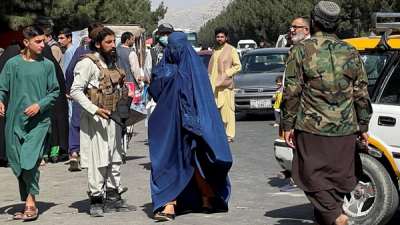
Residents of Helmand say Taliban morality police have intensified pressure on women over dress-code rules, detaining more than 10 women in the past week for allegedly failing to observe the required hijab.
Residents of Lashkar Gah told Afghanistan International that most of the arrests took place around the women’s market in the Karte Lagan area of the city.
They said the measures had created fear among women and severely affected economic activity at the market.
Sardar Mohammad, a Helmand resident, said more than 10 women had been detained in the past week for allegedly failing to observe the Taliban’s hijab and dress code rules or refusing to follow the orders of ministry for the propagation of virtue and prevention of vice officers.
He added that many women were now avoiding the market for fear of arrest.
According to the source, several other women were detained at the same market over the past two days for allegedly failing to observe the required hijab and travelling without a male guardian.
Witnesses also reported an altercation between a Taliban morality police officer and a woman near the women’s market.
They said the woman intended to enter the market after getting out of a vehicle, but the Taliban officer stopped her.
According to witnesses, the officer grabbed the woman’s hand, prompting her to strike him with her shoe. The dispute then escalated into a physical confrontation, with several members of the public intervening.
Witnesses said that following the incident, Taliban morality police increased surveillance, searches and questioning of women at the market and imposed further restrictions.
Local sources said many women were now staying away from the market to avoid detention and were asking male relatives to make purchases on their behalf.
Traders at the women’s market also said the Taliban’s strict restrictions had caused a sharp fall in customer numbers and brought their businesses close to a standstill.
They said the monthly rent for each shop ranged from 20,000 to 40,000 afghanis, but declining sales had left many shopkeepers unable to pay their rent.
They warned that they would be forced to close their businesses if the situation continued.
The Taliban has not commented on reports of women being detained in Helmand.
Credible sources in the Taliban’s Justice Ministry say the commission for recovering seized land plans to review Hazara and Shia townships and properties across several Afghan provinces.
The commission recently declared Omid-e Sabz township in western Kabul to be state-owned and ordered residents to leave their homes.
Residents have submitted complaints to Taliban Interior Minister Sirajuddin Haqqani, Foreign Minister Amir Khan Muttaqi, Defence Minister Mohammad Yaqoob Mujahid, intelligence chief Abdul Haq Wasiq and deputy intelligence chief Tajmir Jawad.
However, the order for the forced eviction of Omid-e Sabz residents has not been withdrawn.
Residents also intend to seek a meeting with Taliban leader Hibatullah Akhundzada to raise their complaints.
Akhundzada, who has not appeared publicly, has not met representatives of Afghanistan’s Shia and Hazara communities during the Taliban’s five years in power.
Sources said the Taliban’s land recovery commission planned to review Jebrael township in Herat, as well as extensive properties in Kabul, Mazar-e-Sharif, Bamiyan, Ghazni and several other cities, and potentially declare them state-owned.
Further details of the plan are not available.
A community elder from western Kabul told Afghanistan International: “The Hazaras do not want conflict with the Taliban, but the Justice Ministry is making provocative decisions that leave them no option except to take to the mountains.”
Sources previously told Afghanistan International that the Taliban’s Justice Ministry had given residents of Omid-e Sabz township until Thursday, 6 August, to evacuate their homes.
The order was announced on Sunday during a meeting with neighbourhood representatives and property agents from the township.
According to a notice obtained by Afghanistan International, residents were also told that from Sunday, 2 August, no one would be allowed to rent out a house or collect rent from tenants.
A Taliban special court ruled in early May that more than 741 acres of land in Omid-e Sabz township belonged to the state.
In a statement issued on 26 April, the Taliban’s Justice Ministry said the special court handling cases involving allegedly seized state land in the central zone had examined documents and declared approximately 745 acres of the township to be state property.
The court ruled that all the land belongs to the emirate.
After returning to power, the Taliban established a commission to prevent land seizures and recover allegedly usurped land.
However, reports indicate that the group has confiscated thousands of acers of privately held land in different regions by designating it as “state-owned”.
In late 2025, a Taliban special court also classified and confiscated approximately 911 acres of land in Nawabad township in Ghazni as state property.
An Afghanistan International report at the time said the Taliban had provided no transparency about the review process and that affected landowners were not permitted to appeal within the administration or publicise their documents.
Taliban spokesman Zabihullah Mujahid has welcomed recent remarks by Iran’s deputy ambassador in Kabul about armed opponents of the group, saying they reflect the wishes of the Afghan people.
Seyed Hassan Mortazavi, Iran’s deputy ambassador in Kabul, had earlier said Tehran did not support any political or military group opposing the Taliban and did not regard armed conflict against the group as resistance.
Referring to Mortazavi’s position on Monday, Mujahid said the Iranian embassy adopted a very clear position and demonstrated that Iran’s stance is the stance of the Afghan people.
The Taliban spokesman described the remarks as commendable.
He added that no one supported war in Afghanistan and that any person or group that creates disorder under different names and fuels insecurity is condemned.
Mujahid also said Iran understood the importance of regional security and stability and claimed that the Taliban had succeeded in ensuring security in Afghanistan.
Controversial remarks by Iran’s deputy ambassador
The Taliban spokesman’s response followed unprecedented remarks by Seyed Hassan Mortazavi, Iran’s deputy ambassador in Kabul.
At a meeting in Kabul, Mortazavi said Tehran supported no political or military group opposing the Taliban and did not consider their armed struggle against the group to be resistance.
He said Iran regarded developments in Gaza and Lebanon, as well as confrontation with the United States, as resistance.
He described the armed struggle of Taliban opponents as resistance against a Muslim brother and said it did not conform to the Islamic Republic’s definition of resistance.
Iran’s deputy ambassador also said an Islamic government had been established in Afghanistan and that Taliban opponents should resolve their differences through dialogue with the group and reach an accommodation.
The senior Iranian diplomat’s remarks came amid a recent rise in attacks and military activity by anti-Taliban fronts in several provinces, particularly Badakhshan.
Mortazavi, who has been identified as a member of Iran’s Islamic Revolutionary Guard Corps, publicly outlined Tehran’s position on groups opposing the Taliban for the first time.
His comments prompted mixed reactions, with several anti-Taliban movements and groups criticising them.
Habibullah Hassam, head of the National Resistance Front’s council of religious scholars, strongly criticised Mortazavi’s remarks, saying the Iranian diplomat was not in a position to issue religious rulings or determine boundaries between the National Resistance Front and what he called a proxy un-Islamic group.
Taliban spokesman Zabihullah Mujahid says the group has suspended operations at some mines in Badakhshan while it reviews extraction guidelines, citing illegal mining, disorder and the seizure of mining sites.
Mujahid made the remarks in the second episode of the programme Government in the Mirror of the Press. He said the mining sector had previously faced problems including disorder, the seizure of mines and illegal extraction.
According to him, operations at some mines will remain suspended until new guidelines are finalised.
The Taliban halted mining activities in Badakhshan following increased unrest in the province. The Taliban leader had earlier ordered an end to what the group described as illegal mining.
The order directly threatened the economic interests of some local Taliban commanders and fuelled internal tensions. Control over mines has become a major source of disagreement between local Taliban figures in Badakhshan and the group’s leadership.
The ban on illegal mining led to weeks of tension between Juma Khan Fateh, a local Taliban commander who has been at odds with the group’s leadership, and senior Taliban officials. The dispute reportedly reached the point where both sides prepared for a possible armed confrontation.
Meanwhile, some mine workers in Badakhshan previously protested against the continued closure of mining sites by the Taliban.
The protesters said workshops belonging to low-income residents had remained closed for about a month, while operations linked to powerful individuals were continuing.
Mujahid said the Taliban’s Ministry of Mines and Petroleum would announce the new guidelines once they were finalised, and that mining would resume under revised laws and standards.
He also claimed that the Taliban had prevented unauthorised extraction and substandard excavation and had ended uncontrolled mining.
According to him, the measures were intended to protect mineral resources and ensure extraction was carried out in accordance with established standards.
Since returning to power, the Taliban has signed numerous mining contracts with domestic and foreign companies.
However, the management of mineral resources, efforts to prevent illegal extraction and the transparency of mining contracts remain widely debated issues in Afghanistan’s mining sector.
Unregulated mining has also drawn criticism from environmental experts.
As the fifth anniversary of the Taliban’s return approaches, Human Rights Watch says Afghanistan faces one of the world’s gravest human rights and humanitarian crises.
In a report published on Monday, 3 August, to mark the fifth anniversary of the Taliban’s return to power, Human Rights Watch said the group had violated citizens’ fundamental rights through sweeping restrictions, particularly those imposed on women and girls.
The organisation said women and girls remained barred from secondary and university education and faced extensive restrictions on employment, freedom of movement, freedom of expression and participation in public life.
The report said journalists, civil society activists and people considered critics of the Taliban continued to face threats, arbitrary detention and torture.
Human Rights Watch also said hundreds of former government security personnel had been subjected to revenge attacks and extrajudicial killings in recent years.
The organisation described Afghanistan’s humanitarian situation as critical, saying that after major reductions in international assistance, half of the country’s population now required food and medical aid.
According to the report, more than 3.7 million children in Afghanistan are suffering from acute malnutrition, while the country’s health system is struggling with severe shortages of resources.
The report also said the mass expulsion of Afghan migrants from Pakistan and Iran had deepened the humanitarian crisis, as many returnees lacked shelter, employment and sources of income.
Human Rights Watch added that armed clashes between the Taliban and Pakistan, as well as attacks by Islamic State Khorasan Province, had caused hundreds of civilian casualties in recent years.
Referring to arrest warrants issued for Taliban leaders by the International Criminal Court and the establishment of an independent UN accountability mechanism for Afghanistan in 2025, the organisation described the measures as important steps towards ending impunity for human rights violations.
Human Rights Watch said condemning Taliban policies alone was not enough.
It called on governments to increase pressure on the group to lift all restrictions imposed on women and girls, support international accountability processes, fund Afghanistan’s humanitarian programmes and end the forced deportation of Afghan refugees and migrants.