Double Standards Weaken Global Fight Against Terrorism, Says Russia

Russia’s UN envoy warned that expanding terrorist activity, the movement of foreign fighters and terrorists’ use of emerging technologies pose a threat to global security.
Russia’s UN envoy warned that expanding terrorist activity, the movement of foreign fighters and terrorists’ use of emerging technologies pose a threat to global security.
The UN Security Council met on Wednesday, 5 August, to discuss threats to international peace and security caused by terrorism.
Vasily Nebenzya, Russia’s ambassador to the United Nations, said many foreign fighters were moving back to their countries of origin or to other conflict zones after gaining combat experience in the Middle East.
He said the international community should make greater efforts to prevent their movement and activities.
Although the Russian representative did not directly mention Afghanistan, much of his speech reflected security concerns surrounding the country.
Russia has repeatedly expressed concern in recent years about the threat posed by Islamic State Khorasan Province, the presence of foreign fighters and the impact of instability in Afghanistan on Central Asia.
Nebenzya also warned that terrorists were using emerging technologies, including artificial intelligence, cryptocurrencies and drones.
He said these tools had increased terrorist groups’ ability to recruit members, raise funds and carry out attacks.
In another part of his remarks, Nebenzya said double standards and selective approaches to counterterrorism were among the main factors contributing to the spread of terrorist threats worldwide.
He stressed that counterterrorism efforts should not be influenced by political objectives and that international cooperation should be conducted without discrimination.
The Russian representative also highlighted expanding counterterrorism cooperation through the United Nations, the Shanghai Cooperation Organisation, the Collective Security Treaty Organisation and other regional mechanisms.
He said Moscow was working to strengthen the capacity of Central Asian countries to confront terrorist threats.
The Security Council meeting came as representatives of several countries and UN counterterrorism bodies also expressed concern about threats posed by Islamic State and other extremist groups.
Russia is the only country to have formally recognised the Taliban administration.
Moscow has expanded its political, diplomatic, economic and security relations with the Taliban in recent years, while continuing to warn about IS-K activity and the risk of instability spreading from Afghanistan into Central Asia.
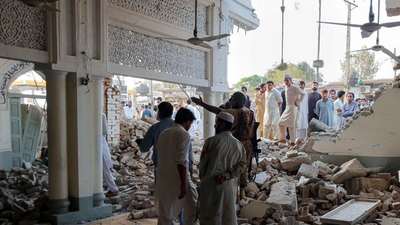
Pakistan’s UN envoy Asim Iftikhar urged member states to confront what he called the growing terrorist threat from Afghanistan, saying multiple groups had expanded their operations since the Taliban’s return.
Speaking at the Security Council on Wednesday, 5 August, Iftikhar said the situation in Afghanistan was deeply concerning.
He claimed that safe havens were currently available in Afghanistan to groups including Tehreek-e-Taliban Pakistan, the Balochistan Liberation Army, Islamic State Khorasan Province, the East Turkistan Islamic Movement and al-Qaeda.
The UN Security Council meeting was held under the title “Threats to International Peace and Security Caused by Terrorist Acts”.
Pakistan’s representative said many of these groups recruited and trained members inside Afghanistan and planned terrorist attacks in Pakistan with complete impunity.
He also alleged that some of the groups received financial support from Pakistan’s eastern neighbour, referring to India.
Iftikhar said the Security Council should hold the Taliban accountable for its commitment not to allow Afghan territory to be used by terrorist groups for cross-border attacks.
He added that foreign sponsors of terrorist groups should also be held accountable for supporting, financing and arming them.
The senior Pakistani diplomat said a UN monitoring team report had made clear that, although sustained counterterrorism efforts had weakened Islamic State’s capabilities, the terrorist threat continued to expand in Africa, the Middle East and Afghanistan.
He proposed that a comprehensive international response to terrorism should address all its forms and manifestations, including state terrorism.
Pakistan’s representative said international efforts and Pakistani counterterrorism operations had dealt setbacks to IS-K, but the group’s activities in Afghanistan remained a serious concern.
He stressed that no country could confront the threat of cross-border terrorism alone and called for stronger international cooperation against the growing activities of terrorist groups.
Iftikhar also expressed concern over terrorists’ use of emerging technologies, including drones, intelligence tools, social media and artificial intelligence.
He said stronger border management, greater capacity for law-enforcement agencies and improved cooperation among member states remained essential to counter transnational terrorist threats.
China’s UN envoy, Sun Lei, said terrorist groups based in Afghanistan remain a serious threat to the country and its neighbours, warning that IS-K is strengthening its motivation and ability to carry out cross-border attacks.
The UN Security Council meeting was held under the title “Threats to International Peace and Security Caused by Terrorist Acts”.
Sun Lei, chargé d’affaires of China’s permanent mission to the United Nations, addressed the meeting.
He said China urged Afghanistan’s authorities, referring to the Taliban, to honour their counterterrorism commitments and take decisive action against all terrorist groups based in the country.
These include individuals and entities listed by the Security Council committee established under Resolution 1267.
Sun said such action was necessary to prevent Afghanistan from once again becoming a safe haven for terrorism.
The Chinese diplomat added that the international community should help Afghanistan revive its economy and improve people’s livelihoods in order to address the root causes of terrorism.
He said China supported cooperation between Central Asian countries, regional organisations such as the Shanghai Cooperation Organisation and Afghanistan in jointly confronting cross-border terrorist threats.
Sun said terrorist groups were increasingly using the internet, artificial intelligence, drones and other emerging technologies for incitement, recruitment, financing and attacks.
He said this was creating new challenges for global counterterrorism efforts.
China supported efforts by the United Nations and the international community to strengthen governance of emerging technologies and improve risk-assessment systems and regulatory frameworks, he said.
Sun called for preventing what China describes as the three forces, violent terrorism, ethnic separatism and religious extremism, from exploiting these technologies to expand their influence.
He said developing countries should receive greater support through technology transfers, equipment, technical assistance, training and intelligence sharing to strengthen their counterterrorism capabilities.
The Chinese representative said the Security Council should make full use of the sanctions mechanisms established under Resolutions 1267 and 2713.
He also called for the Balochistan Liberation Army and its Majeed Brigade wing to be added to the sanctions list as soon as possible to support international counterterrorism efforts.
Sun said a recent suicide attack in Pakistan had killed and wounded civilians.
He strongly condemned the attack and urged the international community to support Pakistan’s counterterrorism efforts.
Terrorism Threat Remains Serious
China’s representative said the threat of international terrorism remained complex and severe.
He said terrorist attacks were continuing, terrorist organisations were steadily improving their operational capabilities and exploiting regional conflicts to expand their influence.
This posed a serious threat to international peace and security, he added.
Sun said the international community should uphold a new security concept based on common, comprehensive, cooperative and sustainable security.
He called for a zero-tolerance approach to terrorism, warned against politicising or instrumentalising counterterrorism, and urged greater solidarity and cooperation to improve the effectiveness of global efforts.
As the Taliban complete five years in power this August, two confident predictions made in the autumn of 2021 have both aged badly.
The first was that the movement, unable to govern, would fracture within a season. The second, its mirror image, was that whoever governed Afghanistan would eventually be disciplined by the ordinary requirements of statecraft — revenue, recognition, neighbours — into moderation.
Neither happened. What has emerged instead is a government that is administratively more capable than its critics expected and politically more brittle than its own propaganda suggests. Holding both halves of that sentence together is the analytical task of the moment.
The quiet accumulation of Kandahar
Begin with Hibatullah Akhundzada, who is stronger today than at any point since 2016. This is not an accident of personality, and it is certainly not the product of charisma. He is a reclusive jurist who rarely meets his own ministers and communicates through clerical intermediaries. His strength has been assembled, patiently, from four materials.
The first is tribal. Hibatullah's Nurzai lineage within the Panjpai confederation has been quietly converted into an appointments network. Men like Balkh governor Muhammad Yousuf Wafa — a fellow Nurzai who has functioned as gatekeeper to the leader — illustrate how kinship substitutes for institutions. By late 2025, every commanding height of the state sat in Kandahari hands: the leadership, the premiership, the central bank, the chief justiceship.
The second is clerical, and it is the most underappreciated. Hibatullah's real constituency is not the old guerrilla commander but the new mosque-based clergy: prayer leaders and teachers in provincial towns who had status without resources under the Republic. The Taliban have given them both.
A leadership decree specifying dormitories for five hundred to a thousand students per madrassa, daily student stipends, and graded salaries for shaykh al-ḥadīth and Qur'an instructors is not merely an education policy. It is a patronage system with a curriculum attached. Alongside some fifteen thousand registered madrassas sits a parallel network of leadership-sponsored schools operating outside the ordinary system, with their own syllabus, oaths of allegiance to the leader, and — in provinces like Panjshir — buildings repurposed from shuttered girls' schools. Provincial ulema councils extend the same logic into dispute resolution.
The calculation is sound on its own terms. A cleric who owes his salary, his students and his standing to Kandahar is a more reliable instrument of rule than a commander who remembers his own battlefield.
The third is coercive. Since early 2025, units personally loyal to the leader have been moved into positions once held by the Haqqani network, including at Kabul airport and Bala Hissar. Decisions on weapons distribution and force deployment increasingly bypass the cabinet entirely.
The fourth is legal-bureaucratic. The 119-article criminal procedure code approved in January 2026 was circulated to provincial courts without announcement, surfacing only when the Afghan rights group Rawadari published a leaked copy. It codifies obedience, extends detention powers and criminalises public criticism. It arrived amid a two-month burst of reshuffles touching more than twenty-five officials, and a fourteen-point directive warning the movement that it faced a “major test.”
The paradox of rivalry
Here is the counter-intuitive part. A cabinet of prominent names — Baradar on the economy, Sirajuddin Haqqani at interior, Yaqub at defence, Muttaqi at foreign affairs — has not produced paralysis.
Because none of these men can challenge Kandahar openly, and because each needs a demonstrable record to protect his standing, the rivalry has been sublimated into competitive delivery. Ministries compete to be seen performing. The friction is real, but it is hidden from public view and channelled into output rather than confrontation.
Kabul Municipality is the showcase. Officials report roughly 450 kilometres of road built over four and a half years, 137 of them in 2025 alone; nearly 29 billion afghanis in revenue collected since March 2022; some 29,000 streetlights activated; twelve parks rebuilt; and 233 development projects budgeted for the current solar year. Set against the donor-financed municipal experiments of the Karzai and Ghani years, this is not a trivial record.
But the caveats matter as much as the numbers. Land acquisition covering more than eleven thousand properties has proceeded with almost no transparency, whole districts were transferred to the municipality by leadership order, and in June 2026 Afghan outlets reported — without official confirmation — a corruption investigation reaching the mayor himself.
This is a model of administration that delivers pavement while eroding property rights, and audits nothing. It is worth naming precisely, because it is the template now being exported to other Afghan cities.
Northern anchors
The same competence-without-legitimacy pattern shapes foreign policy, where Kabul's northern turn has been its most successful project.
Russia recognised the Taliban government in July 2025, and Putin accepted the Afghan ambassador's credentials in January 2026. China had accredited a Taliban ambassador as early as December 2023; the UAE, Kazakhstan and Uzbekistan have followed on credentials without formal recognition.
Trade with the five Central Asian states has grown to roughly $1.7 billion. Uzbekistan, whose bilateral trade passed $1 billion, is Kabul's most active partner and the sponsor of the Termez–Naibabad–Kharlachi “Kabul corridor.” Afghan exports through Turkmenistan's Torghundi crossing have more than doubled while Ashgabat presses on with TAPI. Kyrgyzstan removed the Taliban from its terrorism list and, with Tajikistan, inaugurated components of CASA-1000. Russian and Uzbek railway administrations have supplied the technical scaffolding, and Kabul's endorsement of the 1520mm Russian gauge was a geopolitical declaration disguised as an engineering choice.
None of this is affection. It is risk management by neighbours who want corridors, electricity markets and a quiet border — and who have concluded that the Taliban are the address at which such things are now negotiated.
It also remains modest. Most volume is Afghan imports, the rail projects are underfunded, and non-recognition still bars Kabul from the World Bank and the IMF.
Where Kabul fails
Two failures define the record, and neither is incidental.
The first is the treatment of women and minorities. UNAMA's April–June 2026 reporting documents arrests over hairstyles, floggings for breaking the Ramadan fast, at least thirty women detained in Herat in three days for “improper hijab,” hundreds of arbitrary arrests by the vice and virtue apparatus, and instructions to shopkeepers and clinics not to serve women unaccompanied by a maḥram. Afghan women have now been barred from UN premises for the better part of a year.
Minorities fare no better. Shia communities are pressed to observe the state's Eid calendar, Nowruz is discouraged, and the April attack near a Shia shrine in Herat killed twelve civilians. The ICC's July 2025 arrest warrants for Hibatullah and Chief Justice Abdul Hakim Haqqani named gender persecution for what it is.
The crucial analytical point is that these policies are not a bargaining chip being withheld for a better offer. They are the currency in which Kandahar pays its clerical base. That is why every envoy who has offered recognition in exchange for girls' schooling has come home empty-handed — and why incremental diplomacy on this file keeps failing for reasons that have nothing to do with the skill of the diplomats.
The second is regional militancy, and here the irony is bitter. The relationship Kabul was most expected to manage — with Pakistan — has collapsed further than anyone forecast.
Islamabad's demands regarding the TTP have gone unmet, in part because a genuine crackdown would tear at the movement's own coalition and forfeit a fallback sanctuary its leaders still quietly value. Since the October 2025 clashes and border closure, the Doha ceasefire has collapsed, Istanbul talks deadlocked, and cross-border strikes resumed through 2026.
Pakistan–Afghanistan transit trade has fallen from roughly $5 billion in FY21 to about $367 million in FY26. That is a strategic amputation for Pashtun traders on both sides of the Durand Line, and a windfall for Chabahar and Iranian routes. Chinese shuttle mediation by special envoy Yue Xiaoyong achieved nothing; Qatari, Turkish and Saudi efforts produced only pauses. Beijing's economic leverage over two clients did not translate into influence over either — a finding that should temper expectations of Chinese conflict management everywhere in the region.
Central Asia's rail ambitions are collateral damage. Meanwhile UN monitors count more than twenty armed groups on Afghan soil and assess that ISKP, though degraded, retains the capacity to regenerate fighters faster than it loses them.
Washington's absence
Against all this, American policy is thin.
Quiet track-two conversations involving former diplomats and think-tank figures on both sides continue in Doha and Istanbul. They are useful: they preserve vocabulary, relationships and a shared factual baseline for a negotiation that will eventually have to happen. But Washington's power corridors are unmoved. The 2026 counterterrorism strategy barely mentions Afghanistan beyond ISKP and Abbey Gate. Engagement runs through detainee releases and episodic talk of Bagram rather than any strategy.
Counterterrorism has become the whole of policy. The United States therefore has views about Afghanistan but no position on Afghans.
The verdict
So: stable, or brittle? Both — and the tension between the two is the story.
The Taliban face no organised challenger. The diaspora remains split across the Vienna Process, the National Resistance Front and the Ankara grouping, each with a platform and none with a plan; the ethnic and generational arithmetic that divided them in 2001 divides them still.
Yet the cracks in the power corridors are widening. Leaked audio has Hibatullah himself warning that internal discord could destroy the government. Sirajuddin Haqqani has publicly condemned rule by fear. The demolition of the Jalaluddin Haqqani madrassa in Khost was read across the movement as calculated humiliation. Non-Pashtun commanders have been sidelined, and no successor has been named — a silence that becomes more dangerous with every year the leader ages.
The more consequential pressure, however, is coming from below. Nearly five million returnees since 2023, twenty-eight million people in poverty, per capita income falling. And against that: teachers running underground classes, women documenting abuses, traders rerouting supply chains, and Afghans abroad organising with more coherence than their political class has managed.
Ordinary Afghans, inside and outside the country, are the one variable that cannot be appointed, salaried or reshuffled. Regimes of this type rarely fall to a rival. They bend — unevenly, and without ever admitting it — under the weight of a society that has stopped believing them.
Sources and further reading
1. Human Rights Watch. World Report 2026: Afghanistan. New York: Human Rights Watch, 2026. https://www.hrw.org/world-report/2026/country-chapters/afghanistan
2. United Nations Assistance Mission in Afghanistan. Quarterly human rights update, April–June 2026, summarised in UN News, “A hijab inspection, a slap, a warning letter: Inside three months of Taliban rule,” July 2026. https://news.un.org/en/story/2026/07/1168039
3. Congressional Research Service. Afghanistan: Background and U.S. Policy in Brief, R45122, updated 10 March 2026. https://www.congress.gov/crs-product/R45122
4. Weinbaum, Marvin G. “Unfinished Business Will Drive the Mideast Agenda in 2026.” Middle East Institute, March 2026. https://mei.edu/brief/unfinished-business-will-drive-the-mid-east-agenda-in-2026/
5. Middle East Institute. “Time for a More Realistic Approach to Afghanistan.” January 2025. https://www.mei.edu/publications/time-more-realistic-approach-afghanistan
6. Atlantic Council. “In the Thorny World of Intra-Afghan Talks, New Challenges and Opportunities Emerge.” MENASource, 2025. https://www.atlanticcouncil.org/blogs/menasource/in-the-thorny-world-of-intra-afghan-talks-new-challenges-and-opportunities-emerge/
7. The Diplomat. “Despite Chinese Mediation Efforts, Taliban-Pakistan Conflict Continues With New Strikes.” July 2026. https://thediplomat.com/2026/07/despite-chinese-mediation-efforts-taliban-pakistan-conflict-continues-with-new-strikes/
8. Eurasianet. “Pakistan-Afghanistan Conflict Scrambling Central Asia's Trade Aspirations.” 3 March 2026. https://eurasianet.org/pakistan-afghanistan-conflict-scrambling-central-asias-trade-aspirations
9. Radio Free Europe/Radio Liberty. “Afghanistan Pivots to Central Asia as It Seeks to End Economic Dependence on Pakistan.” November 2025. https://www.rferl.org/a/afghanistan-pakistan-border-trade-central-asia-kazakhstan-uzbekistan-turkmenistan/33592451.html
10. Times of Central Asia. “Trans-Afghan Corridor Becomes Central Asia's New Trade Gateway Amid Competition.” December 2025. https://timesca.com/trans-afghan-corridor-becomes-central-asias-new-trade-gateway-amid-competition/
11. Hasht-e Subh. “The Expansion of Taliban Madrasas: A Breeding Ground for Extremism.” September 2025. https://8am.media/eng/the-expansion-of-taliban-madrasas-a-breeding-ground-for-extremism-and-a-dark-future-for-the-people-of-afghanistan/
12. Pajhwok Afghan News. “Kabul Municipality to Implement 233 Development Projects Worth Over 9b Afs.” 11 April 2026. https://pajhwok.com/2026/04/11/kabul-municipality-to-implement-development-233-projects-worth-over-9b-afs/
Amid increasing Taliban pressure on the media, a senior official has urged outlets to report on the “crimes of the past 20 years” and the withdrawal of foreign forces from Afghanistan.
The Taliban was one of the principal parties to the conflict during those two decades and has been accused of killing civilians.
The request comes as the Taliban does not permit the media to criticise freely either its past conduct or its current administration. Many journalists have been detained and independent outlets closed over critical reporting.
Hayatullah Muhajir Farahi, the Taliban’s deputy information and culture minister, told journalists and media officials in Paktia province on Wednesday, 5 August: “Those whose hands are stained with the people’s blood and who looted the country’s wealth are still encouraging young people from abroad to create insecurity in Afghanistan.”
Farahi claimed the “crimes” of the past two decades had not been fully explained to the public and urged the media to raise awareness of what he described as “the realities of the occupation period”.
However, he made no reference to the Taliban’s role as one of the principal parties to the 20-year conflict.
The Taliban fought the former Afghan government and international forces stationed in Afghanistan for two decades.
During the war, the group claimed responsibility for some of the deadliest attacks, including incidents in which civilians were killed.
Human rights organisations and war victims have repeatedly called for investigations into alleged war crimes, including the prosecution of Taliban members before international courts.
In January 2016, the Taliban attacked a vehicle carrying media workers in Kabul in an incident that became known as “Black Wednesday”.
At least seven employees of the private broadcaster Tolo News were killed and 20 others were wounded. Taliban spokesman Zabihullah Mujahid claimed responsibility for the attack at the time.
During the war, the Taliban repeatedly claimed responsibility for suicide bombings, other explosions and attacks on government, educational and civilian sites.
Human rights groups and international organisations also accused the group in numerous reports of killing civilians and committing human rights violations.
Since returning to power, the Taliban has prohibited public and media criticism of its administration and imposed severe restrictions on news organisations.
Domestic media outlets and journalists in Afghanistan currently operate under extensive Taliban censorship.
A Fatemiyoun Division commander told Afghanistan International on Tuesday that he and hundreds of fighters under his command were ready to fight the Taliban.
The commander said that any anti-Taliban group able to provide sufficient resources could mobilise hundreds of his fighters under its banner for operations against the group.
The Fatemiyoun commander, who asked not to be named for security reasons, said remarks by Seyed Hassan Mortazavi, Iran’s deputy ambassador in Kabul, that Tehran did not regard war against the Taliban as “resistance” had angered Fatemiyoun fighters.
According to him, many members of the Fatemiyoun believe that if fighting the Taliban does not qualify as resistance, then conflicts in Gaza, Lebanon, Syria and the Strait of Hormuz are also meaningless.
The commander, who was trained by Iran’s Islamic Revolutionary Guard Corps, said that for many Fatemiyoun members with whom he works, addressing Afghanistan’s situation takes priority over any other regional conflict.
Sources within the Fatemiyoun said some members of the division were currently stationed in the Strait of Hormuz.
A second Fatemiyoun source said the Iranian deputy ambassador’s remarks had even affected the morale of fighters currently on alert in the strait.
The source said they were angered by inequality and discrimination against their communities in Afghanistan and considered resistance against the Taliban “a religious duty”.
Mortazavi recently said the Islamic Republic did not support any political or military group opposing the Taliban.
He said Tehran did not regard armed conflict against the Taliban administration as “resistance”.
Mortazavi added that an “Islamic government” had been established in Afghanistan and that all sides should resolve the crisis through dialogue.
Taliban spokesman Zabihullah Mujahid welcomed the Iranian diplomat’s remarks, but the comments have fuelled discontent among Fatemiyoun fighters.
For the first time, a Fatemiyoun commander provided Afghanistan International with confidential information about the division’s relationship with the Islamic Revolutionary Guard Corps.
According to the commander, the Revolutionary Guard promised Fatemiyoun members in 2016 that it would support them in forming a powerful military-political organisation in Afghanistan like Hezbollah in Lebanon.
The commander said the organisation was intended eventually to become an influential force in Afghanistan’s political affairs, but the Islamic Republic “never fulfilled its promise”.
When the Taliban entered Kabul in August 2021, Revolutionary Guard officials reportedly told the Fatemiyoun to wait for an appropriate time before resisting the group.
The commander said Guard officials warned that immediate fighting against the Taliban could trigger killings among Afghanistan’s Shia population.
At the time, the Revolutionary Guard reportedly promised that by the spring of 2027, the Fatemiyoun would become a powerful force in Afghanistan comparable to Hezbollah.
The commander said Afghanistan’s suffering mattered more to him than events in Gaza and Lebanon.
He said most Fatemiyoun fighters had joined the Revolutionary Guard because of religious convictions and what he described as grand promises.
However, he said repeated broken promises, disregard for the lives of Fatemiyoun fighters killed in combat, mistreatment and discrimination against Afghans in Iran had gradually discouraged members from continuing to cooperate with the Islamic Republic.
He argued that Tehran’s alignment with the Taliban would prompt many Fatemiyoun fighters to seek opportunities to join anti-Taliban resistance groups.
According to the commander, Fatemiyoun members would be willing to leave the Revolutionary Guard and return to Afghanistan to fight for their country if an anti-Taliban front provided the necessary resources.
The Fatemiyoun Division was established in 2013 with the support and organisation of Iran’s Islamic Revolutionary Guard Corps by bringing together Afghan fighters, including former members of the Abuzar Brigade and other Afghan combatants.
The militia has primarily recruited Shia and Hazara Afghans, particularly migrants living in Iran.
As one of Iran’s most important allied forces supporting Bashar al-Assad’s government, the Fatemiyoun fought for years in the Syrian war, which killed hundreds of thousands of people and displaced millions.
Fatemiyoun’s Complex Contact With the Revolutionary Guard
The commander said Fatemiyoun members and commanders communicated through a website called “Derakhshan” with a branch of the Revolutionary Guard allegedly connected directly to the leadership office of Mojtaba Khamenei.
He said Fatemiyoun members and commanders entered coded requests on the Derakhshan website when they needed assistance and later received responses from the Revolutionary Guard through telephone calls or in-person meetings.
The website’s main office is reportedly located in Mashhad, with branches in several Iranian cities.
Iran has not released precise figures for the number of Fatemiyoun fighters.
Afghanistan’s Hazaras and Shias, who make up a large proportion of Fatemiyoun members, continue to face security and legal challenges under Taliban rule.
Islamic State Khorasan Province attacks against Shias and Hazaras have continued, while reports have documented land disputes and forced displacement in some areas.
These communities are also largely absent from the Taliban’s main power structures.
Shia jurisprudence has been removed from the legal and judicial system, universities and schools, while access to public services remains limited in some Hazara-majority areas.
The Taliban denies these allegations, but human rights organisations and the United Nations continue to express concern about the situation of Hazaras and Shias.
The Taliban has not responded to Iran’s military recruitment and use of Afghan migrants through the Fatemiyoun Division.
The former Afghan government, however, had called on Iran to dissolve the Revolutionary Guard-backed force.
After Fatemiyoun casualty figures were published in 2018, the Afghan presidency criticised the use of Afghan citizens in proxy wars and implicitly called for the organisation to be disbanded.
At the time, the presidency said the emotions and hardships of Afghan migrants in Iran should not be exploited for expansionist policies or the political objectives of neighbouring countries.
The US Treasury Department sanctioned the Fatemiyoun Division in January 2019.