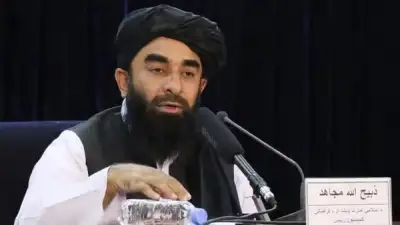
He said such information could create concern among regional countries and fuel tensions between Afghanistan and its neighbours.
The Taliban spokesman added: “The Taliban has repeatedly stressed that no threat to any other country originates from Afghan territory.” He also said Taliban forces had ensured security across Afghanistan and were “aware of all problems” in border areas.
Mujahid’s remarks came after Taalatbek Masadykov, secretary-general of the Collective Security Treaty Organization, expressed concern about the situation along the Afghanistan-Tajikistan border.
Masadykov told Russia’s state-run TASS news agency that the first shipments of weapons and equipment aimed at strengthening the Tajikistan-Afghanistan border would be delivered to Dushanbe this autumn.
Russia is taking the leading role in supplying the equipment.
Masadykov warned that any security incident along the border could have consequences beyond Tajikistan, potentially affecting other CSTO and Commonwealth of Independent States member countries.
According to him, CSTO member states have agreed on a list of lethal and non-lethal equipment needed by Tajikistan.
The equipment will be supplied under an interstate targeted programme designed to strengthen the Tajikistan-Afghanistan border.
Masadykov stressed the need to reinforce the border as quickly as possible, saying any security problem in the area could also affect other CSTO member states.
Security Concerns Along the Border
Masadykov said that during a recent visit to the region at the invitation of Tajik President Emomali Rahmon, he travelled along more than 700 kilometres of Tajikistan’s roughly 1,300-kilometre border with Afghanistan.
He was accompanied by the commander of Tajikistan’s border forces.
According to the CSTO secretary-general, Tajik border guards are working to secure the area but lack sufficient resources.
The CSTO Collective Security Council moved towards approving a five-year programme to strengthen the Tajikistan-Afghanistan border in late 2024. Implementation began last year.
Tajik authorities have said several attacks have been launched from Afghan territory into Tajikistan since November 2025.
Several civilians, including Chinese nationals, and Tajik border guards have been killed or wounded in the attacks.
Tajik officials have also said weapons and drugs were seized from the attackers and that some of the assailants were killed.
Fighting in Badakhshan
In recent months, Afghanistan’s northeastern Badakhshan province has seen an increase in armed clashes.
In recent weeks, Taliban forces and the Afghanistan Freedom Front have clashed several times in Zebak district.
In Yaftal district, fighters from the Sepahiyan-e Mihan Front briefly took control of the district centre. After they withdrew, the Taliban deployed additional forces to the area.
Tensions and clashes have also been reported in Nusay district between Taliban forces and men affiliated with Juma Khan Fateh, a local Taliban commander.
Two Taliban officials have also been assassinated in Badakhshan in less than a month. Islamic State Khorasan Province claimed responsibility for killing the Taliban’s information and culture chief, while the National Resistance Front claimed the killing of the Faizabad mayor.
Alongside armed Taliban opponents, the activities of regional extremist groups in Afghanistan remain another concern for Central Asian countries.
Islamic State Khorasan Province is also active in Afghanistan, and regional states have repeatedly warned about possible threats from armed groups operating from Afghan territory.
However, in his interview with TASS, Masadykov did not directly link the planned arms and equipment deliveries to Tajikistan with the recent fighting in Badakhshan.