• العربية
  • پښتو
  • فارسی
Brand
  • Afghanistan
  • Sport
  • Analysis
  • Markets
  • Afghanistan
  • Sport
  • Analysis
  • Markets
  • Theme
  • Language
    • العربية
    • پښتو
    • فارسی
  • Afghanistan
  • Sport
  • Analysis
  • Markets
All rights reserved for Volant Media UK Limited
volant media logo

Only Three Female Specialist Doctors Remain In Southern Afghanistan

Sep 1, 2026, 15:54 GMT+1

A shortage of medical staff, particularly female specialists, has become a serious problem in southern Afghanistan. Afghanistan International found no female specialists in Helmand, Zabul or Uruzgan, and only three in Kandahar.

Health sources and residents of southern provinces say the number of female specialist doctors has steadily declined during the five years of Taliban rule. They say only three female specialists now remain across the south, all of them in Kandahar.

A health source who asked not to be named told Afghanistan International: “At present, only three female specialist doctors are working in Kandahar, but one of them is absent from the province most of the time.”

The source said the shortage extends beyond female doctors. Other female health workers, including midwives, nurses and specialised staff, have also been pushed out of their jobs because of the Taliban’s restrictive policies.

Bloomberg recently reported that Taliban restrictions on women’s education and employment cost Afghanistan’s economy at least $84 million a year, equivalent to about 0.5 per cent of gross domestic product. Around 3.8 million girls are currently deprived of education in Afghanistan.

A former health official in Kandahar under the previous government, who also requested anonymity, said that although fighting was ongoing in districts at the time and insecurity made travel extremely difficult, most health workers continued working in cities and relatively safer areas.

The source said: “Although there was fighting in the districts and roads were often covered with Taliban mines, most health workers continued working in cities and areas where travel risks were highest. Female specialist doctors were among them, although their exact number was not known.”

Health sources say Taliban restrictions on education, movement and employment, as well as the departure of female specialist doctors from the country, are among the main reasons for the decline in the female health workforce in southern provinces.

Residents say that while the number of female specialist doctors has fallen in cities, the situation in districts and remote areas is even more critical. In many districts, they say, there are neither female specialists nor enough female general practitioners, midwives or other health workers.

UNICEF warned last year that if restrictions on women’s medical education continue, more than 5,000 mothers and children could die. The agency said the bans could lead to the deaths of at least 1,600 mothers and 3,500 infants.

A resident of Chora district in Uruzgan said the absence of female specialist doctors has created serious difficulties. “There are no specialist doctors in Uruzgan, and we are forced to go first to Kandahar and then to Kabul or Herat. When we transfer patients from here, their condition gets worse,” he said.

Zabul is also among the southern provinces facing a severe shortage of female specialists. According to sources, no female specialist doctor had been registered in the province for the past three years, with only a few female general practitioners working there. Residents say female patients are usually transferred to Kandahar for specialist treatment.

Helmand is also struggling with a shortage of female health workers. Residents of Musa Qala district recently protested over the absence of a female general practitioner and threatened to close a health centre. Residents say that in some areas of Helmand there are not only no female specialists, but no female general practitioners either.

A resident of Lashkar Gah, the capital of Helmand, said: “There are no specialist doctors here, and even female general practitioners are scarce. We take patients from one doctor to another without success and eventually have to go elsewhere.”

The international community and the UN mission in Afghanistan have repeatedly urged the Taliban to end what they have described as the “tragedy” of denying education to millions of Afghan girls.

Female Health Workforce Since the Taliban’s Return

Residents of southern provinces and health sources say restrictions imposed on women’s education and employment since the Taliban returned to power in 2021 have directly affected the female health workforce.

After restrictions were imposed on girls’ secondary education, female students were barred from universities, and medical studies and professional health training for women later faced severe restrictions.

Health sources say this has created a serious long-term crisis for the training of female doctors, midwives, nurses and other health workers.

UN reports and UN Women have also repeatedly warned that restricting women’s medical education greatly increases the risk of a future shortage of female health workers in Afghanistan’s healthcare system.

Most Viewed

Taliban Offers United States Access To Afghanistan’s Mineral Wealth
1

Taliban Offers United States Access To Afghanistan’s Mineral Wealth

2

Kabul Wants To Normalise Relations With US, Says Taliban FM

3

More Taliban Commanders Defy Kandahar Leadership In Badakhshan

4

SCO Summit Opens In Bishkek Without Taliban Representation

5

Pakistan Loses Billions Of Dollars As Afghanistan Border Remains Closed

•
•
•

More Stories

Shanghai Cooperation Organisation Again Calls For Inclusive Government In Afghanistan

Sep 1, 2026, 13:21 GMT+1
100%

Leaders of Shanghai Cooperation Organisation member states have called for an inclusive government in Afghanistan involving all ethnic and political groups, saying it is the only path to lasting peace in the country.

Member states expressed their readiness to support international efforts to promote peace, stability and development in Afghanistan.

The SCO summit is being held in Bishkek, the capital of Kyrgyzstan. On Tuesday, 1 September, the organisation called for an independent, neutral Afghanistan free from terrorism and drugs.

The organisation also called for an inclusive government in Afghanistan last year.

The Taliban has repeatedly rejected international calls to establish an inclusive government, describing them as interference in Afghanistan’s internal affairs.

Counterterrorism and Regional Security

In another section of the declaration, SCO members stressed the need to resolutely combat terrorism, separatism and extremism, and said the use of terrorist groups for self-serving purposes was unacceptable.

Member states also rejected double standards in counterterrorism, emphasised the central role of the United Nations and called for measures to prevent the cross-border movement of terrorists.

The declaration called for continued security cooperation, regular joint counterterrorism exercises and stronger collaboration against drug trafficking.

As part of these efforts, regulations governing the SCO’s Centre for Countering Security Challenges and Threats in Tashkent and the Executive Committee of the Anti-Drug Centre in Dushanbe were approved.

Economic Cooperation and SCO Structure

SCO members stressed that the organisation is not a military-political bloc and called for the peaceful resolution of international disputes and conflicts.

Economic cooperation, transit, energy, agriculture and emerging technologies, including artificial intelligence, were also discussed. Members welcomed progress towards establishing the Shanghai Cooperation Organisation Development Bank.

Pakistan also assumed the organisation’s rotating presidency, and the next summit will be held there in 2027.

Afghanistan, particularly threats from terrorism, extremism and drug trafficking, remains a major concern for SCO members. In previous years, member states have also repeatedly called for the establishment of an inclusive political structure in the country.

Afghanistan has held observer status in the Shanghai Cooperation Organisation since 2012, but the Taliban was not represented at the summit in Bishkek.

Taliban’s 11-Year Insurgency ‘Left 40,000 Civilians Dead’

Sep 1, 2026, 09:34 GMT+1
100%

The UN Assistance Mission in Afghanistan has released a report on victims of armed conflict, documenting 40,000 civilian deaths and more than 77,000 injuries between January 2009 and the Taliban’s return to power in August 2021.

UNAMA said the report presents findings from research conducted in 2024 and 2025 by its Human Rights Service to understand the experiences and needs of victims of armed conflict in Afghanistan.

The report focuses mainly on the period from the US-led military intervention in 2001 until the Taliban took control of Afghanistan on 15 August 2021.

It is based on interviews with 195 victims of armed conflict and their relatives, 23 non-governmental organisations working to address victims’ needs, and 23 officials from the Taliban administration.

Decades of War in Afghanistan: Who Were the Main Parties to the Conflict?

UNAMA’s new report, which examines the situation of victims of Afghanistan’s wars over recent decades, provides an overview of the main parties involved in the country’s armed conflicts.

According to the report, Afghanistan experienced several armed conflicts between 2001 and 2021 involving government forces, the Taliban, Islamic State-Khorasan, local armed groups and international forces.

UNAMA says victims were affected by the actions of all sides to the conflict and that their accounts reflect part of the complex reality of a war that overshadowed Afghanistan for more than two decades.

UNAMA did not provide a breakdown of the number of civilians killed or wounded by each party to the conflict. Instead, the report focuses mainly on the accounts, experiences and needs of war victims and attributes responsibility for the incidents examined to various parties, including the Taliban, former government forces, Islamic State and international forces.

In its latest report, UNAMA only stresses that all parties to the conflict in Afghanistan contributed to civilian harm.

UNAMA Reports Before the Taliban Takeover

In UNAMA’s mid-year report published in 2021, the Taliban was identified as the leading cause of civilian casualties.

According to that report, between 1 January and 30 June 2021, 2,044 civilians were killed or wounded in incidents attributed to the Taliban, including 699 deaths and 1,345 injuries.

At the time, UNAMA said the figure accounted for 39 per cent of all civilian casualties recorded during the first six months of 2021.

Two months after the report was published, the Taliban returned to power in August 2021, and the former Afghan government collapsed.

In its 2020 annual report, Protection of Civilians in Armed Conflict in Afghanistan, UNAMA said the Taliban had caused the highest number of civilian casualties among all parties to the war.

According to the report, between 1 January and 31 December 2020, at least 3,960 civilians were killed or wounded in attacks attributed to the Taliban, including 1,470 killed and 2,490 wounded.

Around 45 per cent of all civilian casualties were attributed to anti-government elements.

UNAMA said in its reports that a large proportion of these casualties resulted from roadside bombs, improvised explosive devices, targeted attacks and ground engagements.

UNAMA has not explained why its latest report does not specify the share of casualties attributed to each party. It appears that the UN mission in Afghanistan has overlooked the Taliban’s role in civilian casualties under pressure from the group.

Taliban

UNAMA’s latest report identifies the Taliban as the main armed opposition force to the government between 2001 and 2021.

The report says that after the fall of the Taliban’s first regime in 2001, the group reorganised as an insurgency against the republic and international forces. As foreign troops gradually withdrew, the Taliban expanded its influence, established parallel administrative structures and eventually took effective control of Afghanistan on 15 August 2021.

Former Afghan Government Security Forces

The security forces of the former Islamic Republic of Afghanistan included the Afghan National Army, Air Force, special forces, National Directorate of Security, national police, local police, public order forces and border forces.

With support from Western governments and international forces, they fought the Taliban, Islamic State and other armed groups opposed to the government. These institutions ceased functioning after the republic collapsed and the Taliban entered Kabul on 15 August 2021.

International Forces

The former Afghan government received military support from the United States, NATO and other members of the international coalition.

The military intervention by the United States and its allies began on 7 October 2001. The International Security Assistance Force and later NATO’s Resolute Support Mission were also present in Afghanistan.

These forces operated alongside Afghan government troops against the Taliban and other insurgent groups. Their military presence ended with the withdrawal of foreign forces and the collapse of the republic.

Pro-Government Armed Groups

Alongside official government forces, a number of local armed groups and militias also operated in support of the government.

These included popular uprising forces and other local armed groups that participated in fighting against the Taliban and other anti-government forces.

UNAMA’s report says these groups were not formally part of the state structure but played an active role in the conflict.

Islamic State-Khorasan

Islamic State-Khorasan officially announced its presence in Afghanistan in January 2015.

The group operated mainly in eastern Afghanistan and was blamed for some of the deadliest attacks against civilians, religious sites, public gatherings and educational centres.

According to UNAMA, although the group lost some of its territory, it continued to carry out deadly, high-casualty attacks in Kabul and other areas through 2020 and beyond.

Other Anti-Government Armed Groups

In addition to the Taliban and Islamic State, other armed opposition groups operated in parts of Afghanistan.

These groups fought against the republican government and, in some cases, against each other, forming part of Afghanistan’s non-international armed conflicts.

Civil Wars of the 1990s

UNAMA also notes that some of the victims interviewed had been affected by events during Afghanistan’s civil wars between 1992 and 1996.

During that period, various mujahideen factions fought each other for control of the Afghan government. The Taliban also emerged during this period and later took control of large parts of the country.

Pakistan Loses Billions Of Dollars As Afghanistan Border Remains Closed

Aug 31, 2026, 15:51 GMT+1
100%

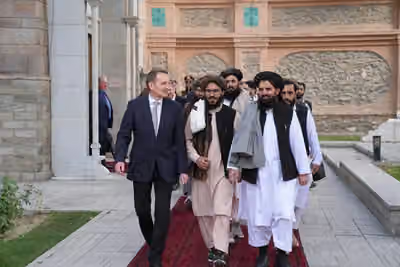
Pakistani media report that the prolonged closure of crossings with Afghanistan has hurt Pakistan’s trade, agriculture, poultry industry and exports, while leaving large numbers of people on both sides of the border without work.

Dawn reported on Monday that the closure of the Torkham and Chaman crossings over the past 10 to 11 months has placed traders under severe financial and psychological pressure.

Pakistan Has Lost Nearly $1 Billion in Exports

Zia-ul-Haq Sarhadi, senior vice-president of the Pakistan-Afghanistan Joint Chamber of Commerce and Industry, said Pakistan used to export goods worth about $1.5 billion annually to Afghanistan.

According to him, Pakistani traders have lost nearly $1 billion from this sector over the past 10 months.

He said Afghanistan had been one of the closest and most important markets for Pakistani products, with Afghan buyers usually paying for their orders before the goods were dispatched.

Pakistan also exported goods worth about $800 million annually to Central Asian countries through Afghanistan. Sarhadi said the closure of the transit route over the past 10 months had cost Pakistani exporters about $225 million.

Pakistan also imported cotton, pulses and other goods from Central Asia through Afghanistan at lower cost. The suspension of this route has increased the cost of importing these products.

Afghanistan Has Also Lost Hundreds of Millions of Dollars

According to Dawn, Afghanistan’s annual exports to India through the Wagah crossing were worth about $300 million.

Sarhadi said the suspension of this route over the past 10 months had cost Afghan exporters nearly $200 million.

He also said the halt in Afghanistan-Pakistan trade had left millions of people directly and indirectly without work, while Pakistan’s treasury had lost billions of rupees in customs and tax revenue.

Stranded Containers Have Cost $1.2 Million a Day

Around 40,000 to 45,000 containers carrying Afghan goods used to pass through Karachi’s ports each year. Transport, insurance, port services, customs clearance and other services cost an average of about $4,000 per container.

Pakistan earned about $160 million annually from this activity. Sarhadi estimated that the suspension of these operations had cost Pakistan about $106 million.

Dawn reported that from October 2025 to April 2026, around 10,000 Afghan transit containers were stranded in Pakistan. A daily detention charge of about $120 was imposed on each container.

By this calculation, Afghan importers paid around $1.2 million in additional charges every day.

Pakistan’s Poultry Industry Faces Oversupply

Pakistan’s Business Recorder also reported that before the border closure, around 20 per cent of Pakistan’s poultry production was exported to Afghanistan. The suspension of these exports has left the domestic market with excess supply.

Imran Khan, an executive member of the Pakistan Poultry Association, said producing one kilogram of chicken costs around 290 rupees, while producers are selling it for about 250 rupees, resulting in a loss of roughly 40 rupees per kilogram.

Industry representatives say Pakistan’s poultry sector is now facing an oversupply of about 20 per cent. They have described the current situation as the worst crisis facing the industry and called for exports to Afghanistan to resume.

Afghan Market Closed to Pakistani Agricultural Products

In a separate report, Dawn said Afghanistan had traditionally been an important market for Pakistani sugar, rice and maize. The border closure has made it more difficult to sell surpluses of these products and increased pressure on Pakistani farmers.

Pakistan’s rice exports fell from $3.35 billion in the 2025 financial year to $2.29 billion in the 2026 financial year. The decline came amid high production costs, difficulties accessing global markets and the closure of the Afghan market.

Pakistan’s sugar industry has also called for permission to export 600,000 tons of surplus sugar. Farmers are concerned that keeping this volume in the domestic market could push down sugarcane prices in the next season.

Maize producers are also facing high inventories and difficulties exporting their products.

Pakistan’s Transit Route Has Lost Ground

Customs figures show that Afghan goods transiting through Pakistan reached 102,886 containers worth $6.7 billion in the 2023 financial year.

The figure fell to 54,114 containers in 2024 and 42,959 in 2025. In the 2026 financial year, only 11,592 containers worth $367 million passed through the route.

Afghan exports to other countries through Pakistan also fell sharply, from $454 million in the 2025 financial year to just $7 million in 2026.

Dawn reported that Afghanistan has meanwhile shifted part of its trade towards Iran and Central Asian countries. Citing World Bank data, the newspaper said direct imports from Iran and goods entering through Iran together accounted for 48.6 per cent of Afghanistan’s total imports.

In an editorial on Monday, Dawn said the Asian Development Bank had approved a $400 million package to modernise regional border crossings but warned that infrastructure upgrades alone would not revive trade without open borders and stable relations.

The newspaper said that while Pakistan is investing in becoming a regional trade corridor, its economic links with surrounding markets remain weak because of the closure of the Afghan border, limited trade with Iran and the suspension of most trade with India.

SCO Summit Opens In Bishkek Without Taliban Representation

Aug 31, 2026, 13:40 GMT+1
100%

The Shanghai Cooperation Organisation summit opened in Bishkek on Monday, 31 August, with Afghanistan-related concerns over security, terrorism and drug trafficking expected to feature. The Taliban was again not invited.

Afghanistan has held formal observer status in the Shanghai Cooperation Organisation since 2012, but the Taliban has not attended any of the organisation’s annual leaders’ summits since returning to power.

The main summit of SCO leaders will take place on Tuesday. On the first day, member states are mainly holding bilateral and multilateral meetings.

Leaders attending include Chinese President Xi Jinping, Russian President Vladimir Putin, Indian Prime Minister Narendra Modi, Iranian President Masoud Pezeshkian and Pakistani Prime Minister Shehbaz Sharif, alongside the leaders of Kazakhstan, Kyrgyzstan, Tajikistan, Uzbekistan and Belarus.

UN Secretary-General António Guterres and Turkish President Recep Tayyip Erdoğan are also attending. Turkiye is not a full SCO member and holds the status of a dialogue partner.

Several bilateral meetings have been scheduled on the sidelines, including talks between Putin and the leaders of China, India, Iran and Turkiye. Economic and trade cooperation, energy, transport and regional connectivity are also expected to be discussed alongside security issues.

At the end of the summit, leaders are expected to adopt the Bishkek Declaration marking the 25th anniversary of the Shanghai Cooperation Organisation and Kyrgyzstan will hand over the organisation’s rotating presidency to Pakistan.

Concerns over the activities of terrorist groups, particularly Islamic State, in Afghanistan have long featured in SCO discussions.

Member states, especially Afghanistan’s neighbours, view the activities of terrorist groups in the country as a threat to regional security, and the issue is expected to be raised as part of the summit’s security discussions.

Afghanistan’s security was also discussed at an SCO foreign ministers’ meeting on 24 July. Pakistani Foreign Minister Ishaq Dar described terrorism originating from Afghanistan as one of his country’s most serious security challenges, while Iranian Foreign Minister Abbas Araghchi called for a stable Afghanistan free of terrorism. The Taliban administration was also not represented at that meeting.

The Shanghai Cooperation Organisation was established in 2001 and now has 10 full members. China and Russia have increasingly used the organisation to promote a multipolar vision of the international system, although the SCO officially says it is not an alliance directed against other countries.

More Taliban Commanders Defy Kandahar Leadership In Badakhshan

Aug 31, 2026, 12:09 GMT+1
100%

Nearly two weeks after Juma Khan Fateh, a Taliban dissident commander, surrendered and one phase of tensions in Badakhshan ended, the province is entering a new period of deeper internal Taliban divisions and defiance of orders from Kandahar.

As Taliban leader Hibatullah Akhundzada appoints a new governor and police chief to contain the unrest, evidence suggests the list of dissatisfied local Taliban figures in Badakhshan is growing.

The Taliban leadership’s “monopolistic” policies, the marginalisation of Tajik and Badakhshani figures, and what critics describe as the unchecked looting of gold mines by outsiders have pushed some younger Taliban commanders in the province to the limit.

Discontent among Badakhshani Taliban members initially emerged through sharp criticism on social media. It later developed into open armed confrontation after Mahfuzullah, the former intelligence chief in Baharak, attacked the intelligence directorate and Juma Khan Fateh subsequently clashed with Taliban forces in Nusay district in August.

Recent investigations by Afghanistan International, along with interviews with several dissenting commanders in Jurm and Warduj districts, regarded as major strongholds of Badakhshani Taliban members, reveal new dimensions of the crisis.

On 25 August, Hibatullah appointed Rahmatullah Najib as governor of Badakhshan and Ahmad Shah Dindost as the provincial police chief.

Critics say the appointment of Pashtun officials and figures close to Hibatullah to key posts in Badakhshan has further marginalised local Taliban members. Sources say even the latest provincial reshuffle has failed to ease tensions because the most important positions remain in the hands of figures trusted by Kandahar, while local Taliban members are given largely symbolic roles.

Dissenting commanders say the deliberate exclusion of Tajik figures and the allocation of Badakhshan’s gold reserves to companies from Kandahar and Helmand have not only pushed them away from the governing structure but also seriously weakened their standing among local communities.

One of the first figures to openly oppose the Taliban’s Pashtun governor around three years ago was Salahuddin Salar, deputy head of intelligence at the Taliban Defence Ministry.

Over time, the protests widened. Juma Khan Fateh eventually entered armed clashes with Taliban forces and killed several fighters from Kandahar and Helmand. He later surrendered to Qari Fasihuddin and is now in Kabul awaiting trial before a military court. The outcome of the case could influence the direction of the wider unrest.

The Taliban has launched an extensive campaign to gather complaints and evidence against Fateh, apparently seeking to build a serious case against the dissident commander.

Salahuddin Salar

Salahuddin Salar, a resident of the Khastak area of Jurm district, has repeatedly criticised Taliban leadership policies on Facebook and has even described pledging allegiance to an “unseen emir” as a mistake.

Sources say his close relationship with Qari Fasihuddin has so far protected him from direct prosecution. However, Salar’s continued criticism and the Taliban’s silence have led some local Taliban members to speculate that he may have connections with the group’s intelligence apparatus and leadership.

Sayad Khastaki

Sayad Khastaki, a Taliban police recruitment commander in Badakhshan, is another figure who has criticised the group’s policies.

Following the clashes involving Juma Khan Fateh, he wrote: “The blood of our mujahideen had one value before the victory, but now they kill us and brand us as rebels.”

Khastaki was arrested several months ago by the Taliban police chief and removed from his post. Sources say, however, that he later returned to work and resumed his duties despite orders from Badakhshan police officials.

Qari Mahfuz

Qari Mahfuz, the former intelligence chief of Baharak district and a figure close to Helmand Governor Amanuddin Mansoor, became involved in a verbal dispute with Pashtun Taliban members in Faizabad.

On 1 August, he attacked the Taliban intelligence directorate with a PK machine gun before fleeing the area. Sources say he has since been dismissed from his position.

Mahfuzullah Qutiba

Mahfuzullah Qutiba, a resident of Jurm district, has also expressed dissatisfaction with Taliban leadership policies, particularly those concerning Badakhshan, and has occasionally voiced his criticism on Facebook.

After Abdul Matin Rahimzai, the Pashtun head of Badakhshan’s mines department and an ally of the Taliban leader, was dismissed, Qutiba posted a photograph of him and wrote that some people come to Badakhshan claiming they want to serve and develop the province, but instead “play the role of thieves and then flee”.

Discontent within the ranks of the Badakhshani Taliban is not limited to a handful of figures. The protests are gradually spreading to a broader group of local commanders.

Figures including Dr Ibrahim Baharaki and Jahan Khan Noori, the Taliban police chief of Yaftal district, have also repeatedly voiced objections to the central leadership’s policies at public gatherings.

Their main grievances include the exclusion of Badakhshani Taliban members from decision-making in the province, the large presence of non-local forces, and the extraction and alleged looting of Badakhshan’s gold reserves by companies from Kandahar and Helmand, a process they believe is transferring the province’s wealth outside Badakhshan.

Available findings suggest that many of the commanders now at the forefront of opposition to Kandahar’s policies are close to, or under the influence of, Qari Fasihuddin, the Taliban army chief of staff, and Mawlawi Amanuddin, the governor of Helmand.