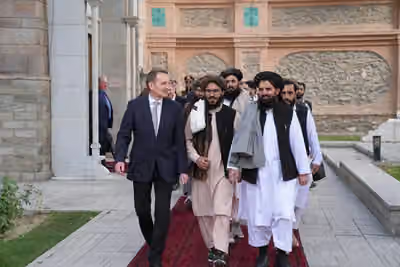
UNAMA said the report presents findings from research conducted in 2024 and 2025 by its Human Rights Service to understand the experiences and needs of victims of armed conflict in Afghanistan.
The report focuses mainly on the period from the US-led military intervention in 2001 until the Taliban took control of Afghanistan on 15 August 2021.
It is based on interviews with 195 victims of armed conflict and their relatives, 23 non-governmental organisations working to address victims’ needs, and 23 officials from the Taliban administration.
Decades of War in Afghanistan: Who Were the Main Parties to the Conflict?
UNAMA’s new report, which examines the situation of victims of Afghanistan’s wars over recent decades, provides an overview of the main parties involved in the country’s armed conflicts.
According to the report, Afghanistan experienced several armed conflicts between 2001 and 2021 involving government forces, the Taliban, Islamic State-Khorasan, local armed groups and international forces.
UNAMA says victims were affected by the actions of all sides to the conflict and that their accounts reflect part of the complex reality of a war that overshadowed Afghanistan for more than two decades.
UNAMA did not provide a breakdown of the number of civilians killed or wounded by each party to the conflict. Instead, the report focuses mainly on the accounts, experiences and needs of war victims and attributes responsibility for the incidents examined to various parties, including the Taliban, former government forces, Islamic State and international forces.
In its latest report, UNAMA only stresses that all parties to the conflict in Afghanistan contributed to civilian harm.
UNAMA Reports Before the Taliban Takeover
In UNAMA’s mid-year report published in 2021, the Taliban was identified as the leading cause of civilian casualties.
According to that report, between 1 January and 30 June 2021, 2,044 civilians were killed or wounded in incidents attributed to the Taliban, including 699 deaths and 1,345 injuries.
At the time, UNAMA said the figure accounted for 39 per cent of all civilian casualties recorded during the first six months of 2021.
Two months after the report was published, the Taliban returned to power in August 2021, and the former Afghan government collapsed.
In its 2020 annual report, Protection of Civilians in Armed Conflict in Afghanistan, UNAMA said the Taliban had caused the highest number of civilian casualties among all parties to the war.
According to the report, between 1 January and 31 December 2020, at least 3,960 civilians were killed or wounded in attacks attributed to the Taliban, including 1,470 killed and 2,490 wounded.
Around 45 per cent of all civilian casualties were attributed to anti-government elements.
UNAMA said in its reports that a large proportion of these casualties resulted from roadside bombs, improvised explosive devices, targeted attacks and ground engagements.
UNAMA has not explained why its latest report does not specify the share of casualties attributed to each party. It appears that the UN mission in Afghanistan has overlooked the Taliban’s role in civilian casualties under pressure from the group.
Taliban
UNAMA’s latest report identifies the Taliban as the main armed opposition force to the government between 2001 and 2021.
The report says that after the fall of the Taliban’s first regime in 2001, the group reorganised as an insurgency against the republic and international forces. As foreign troops gradually withdrew, the Taliban expanded its influence, established parallel administrative structures and eventually took effective control of Afghanistan on 15 August 2021.
Former Afghan Government Security Forces
The security forces of the former Islamic Republic of Afghanistan included the Afghan National Army, Air Force, special forces, National Directorate of Security, national police, local police, public order forces and border forces.
With support from Western governments and international forces, they fought the Taliban, Islamic State and other armed groups opposed to the government. These institutions ceased functioning after the republic collapsed and the Taliban entered Kabul on 15 August 2021.
International Forces
The former Afghan government received military support from the United States, NATO and other members of the international coalition.
The military intervention by the United States and its allies began on 7 October 2001. The International Security Assistance Force and later NATO’s Resolute Support Mission were also present in Afghanistan.
These forces operated alongside Afghan government troops against the Taliban and other insurgent groups. Their military presence ended with the withdrawal of foreign forces and the collapse of the republic.
Pro-Government Armed Groups
Alongside official government forces, a number of local armed groups and militias also operated in support of the government.
These included popular uprising forces and other local armed groups that participated in fighting against the Taliban and other anti-government forces.
UNAMA’s report says these groups were not formally part of the state structure but played an active role in the conflict.
Islamic State-Khorasan
Islamic State-Khorasan officially announced its presence in Afghanistan in January 2015.
The group operated mainly in eastern Afghanistan and was blamed for some of the deadliest attacks against civilians, religious sites, public gatherings and educational centres.
According to UNAMA, although the group lost some of its territory, it continued to carry out deadly, high-casualty attacks in Kabul and other areas through 2020 and beyond.
Other Anti-Government Armed Groups
In addition to the Taliban and Islamic State, other armed opposition groups operated in parts of Afghanistan.
These groups fought against the republican government and, in some cases, against each other, forming part of Afghanistan’s non-international armed conflicts.
Civil Wars of the 1990s
UNAMA also notes that some of the victims interviewed had been affected by events during Afghanistan’s civil wars between 1992 and 1996.
During that period, various mujahideen factions fought each other for control of the Afghan government. The Taliban also emerged during this period and later took control of large parts of the country.