• العربية
  • پښتو
  • فارسی
Brand
  • Afghanistan
  • Sport
  • Analysis
  • Markets
  • Afghanistan
  • Sport
  • Analysis
  • Markets
  • Theme
  • Language
    • العربية
    • پښتو
    • فارسی
  • Afghanistan
  • Sport
  • Analysis
  • Markets
All rights reserved for Volant Media UK Limited
volant media logo

Taliban Holds Security Meeting To Assess Situation Across Afghanistan

Sep 3, 2026, 09:46 GMT+1

The Taliban’s Security and Clearance Affairs Commission says it held a meeting chaired by Defence Minister Mullah Yaqoob Mujahid to assess Afghanistan’s security situation, which the group described as reassuring.

In a statement issued on Wednesday, 2 September, the commission said reports from provincial security and clearance commissions across Afghanistan were also reviewed, and the overall security situation was considered satisfactory and reassuring.

The meeting also stressed coordination between the Taliban’s security and civilian institutions to improve operations and the delivery of services.

The Taliban’s Security and Clearance Affairs Commission is responsible for assessing the security situation and reviewing the performance of the group’s forces in different provinces.

Despite Taliban claims that nationwide security has been established, international reports and figures indicate that security threats, particularly the activities of opposition groups and terrorist attacks, remain serious challenges in Afghanistan.

Taliban spokesperson Zabihullah Mujahid said at a press conference on Wednesday that the group’s Defence Ministry had carried out 602 independent and joint operations with the Interior Ministry and intelligence agency this year. He claimed the operations had disrupted complex enemy plots and dismantled opposition hideouts and networks.

Mujahid did not provide details about the groups involved, where the operations took place or the nature of the security threats. However, armed groups opposing the Taliban have expanded their attacks across Afghanistan in recent months.

The Afghanistan United Front previously said it had carried out at least 43 operations against the Taliban in 14 provinces over the past month. The group claimed that 74 Taliban members were killed and 35 others wounded.

The Afghanistan Freedom Front has also said it expanded its armed operations against the Taliban to eight provinces during the previous Afghan month and carried out at least 21 guerrilla and front-line operations. It claimed that at least 65 Taliban members were killed and around 90 others wounded.

Most Viewed

Afghan Soil Should Not Be Used Against Pakistan, Says Taliban Ambassador
1

Afghan Soil Should Not Be Used Against Pakistan, Says Taliban Ambassador

2

Taliban Defends Nationwide Protest Ban, Citing Islamic Law

3

Afghanistan’s ‘$1 Trillion’ Mineral Wealth: Who Controls It?

4

SCO Decisions Have Little Value Without Its Participation, Says Taliban

5

Regional Peace Is Impossible While Terrorists Use Afghan Soil, Says Pakistan PM

•
•
•

More Stories

China’s Mediation Cannot Succeed Without Taliban Policy Change, Says Pakistan

Sep 3, 2026, 08:58 GMT+1
100%

Pakistan’s Foreign Ministry spokesman says Islamabad welcomes China’s role in Afghanistan and its efforts to ease tensions but says Beijing’s mediation will not succeed unless the Taliban changes its relationship with Pakistani insurgent groups.

Tahir Andrabi said Islamabad had so far received no new guarantees or actions from the Taliban showing that Afghan territory would not be used against Pakistan.

Speaking at his weekly press conference, he said any improvement in relations between Pakistan and Afghanistan would depend on actions and assurances from the Taliban.

Referring to a visit to Islamabad by China’s special envoy for Afghanistan, Yue Xiaoyong, Andrabi said he held talks with Pakistan’s special representative for Afghanistan, Mohammad Sadiq, on 31 August and 1 September.

Following border clashes between Pakistan and the Taliban, peace talks between representatives of the two sides were held in Urumqi, China, from 1 to 7 April. Like previous rounds in Doha, Istanbul and Riyadh, however, they ended without a tangible outcome.

Commenting on China’s efforts to revive the Urumqi process, Andrabi said Pakistan had always supported constructive dialogue on Afghanistan and maintained a positive approach. However, he said progress depended on specific and verifiable action by the Taliban government against Tehreek-e-Taliban Pakistan, the Balochistan Liberation Army and other terrorist groups operating from Afghan territory against Pakistan.

Asked about recent Taliban statements on dialogue with Pakistan, Andrabi said Islamabad had seen no new development or fresh guarantee from the Taliban administration since the previous week’s press conference.

He also addressed the Taliban ambassador’s appearance at Pakistan’s National Defence University, saying diplomats regularly attend academic and educational institutions and that the visit should not be interpreted as a sign of any change in political relations between Islamabad and Kabul.

Andrabi said such visits took place within academic and educational frameworks and that no new decision had been made to expand relations with the Taliban government.

The Pakistani Foreign Ministry spokesman again accused the Taliban of enabling anti-Pakistan armed groups to operate. He said Islamabad had evidence showing that Afghanistan-based elements, including Taliban officials, were supporting armed groups active in Pakistan.

He also accused India of supporting these groups, saying Pakistan possessed specific evidence to support the allegation.

Andrabi added that Pakistan’s prime minister and foreign minister had also raised security threats and what Islamabad describes as the external dimensions of terrorism at recent Shanghai Cooperation Organisation meetings.

Pakistan has repeatedly accused the Taliban in recent years of sheltering members of Tehreek-e-Taliban Pakistan and other armed groups. The Taliban rejects the allegations and says it does not allow Afghan territory to be used against other countries.

The latest remarks by Pakistan’s Foreign Ministry spokesman indicate that despite continuing diplomatic contacts and China’s efforts to facilitate dialogue, Islamabad still considers concrete Taliban action against anti-Pakistan armed groups the main condition for improving relations with Kabul.

Taliban Defends Nationwide Protest Ban, Citing Islamic Law

Sep 2, 2026, 12:51 GMT+1
100%

Taliban spokesperson Zabihullah Mujahid says demonstrations belong to democratic systems and have no place in Islamic law. A recently approved Taliban police law bans all demonstrations across Afghanistan.

Speaking at a press conference on Wednesday, Mujahid said demonstrations were associated with societies governed by separate laws and democratic systems. He added that in an Islamic system, grievances should instead be addressed by referring them to the relevant authorities.

The Taliban spokesperson described demonstrations as a waste of time that cause property damage, disorder and lawlessness. Referring to the police law, he said it had been drafted in accordance with Islamic Sharia.

The Taliban Justice Ministry recently published the Shurta Law. Article 50 states: “All demonstrations throughout Afghanistan are prohibited.”

Expanding International Relations

Although no country other than Russia has formally recognised the Taliban administration, Mujahid said the group had made progress in its diplomatic relations with other countries.

He said senior Taliban officials and representatives of various institutions had made numerous trips abroad over the past year in an effort to expand political and economic relations.

Mujahid announced the establishment of diplomatic and consular relations with Kuwait and said three Taliban political and consular missions abroad had become operational. These included Taliban embassies in Kuwait and Berlin and the group’s consulate general in Bonn, Germany.

He added that agreements had been reached over the ambassadors of Qatar, the United Arab Emirates, Kazakhstan and Pakistan to Afghanistan, while non-resident ambassadors from Belarus, Niger and Ghana had also been accepted.

Mujahid also said the Taliban’s diplomatic relations with Pakistan had improved. He added that a new Taliban mission had been established and begun operating in the Iranian city of Mashhad.

Release of Afghan Prisoners

Mujahid said 1,020 Afghan prisoners had been transferred from Iran to Afghanistan, along with around 120 others from Uzbekistan and the United Arab Emirates.

Speaking during a press conference on the Taliban administration’s achievements, Mujahid said more than 15,000 people were being held in the group’s prisons across Kabul and the provinces.

He said some prisoners had been released in certain cases, while the sentences of others had been reduced. He did not provide specific figures.

Afghanistan’s ‘$1 Trillion’ Mineral Wealth: Who Controls It?

Sep 2, 2026, 09:49 GMT+1
100%

Afghanistan holds some of the region’s largest mineral reserves, including copper, iron, gold, lapis lazuli, emeralds, chromite and other precious stones.

Five years after the Taliban returned to power, these resources have moved closer to the centre of the group’s economic strategy. The Taliban has signed new mining contracts, held biddings and sought foreign investment, particularly from Chinese companies.

But the expansion of mining has raised a more important question: who controls this wealth, and where does the revenue ultimately go?

An estimate put forward by some US officials around a decade ago placed the potential value of Afghanistan’s mineral reserves at nearly $1 trillion.

In the latest development, Taliban Foreign Minister Amir Khan Muttaqi told the Financial Times in an interview on 31 August that Afghanistan would welcome US investment in mining, infrastructure, agriculture and trade. He did not say whether the proposal had been made directly to the White House.

At the same time, the Taliban’s efforts to attract foreign investment have raised questions over the transparency of contracts, the true ownership of companies, the government’s share, benefits for local communities and competition among powerful networks.

Who Controls Afghanistan’s Mines?

Control over Afghanistan’s mines is divided among the Taliban leadership, the Ministry of Mines, private companies, local miners, traders and influential networks. In recent years, however, the Taliban leadership has sought to concentrate greater control over licences, contracts and revenues from strategic resources, particularly gold, around Kandahar.

Hibatullah Akhundzada issued a decree on gold extraction in May 2026 that placed the allocation and supervision of state-owned land containing gold deposits under a centralised government framework.

However, administrative control from Kandahar does not necessarily mean complete and uncontested control at mining sites, where companies, miners, traders and influential local commanders continue to play a role.

In Badakhshan, this competition has become more visible. The growing presence of forces linked to Kandahar and efforts to restrict the influence of Tajik commanders suggest the dispute is not only about extraction, but also about who controls the mines and where the revenue goes.

In major projects, the Taliban administration controls licences and contractual frameworks, while companies provide capital and equipment. In smaller mines, local networks and traders often have greater influence.

Control over Afghanistan’s mines is therefore not uniform, but the broader trend is towards greater concentration of authority and revenue within the Taliban’s central structure.

Ultimately, the main question is not who owns a mine on paper, but who grants the licence, who appoints mining officials, who carries out extraction, who receives the money and how much reaches local communities.

Discontent From Panjshir to Badakhshan

Hibatullah Akhundzada’s tightening control over mining has fuelled growing anger and dissatisfaction among local workers, particularly in north-eastern Afghanistan.

Local workers who say the Mines Ministry, acting on orders from the Taliban leadership, has prevented them from panning for gold accuse the Taliban of extracting national wealth in an opaque manner driven by ethnic considerations, while leaving local communities without a meaningful share of mining revenues.

A lapis lazuli trader in Badakhshan told Afghanistan International on Tuesday: “The Taliban has focused on extracting underground wealth in Tajik-populated areas such as Badakhshan, Takhar and Panjshir, Hazara areas such as Bamyan and Daikundi, and Uzbek-populated areas such as Sar-e Pul.”

He said authority over the appointment of mining officials, the issuing of decrees, work permits and trade licences was nevertheless controlled from Kandahar, hundreds of kilometres away.

Some of Afghanistan’s most important mineral reserves now targeted by the Taliban are located in areas that were either controlled by anti-Taliban forces or remained outside the group’s full control during the 1990s.

In Panjshir, emerald mines were for years part of the local economy and, during the civil war, one of the sources of income for anti-Taliban leader, late Ahmad Shah Massoud’s forces. Today, the Taliban administration sells emeralds through auctions in Panjshir province.

Over the past year, Taliban officials said 23 rounds of auctions had been held in Panjshir, with more than 111,000 carats of emeralds sold for about $4.2 million. Local officials also said more than 32 million afghanis from those sales had been transferred to the Taliban government treasury.

Badakhshan provides another example. The Kuran wa Munjan area, whose lapis lazuli mines were under the influence of anti-Taliban forces during the 1990s, is now under Taliban control.

Today, however, Badakhshan’s importance is increasingly tied to gold.

Taliban officials say gold extraction has expanded across several districts of the province, and that more than 100,000 people are directly or indirectly employed in the sector. Local officials have also said that 112 kilograms of gold were handed over to the government during the past year from this region.

Concentrating Control in Kandahar

As extraction expands, there are growing signs that the Taliban leadership is seeking tighter central control over the mining sector.

Taliban leader Hibatullah Akhundzada’s decree on gold extraction places state-owned land containing gold deposits under specific regulations and assigns the Mines Ministry to allocate and supervise those areas.

The decree also sets out the Taliban government’s share of extracted gold and requirements for restoring land after conducting the mining operations.

In Badakhshan, Taliban officials have also announced the deployment of around 1,000 personnel to protect gold-mining activities.

These measures are being implemented in a region where Taliban officials from central government and local commanders have experienced disputes and armed clashes over control of resources and power in recent years.

Administrative appointments, including the heads of provincial mining departments, are made directly by Taliban leader Hibatullah Akhundzada.

Badakhshani Taliban commanders accuse the group’s leadership of pursuing a coordinated effort to remove local commanders and workers and transfer mining revenues entirely to Kandahar.

Akhundzada governs Afghanistan through a small inner circle. Based in Kandahar, this circle has steadily centralised national revenues and has even pushed officials linked to the Haqqani Network out of customs and border government positions, which are among the government’s largest sources of revenue.

In June 2026, the Kandahar leadership under Akhundzada began restricting the influence of Tajik Taliban figures in Badakhshan and deployed nearly 1,000 special forces personnel to take direct control of gold mines away from local commanders.

Some sources say the Haqqani Network, led by Sirajuddin Haqqani and rooted in Loya Paktia, particularly Khost, Paktika and Paktia, was the first Taliban faction to move after entering Kabul in August 2021, taking control of customs, border posts and the passport department.

According to the sources, the network still controls chromite mine revenues, which analysts say could become an important source of leverage in a potential future power struggle inside the group.

Who Benefits From the Mining Operations?

One of the most difficult questions concerns the true ownership of companies awarded mining contracts.

The Taliban says contracts are awarded through formal procedures and biddings and that revenues are transferred to the government treasury. However, public information about the ultimate ownership of some companies, the full terms of contracts and the actual shares held by the government and investors remains limited.

In some cases, including the Samti gold mine in Takhar, reports have linked operating companies to individuals close to the Taliban.

One name raised in this context is Haji Bashar Noorzai, a figure close to Hibatullah Akhundzada. The Afghanistan-China company, in which Noorzai reportedly holds shares alongside Chinese partners, is extracting gold at the Samti mine in Takhar. However, sufficient transparency about the contract and its bidding process is not available.

Competition Over Resources

Afghanistan’s mines are not merely an economic issue.

In provinces such as Badakhshan, Takhar and Panjshir, natural resources are closely intertwined with local power structures, cross-border trade and rural economies.

Rising resource values can generate more revenue for the government, but they can also intensify competition among local miners, private companies and powerful political networks.

This is particularly significant in Badakhshan. The province possesses valuable gold and lapis lazuli reserves while also experiencing political and security tensions in recent years.

The Cost of Development

The Taliban presents mining as a means of increasing government revenue and creating jobs.

But higher mineral production alone does not necessarily translate into economic development.

In many of Afghanistan’s mining areas, shortages of roads, electricity, capital, technology and processing industries mean that much of the economic value is created only after raw materials leave the area.

This is particularly important for precious stones and gold. If raw materials are extracted locally but processed, traded and converted into higher-value products elsewhere, local communities may receive only a small share of the wealth generated.

Expert: Taliban Leaves Behind ‘Scorched Earth’

Environmental damage is another concern. Experts and local residents in different parts of Afghanistan have warned that unregulated mining can damage land, water resources and local infrastructure.

Sajad Ahmad Hamidi, a professor at Slippery Rock University in Pennsylvania, told Afghanistan International that the Taliban has placed heavy emphasis on mining and that minerals are among the group’s main sources of revenue.

The environmental specialist said his greatest concern was that mining was being carried out in an unsustainable manner that damages the environment.

He said pollutants, including heavy metals and toxic substances produced during mining operations, can enter local soil and water, while the failure to rehabilitate sites after extraction can leave behind “scorched earth”.

Discontent Among Tajik and Hazara Taliban Commanders

Over the past five years, Taliban leader's tight control over mining revenues has also resulted in dissatisfaction among some local commanders.

Hamidi said he believed mining disputes played a role in former Hazara Taliban commander Mawlawi Mahdi’s rebellion in Balkhab district in northern Afghanistan.

Balkhab’s most important mineral resource is copper. The Balkhab copper belt lies in south-eastern Sar-e Pul and extends partly into Balkh and Samangan provinces.

Coal is the district’s second major mineral resource. The Taliban Mines Ministry has also officially referred to coal mines in Balkhab and said extraction takes place in areas such as Gowakh and Gulwarz areas.

Mawlawi Mehdi, the Taliban’s only prominent Hazara military commander, rebelled against the group’s leadership in mid 2022 and was later killed by Taliban forces.

But Mehdi was not the last commander to become dissatisfied with the concentration of power under Taliban leader Hibatullah Akhundzada.

Juma Khan Fateh, a Taliban commander from Badakhshan, fought Taliban forces for a week in Nusay district of Badakhshan in August 2026 before eventually surrendering to the group.

The deployment of a 1,000-strong force to stop what the Taliban described as Fateh’s “illegal” mining activities in Nusay was among the main triggers of the clashes.

A ‘Resource Curse’?

Afghanistan’s experience raises a broader question: can natural resources become a source of corruption, inequality and political competition instead of a driver of development?

In political economy, this is often described as the “resource curse”.

For Afghanistan, however, it may still be too early to draw a definitive conclusion.

Economist Najibullah Roman says poverty, unemployment, a lack of roads and electricity, the absence of processing industries, weak oversight, illegal extraction and competition over mines have prevented local communities in Badakhshan province from receiving a significant share of this wealth.

Roman says mining activities in some areas have also created problems for the environment, homes and public services.

He describes the situation through the concept of the “resource curse”, a condition in which a region possesses abundant natural resources but, because of weak management and a lack of transparency, those resources can fuel corruption, inequality, smuggling and conflict rather than prosperity.

The economist said the core issue is who benefits from the resources and how, and for whom, the resulting revenues are spent.

The Taliban has increased mining revenues and expanded extraction compared with the years of war. China has also shown interest in investing in Afghanistan’s mining sector.

The central question now is whether these revenues can be turned into infrastructure, jobs and public services.

The answer will depend largely on three factors: transparency in contracts, oversight of revenues and the share received by local communities.

Afghanistan may possess some of the largest untapped mineral reserves in the region. But the true value of that wealth will not be determined by estimates of what lies underground, but by who extracts it, who benefits from it and how much reaches the people living alongside the mining sites.

Regional Peace Is Impossible While Terrorists Use Afghan Soil, Says Pakistan PM

Sep 2, 2026, 08:42 GMT+1
100%

Pakistani Prime Minister Shehbaz Sharif told the Shanghai Cooperation Organisation summit in Bishkek on Tuesday that lasting regional peace would remain impossible while terrorist groups use Afghan territory to attack Pakistan and other neighbours.

Referring to Pakistan’s record in combating terrorism, Sharif said the country had suffered more than 90,000 casualties and economic losses exceeding $150 billion over the past two and a half decades.

He said Pakistan, as chair of the SCO’s Regional Anti-Terrorist Structure, had worked to strengthen security cooperation among member states.

The Pakistani prime minister said Islamabad wanted a peaceful, stable and prosperous Afghanistan, but lasting peace in the region would remain out of reach as long as armed groups used Afghan territory to attack Pakistan and neighbouring countries.

The Taliban has repeatedly rejected the allegation, saying it does not allow Afghan territory to be used against other countries. Islamabad, however, says the Taliban must take tangible and verifiable action against armed groups before tensions can ease and dialogue can resume.

Concerns about armed groups operating in Afghanistan are not limited to Pakistan. Tajikistan has also repeatedly warned of security threats emanating from Afghanistan and the possibility of instability spreading into Central Asia. Recent attacks and clashes along the two countries’ border have heightened those concerns.

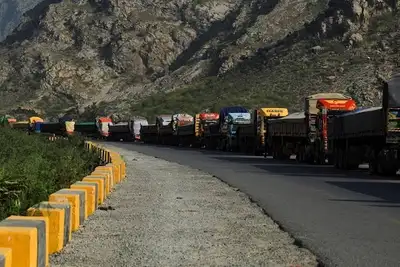
Disputes between Pakistan and the Taliban over the presence and activities of armed groups have sharply strained relations in recent months, affecting trade and the operation of border crossings.

Meanwhile, SCO leaders stressed in the final declaration of the Bishkek summit the need for an inclusive government with broad participation by representatives of Afghanistan’s ethnic and political groups. The Taliban has previously said its government is inclusive and includes all ethnic groups.

In another part of his speech, Sharif called for greater regional connectivity, saying the China-Pakistan Economic Corridor could link regional economies to the Arabian Sea.

He also reaffirmed Islamabad’s support for railway projects, road connectivity and regional energy initiatives, and called for the full implementation of the SCO Development Strategy through 2035.

Sharif said the establishment of an SCO Development Bank would be an important step towards that goal. He added that during Pakistan’s presidency, Islamabad would also prioritise cooperation in information technology and artificial intelligence, energy, poverty reduction, disaster management, health, culture and sport.

Pakistan has assumed the SCO’s rotating presidency for 2026–27, with the organisation’s next summit scheduled to be held in Islamabad in 2027.

Sharif expressed hope that the SCO would become an organisation that prioritises cooperation over confrontation and dialogue over division.

Pakistan assumes the organisation’s presidency as Afghanistan’s security situation and the activities of armed groups in the country remain major regional security concerns.

Afghan Soil Should Not Be Used Against Pakistan, Says Taliban Ambassador

Sep 1, 2026, 16:36 GMT+1
100%

The Taliban’s ambassador in Islamabad says the group understands Pakistan’s concerns about potential threats from Afghan soil and does not want Afghanistan used against Pakistan but said such concerns should not justify military action inside Afghanistan.

Sardar Ahmad Shakib stressed that security allegations should be specific and precise and based on concrete information, identifiable individuals, clearly defined networks and particular cases. He said both the Pakistani government and the Taliban administration pursue their own national interests.

He said that if the Taliban is expected to cooperate over specific Pakistani security concerns, it also wants direct dialogue and engagement with Pakistan over its own security concerns.

Shakib said Afghanistan and Pakistan should move beyond outdated assumptions about each other and engage on the basis of present-day realities.

He said decades of war and political upheaval had created conditions in which the security issues of the two countries had become deeply interconnected.

Speaking on Tuesday, 1 September, at Pakistan’s National Defence University, the Taliban ambassador said the political, security and economic affairs of the two countries affect one another.

Shakib said this was a geographical and strategic reality that neither country could change.

Referring to the interconnected nature of the relationship, he said Afghanistan and Pakistan could either allow their interdependence to become a source of tension or use it to promote stability, security and shared economic benefits.

He said being neighbours did not mean one country had to approve all of the other’s strategic choices. Instead, both countries should be able to make independent decisions while taking each other’s security and national concerns into account.

Shakib added that an independent country could maintain relations with several states, including countries that do not have good relations with one another, without ties with one being interpreted as hostility towards another.

The Taliban’s growing ties with India have caused concern in Islamabad. Pakistan’s Foreign Ministry spokesman recently said the Taliban was acting as an Indian proxy.

Criticism of ‘Political Pressure’ and Trade Route Closures

The Taliban ambassador said the administration would not accept the logic of external pressure over its sovereignty and internal affairs, adding that diplomatic engagement should replace military action.

Shakib said collective punishment of Afghan citizens should not be used as a means of addressing security problems, nor should trade and transit be used as tools of political pressure.