• العربية
  • پښتو
  • فارسی
Brand
  • Afghanistan
  • Sport
  • Analysis
  • Markets
  • Afghanistan
  • Sport
  • Analysis
  • Markets
  • Theme
  • Language
    • العربية
    • پښتو
    • فارسی
  • Afghanistan
  • Sport
  • Analysis
  • Markets
All rights reserved for Volant Media UK Limited
volant media logo

Millions In Afghanistan Lack Safe Drinking Water, Says UN

Sep 14, 2026, 12:05 GMT+1

The UN Human Settlements Programme says millions of people in Afghanistan still lack access to safe and reliable drinking water, despite water being essential to life, and has called for stronger efforts to ensure universal access.

UN-Habitat wrote on X on Sunday, 13 September, that Afghanistan urgently needs smarter urban planning, better water-resource management and improved waste management to protect water supplies, improve sanitation and build healthier communities.

Afghanistan has faced one of its most severe drought and climate-related crises in decades in recent years.

According to previous reports by UN humanitarian agencies, declining rainfall, a sharp fall in groundwater levels and the lack of adequate urban infrastructure have left millions of families in cities and rural areas facing serious water shortages.

In addition to drought, poor management of waste and urban sewage has contaminated limited groundwater resources, particularly in major cities such as Kabul.

International organisations have previously warned that the use of contaminated and unsafe water has significantly increased the spread of infectious diseases, including cholera, as well as gastrointestinal illnesses among children and vulnerable families.

Most Viewed

Taliban Denies Al-Qaeda Presence In Afghanistan
1

Taliban Denies Al-Qaeda Presence In Afghanistan

2

Former Senior Taliban Official ‘Detained’ In Kandahar, Say Sources

3

Muslim & Western Countries Want Girls’ Schools Reopened, Says Taliban FM

4

Millions In Afghanistan Lack Safe Drinking Water, Says UN

•
•
•

More Stories

Former Senior Taliban Official ‘Detained’ In Kandahar, Say Sources

Sep 14, 2026, 10:26 GMT+1
100%

Informed sources told Afghanistan International on Sunday evening that Taliban Interior Ministry and intelligence forces had detained Mutasim Agha Jan, a former senior member of the group, after surrounding his religious school in Kandahar city.

According to the sources, Agha Jan was taken to Kandahar police headquarters following his arrest.

Sources said the school was surrounded after several people described as guests entered the premises. Their identities remain unclear, and it is not known whether they were Afghan citizens or foreign nationals.

Mutasim Agha Jan is a well-known former senior Taliban figure whose relations with the group’s leadership have been strained for years. After the Taliban returned to power, he came back to Afghanistan from Istanbul with the guarantee of Taliban defense minister, Yaqoob Mujahid.

This is not the first time the Taliban has detained Agha Jan. In 2022, Taliban intelligence forces raided his home in Kabul and confiscated some of his personal property.

The Taliban also detained Mutasim Agha Jan on 16 April this year before later releasing him.

The Taliban has not yet commented on the reason for the latest detention of its former senior member.

Who is Mutasim Agha Jan?

Mutasim Agha Jan was a long-standing and influential Taliban figure. During the Taliban’s first period in power, from 1996 to 2001, he served as the group’s finance minister and was considered close to its former leader, Mullah Mohammad Omar.

His name was added to the United Nations sanctions list in 2001.

After the fall of the Taliban government, Agha Jan remained within the group’s leadership structure and for a period headed the Taliban’s political committee.

Reports indicate that he remained an important political figure within the Taliban until around 2009, but gradually developed differences with parts of the leadership over the group’s strategy, particularly the issue of negotiations with the Afghan government.

Agha Jan was among former Taliban officials who openly supported a political settlement to end the war.

He called for the formation of an inclusive political system in Afghanistan and, in the years after 2010, took part in several initiatives and meetings related to peace negotiations.

These positions were opposed by sections of the Taliban, and the group’s leadership at times stressed that Agha Jan and his associates did not officially represent the Taliban in negotiations.

Mutasim Agha Jan was seriously wounded in an armed attack in Karachi, Pakistan, in 2010.

He later left Pakistan and lived for periods in Turkiye and Arab countries, while continuing efforts to promote talks with the Afghan government.

His support for negotiations and growing distance from the Taliban leadership’s official position eventually made him a distinct and somewhat marginal figure among the group’s former senior leaders.

Taliban Denies Al-Qaeda Presence In Afghanistan

Sep 14, 2026, 09:32 GMT+1
100%

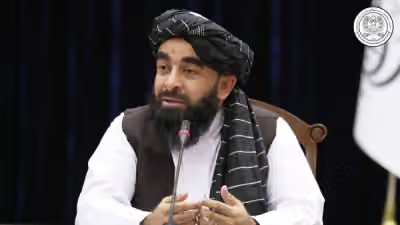
Taliban spokesperson Zabihullah Mujahid on Sunday denied the presence of al-Qaeda in Afghanistan, rejecting a Washington Post report that cited Western security officials and a UN body as saying the group is active again in the country.

Mujahid described the report as propaganda against the Taliban and said there was no evidence proving the presence of foreign groups in Afghanistan.

He told domestic media that such claims were being made by what he described as biased and intelligence-linked circles seeking to fuel tensions and create scenarios of regional insecurity.

Mujahid has previously rejected UN Security Council reports about the presence of al-Qaeda in Afghanistan.

At the same time, Hamdullah Fitrat, the Taliban’s deputy spokesperson, also responded to the Washington Post report by denying to Taliban-affiliated media that foreign groups, including al-Qaeda, were present in Afghanistan.

He said groups that had operated in connection with past wars no longer needed to remain in Afghanistan because circumstances had changed. He also described claims about their activities as propaganda.

In a report published on 12 September, the Washington Post said al-Qaeda and its affiliates had established at least eight training centres in Afghanistan since the Taliban returned to power.

The report said Islamist groups, including ISIS-Khorasan, had also opened new training facilities and that armed groups were present in at least 14 provinces across Afghanistan.

According to the newspaper, the new al-Qaeda centres provide training in the use of weapons, explosives and guerrilla warfare tactics, while there are also signs of instruction in encryption, artificial intelligence, drones and other emerging technologies.

A member of the UN monitoring team also estimated that al-Qaeda had around 100 core members in Afghanistan.

A UN Security Council report also said cooperation between al-Qaeda, the Taliban and Tehreek-e-Taliban Pakistan had increased, and that training camps run by the groups in Afghanistan were focused on training local fighters and TTP members.

The report also said al-Qaeda continued to operate covertly in Afghanistan and that commanders from the network were travelling into the country.

According to the Security Council report, al-Qaeda members in Kunar province had been involved in training TTP members in suicide bombing techniques, while the network also served as an adviser and trainer for allied armed groups.

The Taliban has consistently rejected UN reports about al-Qaeda’s presence and activities in Afghanistan. However, Security Council reports in recent years have said ties between the Taliban and al-Qaeda remain intact, that the network operates training centres in the country and that it cooperates with regional armed groups.

Attacks From Afghanistan Have Killed 4,700 People, Says Pakistan Envoy

Sep 12, 2026, 15:19 GMT+1
100%

Pakistan’s UN representative has expressed deep concern over what he called growing terrorist activity from Afghan territory, saying more than 4,700 Pakistanis have been killed in such attacks over the past three years.

Asim Iftikhar Ahmad, Pakistan’s representative to the United Nations, told a Security Council meeting on Friday, 11 September, marking the 25th anniversary of the September 11 attacks that Tehreek-e-Taliban Pakistan, the Balochistan Liberation Army and its Majeed Brigade continued to operate from safe havens in Afghanistan with significant foreign support.

He said the groups had carried out some of the most brutal terrorist attacks against Pakistan.

Pakistan’s representative also criticised the absence of restrictive measures and UN Security Council sanctions against the Balochistan Liberation Army, saying the group was operating freely.

According to Ahmad, Pakistan’s efforts to have the Balochistan Liberation Army added to the Security Council sanctions list have so far been unsuccessful.

He stressed that other groups, including the East Turkestan Islamic Movement and ISIS, must also be effectively contained.

The Pakistani representative described the terrorist threat in Afghanistan, alongside threats in Africa and the Middle East, as a serious concern in the global fight against terrorism.

In recent years, Pakistan has repeatedly accused the Taliban administration of allowing Tehreek-e-Taliban Pakistan to operate from Afghan territory and has urged Kabul to act against the group.

Islamabad also considers the Balochistan Liberation Army one of its main security threats and alleges that its members also operate from Afghanistan against Pakistan.

The Taliban administration has rejected the accusations, saying it does not allow any group to use Afghan territory against other countries.

The Taliban has also repeatedly said that insecurity in Pakistan is the country’s internal matter and that Islamabad should address its security problems inside Pakistan.

Security tensions between Pakistan and the Taliban administration have increased in recent months.

Pakistan has justified military strikes and operations along the Afghan border as action against armed groups based in Afghanistan, while the Taliban has described the attacks as violations of Afghanistan’s sovereignty.

US Deports Afghan Woman Accused Of Supporting ISIS

Sep 12, 2026, 08:56 GMT+1
100%

Nazira Haji Zada, an Afghan migrant and US permanent resident, has been deported to her country of origin after admitting involvement in an ISIS-inspired attack plot. It is the first such deportation ruling in nearly three decades.

Joan Ericksen, chief judge and presiding judge of the Alien Terrorist Removal Court, ordered Hajizada’s deportation over her role in a plot for a mass shooting inspired by ISIS on the day of the 2024 US presidential election.

Haji Zada’s case was heard in secret, and the deportation order was issued on Thursday, 20 August. The ruling was unsealed on Friday, 11 September. Hearings in the case had previously been postponed twice.

The US Justice Department said the 47-year-old woman admitted that she was an “alien terrorist” and waived her right to appeal the deportation order.

US Deputy Attorney General Todd Blanche said in a statement: “This landmark case, resulting in the prompt removal of this alien terrorist to her country of origin, is a win for national security and the rule of law.”

The Alien Terrorist Removal Court was established in 1996 but had remained unused for nearly three decades. Donald Trump’s administration has now revived the court as part of efforts to bring back older and little-used immigration laws.

Haji Zada was represented in the case by Matthew Farley and Mary Petras, two lawyers from the Federal Public Defender’s Office in Washington, DC. Farley had said during the proceedings that he intended to challenge the government’s effort to deport his client.

The US Justice Department has released few details about the allegations against Haji Zada. The publicly available information includes a sealed application for her removal and a two-paragraph unclassified summary of the allegations.

Hayden O’Byrne, an official with the Justice Department’s National Security Division, said Haji Zada had pledged allegiance to ISIS, played a role in radicalising her children and supported a terrorist plot involving her son and son-in-law.

Her son, Abdullah Haji Zada, and her son-in-law, Nasir Ahmad Tawhedi, had previously been arrested and convicted in connection with the planned attack.

Anti-Taliban Fight Does Not Need Foreign Troops, Says United Front Leader

Sep 11, 2026, 17:10 GMT+1
100%

Sami Sadat, leader of the Afghanistan United Front, says his forces do not need foreign troops to fight the Taliban, but are seeking support from the international community.

In a video message on Friday, 11 September, marking the 25th anniversary of the September 11 attacks, Sadat said Afghans had fought terrorism alongside US forces for 20 years after 9/11.

He said that during this period, institutions and infrastructure were developed and young Afghans gained access to education and global opportunities.

Sadat added that these achievements came at a heavy price for the Afghan people. He referred to the assassination of Ahmad Shah Massoud by al-Qaeda operatives on 9 September 2001 and the killing of former president and High Peace Council chairman Burhanuddin Rabbani.

The Afghanistan United Front leader said Afghans continue to suffer at the hands of the Taliban and terrorist groups, but that the struggle for freedom and against the Taliban, al-Qaeda and other terrorist organisations would continue.

He said the United Front of Afghanistan began military operations against the Taliban on 1 August and had carried out 54 operations by Friday. Sadat claimed that more than 128 Taliban members had been killed or wounded in those attacks.

Sadat also said repression, torture and killings continue in Afghanistan, while large numbers of Afghans are leaving for Iran, Pakistan, Turkiye, Europe and the United States.

He blamed the Taliban for the situation and said that, by contrast, members of terrorist groups from different countries were finding refuge in Afghanistan.

Sadat said the Taliban had established thousands of religious schools over the past five years, where around two million Afghan children were now studying.

He claimed that children in these schools were being taught violence, hatred and the destruction of others in the name of religion.

The Afghanistan United Front leader also said al-Qaeda had become more organised and better equipped.

He described the US agreement with the Taliban as a mistake by American leaders and said the Taliban and al-Qaeda had not achieved victory on the battlefield.

Addressing countries in the region that maintain close relations with the Taliban, Sadat said the group would not bring peace and stability to the region.

He stressed that his forces would continue fighting the Taliban on their own.