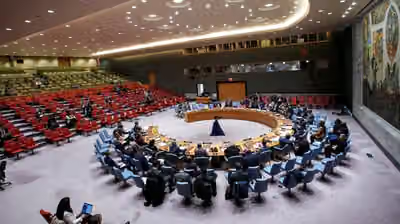
Representatives largely focused on five issues: the activities of terrorist groups, tensions between the Taliban and Pakistan, the humanitarian crisis, restrictions on women, and how the international community should engage with the Taliban.
Terrorism and Rising Insecurity
Almost all Security Council members described the activities of terrorist groups in Afghanistan as a threat extending beyond the country’s borders.
Iran’s representative said the Taliban must prevent Afghan territory from being used to plan or carry out attacks against neighbouring countries. He described ISIS-Khorasan as a serious threat and called for broader regional cooperation.
China urged the Taliban to act decisively against ISIS-Khorasan, al-Qaeda, the East Turkistan Islamic Movement and Tehreek-e-Taliban Pakistan, and to demonstrate greater resolve in doing so.
Russia also expressed concern about ISIS-Khorasan’s ability to recruit fighters, saying members of terrorist groups were being transferred from Syria to Afghanistan.
Russia’s representative said that Islamic State- Khorasan, the East Turkistan Islamic Movement and other terrorist groups remain present in Afghanistan, and the Taliban has so far been unable to fully confront them.
The US ambassador to the United Nations, accused the Taliban of sheltering terrorist groups and said the consequences of developments in Afghanistan would not remain confined within the country’s borders.
He urged the Security Council to demand action, not words from the Taliban. Waltz also accused the group of using foreign nationals as bargaining chips and called for their release.
Denmark also described the presence of Tehreek-e-Taliban Pakistan, al-Qaeda and ISIS-Khorasan as a threat to Afghanistan, its neighbours and international security. France, Britain and Pakistan raised similar concerns.
According to the UN secretary-general’s report, the number of security incidents in Afghanistan increased by 11% compared with the same period last year. Armed groups opposed to the Taliban claimed responsibility for 88 attacks across 21 provinces during the reporting period.
Taliban-Pakistan Tensions
Pakistan’s representative claimed that Tehreek-e-Taliban Pakistan and armed Baloch groups were operating from Afghan territory with impunity.
He said Pakistan had suffered more than 4,700 casualties over the past three years in attacks that Islamabad says were organised from Afghanistan. Pakistan’s representative urged the Taliban to take concrete and verifiable action against the groups.
He also warned about armed groups gaining access to advanced weapons and equipment left behind by international forces in Afghanistan.
Russia and Britain called for de-escalation and for the Taliban and Pakistan to return to dialogue.
The UN secretary-general’s report described the border situation between the two sides as unstable. According to the report, air strikes, reconnaissance drone flights and cross-border shelling have affected parts of Ghazni, Kunar, Khost, Paktika, Paktia, Kandahar and Nangarhar.
The clashes killed at least 57 civilians and wounded another 342 between 1 April and 30 June.
Meanwhile, Turkiye and Qatar have again become involved in mediation efforts. Turkiye’s intelligence chief and Qatar’s deputy national security adviser travelled to Kabul on Tuesday and met Taliban officials.
There has so far been no sign of a lasting improvement in relations between Kabul and Islamabad.
Restrictions on Women and the Humanitarian Crisis
Taliban restrictions on women and girls were another major focus of the meeting.
Britain’s representative said no country could prosper while half its population was excluded from public life.
He referred to the year-long ban on Afghan female employees entering UN offices and said the restriction had disrupted humanitarian assistance. Britain will provide more than $140 million a year in aid to the Afghan people over the next three years.
France described the ban on Afghan women working for the United Nations as unacceptable and said the international community had listened to the Taliban’s demands, and that the Taliban must now respond with practical action to the demands of the international community.
The US representative also recalled remarks by Meryl Streep, saying that a female cat in Kabul had more rights than an Afghan woman because it could leave the house and see sunlight. He described the five-year deprivation of women and girls from education as tragic.
According to the UN secretary-general’s report, around one-third of Afghanistan’s population is experiencing acute food insecurity.
An estimated 13.8 million people are expected to face crisis or emergency levels of food insecurity this year.
Around 3.7 million children under the age of five and 1.2 million pregnant and breastfeeding women are also expected to suffer from acute malnutrition.
From 1 January to 13 August, nearly 1.15 million Afghans returned from neighbouring countries. The large-scale returns have placed additional pressure on the labour market and public services.
Georgette Gagnon said peace did not simply mean the absence of war, but that people must also have dignity, opportunities to progress and hope for the future.
She said Afghans had reported that despite five years of relative calm, Taliban policies had pushed them to the margins. The country’s economy also remains extremely fragile.
Disagreement Over How to Engage With the Taliban
Security Council members agreed on the need for continued engagement with Afghanistan but expressed different views over what form that engagement should take and what conditions should be attached.
The United States, Britain and France said engagement must be accompanied by accountability from the Taliban.
They stressed the need for practical action against terrorist groups, respect for women’s rights, the formation of an inclusive government and the release of foreign nationals.
China, Russia and Iran, however, called for continued dialogue, expanded economic cooperation and efforts to avoid isolating Afghanistan.
China said isolating Taliban-controlled Afghanistan would not solve the country’s problems.
Russia said Afghanistan should not be subjected to pressure or intimidation.
Iran described political engagement and regional cooperation as the most effective way to address Afghanistan’s problems.
India’s representative criticised the mass expulsion of Afghan migrants and the closure of trade routes between Afghanistan and Pakistan, describing it as “trade and transit terrorism”.
He said human rights could not be improved separately from security, development and economic opportunities.
Naseer Ahmad Faiq, Afghanistan’s representative to the United Nations, said no lasting solution could emerge from dialogue between the Taliban and foreign governments without the participation of the Afghan people.
He said that Afghanistan is more than the Taliban. Afghans must be participants, not spectators, in decisions about their future.
Faiq said five years of experience had shown that neither isolating the Taliban alone nor engagement without a clear political objective had produced results.
He said the international community should pursue principled and results-oriented engagement aimed at creating a legitimate, representative and accountable government.
Shared Concerns, Different Solutions
Security Council members agreed on the need for stability in Afghanistan and on preventing the country from becoming a safe haven for terrorist groups.
The main disagreement concerned how that goal should be achieved.
Some countries said pressure, accountability and clear conditions for the Taliban were necessary, while others argued that continued dialogue and expanded economic cooperation would be more effective.
The tone of the meeting showed that the activities of al-Qaeda, ISIS-Khorasan, the East Turkistan Islamic Movement, Tehreek-e-Taliban Pakistan and extremist groups from Central Asia have once again placed Afghanistan at the centre of regional and international security concerns.
Alongside these threats, Taliban-Pakistan tensions, the humanitarian crisis and sweeping restrictions on women remain among the main factors shaping the international community’s policy towards Afghanistan.