• العربية
  • پښتو
  • فارسی
Brand
  • Afghanistan
  • Sport
  • Analysis
  • Markets
  • Afghanistan
  • Sport
  • Analysis
  • Markets
  • Theme
  • Language
    • العربية
    • پښتو
    • فارسی
  • Afghanistan
  • Sport
  • Analysis
  • Markets
All rights reserved for Volant Media UK Limited
volant media logo

Four Fatemiyoun Members Killed In Zahedan, Says Rights Group

Sep 18, 2026, 11:07 GMT+1

The Haalvsh human rights group reported on Friday that at least four members of the Fatemiyoun Division were killed by gunmen in the Rudmahi area of Zahedan. Their vehicle was also set on fire.

In a video published by Haalvsh on Thursday, 17 September, a vehicle can be seen badly burnt, with parts of it completely destroyed. According to the organisation, the incident occurred on Friday, 11 September.

Haalvsh reported that Fatemiyoun members have been stationed in recent months at a base in the Rudmahi area of Zahedan county.

Citing its sources, Haalvsh also reported that hundreds of Fatemiyoun members have been deployed across various parts of Sistan and Baluchestan, including Zahedan, Mirjaveh, Rask, Gasht, Saravan, Zabol, Sib and Suran, Chabahar, Konarak, Zarabad and Iranshahr.

The organisation also claimed that Iran’s Islamic Revolutionary Guard Corps had handed over several local Basij bases in some areas to Fatemiyoun forces.

These claims have not been independently verified.

Iranian authorities have not yet commented on the reported killing of Fatemiyoun members in Rudmahi or provided details of the shooting. The identity of the attackers also remains unknown.

The Fatemiyoun Division is a militia made up mainly of Afghan Shia nationals that has operated under the leadership of the IRGC’s Quds Force.

The group fought alongside forces backed by the Islamic Republic of Iran in support of Bashar al-Assad’s government during the Syrian war, with many of its fighters recruited from Afghan migrants and refugees living in Iran.

In 2019, the US Treasury Department designated the Fatemiyoun Division as a force led by the IRGC’s Quds Force and imposed sanctions on it.

The department said Fatemiyoun fighters were largely recruited from Afghan migrant and refugee communities in Iran, and that some had been sent to fight in Syria under threats of detention or deportation from Iran.

Most Viewed

Afghanistan At UN Security Council: Shared Concerns, Different Approaches To Taliban
1

Afghanistan At UN Security Council: Shared Concerns, Different Approaches To Taliban

2

Legal Action Against Taliban Remains On Track, Says Australia

3

Turkish Intelligence Chief Heads To Pakistan After Afghanistan

4

Khalilzad Must Clarify Where He Stands On Taliban, Says Pakistan

5

Taliban Defence Minister Meets Turkish & Qatari Security Delegations

•
•
•

More Stories

Pak Ready To Reopen Afghan Border If Taliban Cooperates, Says Foreign Ministry

Sep 18, 2026, 10:16 GMT+1
100%

Pakistan’s Foreign Ministry says the country is ready to reopen border crossings and resume trade with Afghanistan if the Taliban cooperates in stopping armed groups that Islamabad says cross from Afghan territory into Pakistan.

Sajjad Haider Khan, the new spokesman for Pakistan’s Foreign Ministry, said on Wednesday that Islamabad wanted to resolve its problems with Afghanistan through dialogue and diplomacy.

He said Pakistan had also sought mediation from Qatar, Turkiye and China to ease tensions, but those diplomatic efforts had yet to produce a clear outcome.

Khan accused the Taliban of refusing to guarantee that armed groups would stop using Afghan territory to operate against Pakistan. The Taliban has repeatedly denied the presence of foreign armed groups in Afghanistan and rejected claims that Afghan soil is being used against neighbouring countries.

Asked about visits by Turkish and Qatari security officials to Kabul, the Pakistani Foreign Ministry spokesman said Islamabad was not aware of the details of the trips but noted that Qatar and Turkey had previously played a role in mediating between Pakistan and the Taliban.

He also referred to China’s efforts to facilitate dialogue between the Taliban and Pakistan.

Pakistan’s Foreign Ministry also said Afghan students who hold valid visas and are enrolled in recognised academic programmes are allowed to continue and complete their studies in Pakistan.

According to Khan, students who have finished their studies and are not yet enrolled in further education or specialist programmes may be deported to Afghanistan.

Earlier, the Pakistan Medical and Dental Council had instructed universities not to admit new Afghan students and ordered the removal of Afghan students already in the country. The decision prompted protests from students.

The Lahore and Sindh high courts, and in one case the Islamabad High Court, suspended implementation of the decision for several students who had challenged it.

The ministry said Afghan students with scholarships may also continue their studies, and that hundreds of Afghan students are currently studying in Pakistan.

The possible invitation of a Taliban administration representative to a meeting of ministers from the Economic Cooperation Organisation in November was also raised at the briefing.

The Pakistani Foreign Ministry spokesman said no decision had yet been made on the matter.

Legal Action Against Taliban Remains On Track, Says Australia

Sep 17, 2026, 14:09 GMT+1
100%

Australia’s Foreign Ministry says it is pursuing legal action with international partners, including Canada, Germany and the Netherlands, to hold the Taliban accountable for widespread violations of the Convention on the Elimination of All Forms of Discrimination against Women.

A ministry spokesman told Afghanistan International that the Taliban was carrying out a campaign of sustained and systematic repression aimed at completely excluding women from public life.

According to Australia’s Foreign Ministry, the Taliban’s actions demonstrate a blatant disregard for the human rights and fundamental freedoms of women and girls in Afghanistan.

Information released by the Australian government says the four countries have invoked Article 29 of the Convention on the Elimination of All Forms of Discrimination against Women and activated its dispute-resolution mechanism, calling on the Taliban administration to enter good-faith negotiations.

In late 2024, Germany, Australia, Canada and the Netherlands jointly warned that they would take the Taliban to the International Court of Justice if the situation of women and girls in Afghanistan did not change.

The International Court of Justice is the United Nations’ principal judicial body and hears disputes between states, including cases involving international legal obligations.

Australian officials said that although the process would take time, Canberra remained firmly committed to supporting Afghan women and girls. The next stages could include referral to international arbitration and ultimately bringing the case before the International Court of Justice.

The Australian Foreign Ministry spokesman said pursuing legal action under the Convention on the Elimination of All Forms of Discrimination against Women did not alter Canberra’s position that the Taliban administration is illegitimate.

The Australian government again stressed that it does not recognise the Taliban as the legitimate representative of the Afghan people and has no intention of accepting diplomats, honorary consuls or any other representatives appointed by the group.

In line with that position, it had previously been agreed that the Afghan embassy in Canberra would cease its activities in Australia.

Australian officials say the legal initiative is grounded in the lived experiences of Afghan women and that Australia is committed to meaningful engagement with Afghan women and civil society organisations throughout the process.

As part of these efforts, Germany hosted civil society consultations in Berlin in March last year involving legal delegations from partner countries. Australia also plans to hold domestic consultations with civil society in October this year to examine the initiative in greater detail.

The joint legal action by the four Western countries comes amid continuing criticism from international human rights organisations over Taliban policies towards women.

UNICEF and Amnesty International have again called on the Taliban administration to lift all restrictions on girls’ education and allow women and girls to return immediately to schools and universities.

Amnesty International has also called for urgent and coordinated international action to pressure the Taliban to reopen girls’ schools.

More than 20 countries have backed the decision by Germany, Australia, Canada and the Netherlands to pursue a case against the Taliban before the International Court of Justice. They said they condemned human rights violations in Afghanistan, particularly gender discrimination against women and girls by the Taliban.

Albania, Andorra, Belgium, Bulgaria, Chile, Croatia, Finland, Honduras, Ireland, Iceland, South Korea, Latvia, Liechtenstein, Luxembourg, Malawi, Morocco, Moldova, Montenegro, Romania, Slovenia, Spain and Sweden are among the 23 countries supporting the initiative by Germany, Australia, Canada and the Netherlands.

The Taliban has previously rejected allegations of human rights violations and gender discrimination in response to the four countries’ decision.

A Taliban Foreign Ministry spokesman said that at the time human rights are protected in Afghanistan and there is no discrimination against anyone.

Afghanistan At UN Security Council: Shared Concerns, Different Approaches To Taliban

Sep 17, 2026, 09:36 GMT+1
100%

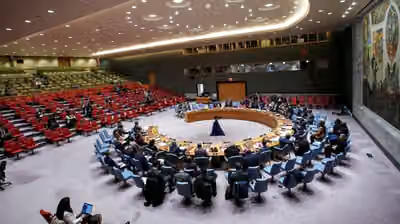
The UN Security Council met in New York on Wednesday, 16 September, to discuss Afghanistan. Georgette Gagnon, acting head of UNAMA, presented the latest UN report on the country’s security, politics, human rights and economy.

Representatives largely focused on five issues: the activities of terrorist groups, tensions between the Taliban and Pakistan, the humanitarian crisis, restrictions on women, and how the international community should engage with the Taliban.

Terrorism and Rising Insecurity

Almost all Security Council members described the activities of terrorist groups in Afghanistan as a threat extending beyond the country’s borders.

Iran’s representative said the Taliban must prevent Afghan territory from being used to plan or carry out attacks against neighbouring countries. He described ISIS-Khorasan as a serious threat and called for broader regional cooperation.

China urged the Taliban to act decisively against ISIS-Khorasan, al-Qaeda, the East Turkistan Islamic Movement and Tehreek-e-Taliban Pakistan, and to demonstrate greater resolve in doing so.

Russia also expressed concern about ISIS-Khorasan’s ability to recruit fighters, saying members of terrorist groups were being transferred from Syria to Afghanistan.

Russia’s representative said that Islamic State- Khorasan, the East Turkistan Islamic Movement and other terrorist groups remain present in Afghanistan, and the Taliban has so far been unable to fully confront them.

The US ambassador to the United Nations, accused the Taliban of sheltering terrorist groups and said the consequences of developments in Afghanistan would not remain confined within the country’s borders.

He urged the Security Council to demand action, not words from the Taliban. Waltz also accused the group of using foreign nationals as bargaining chips and called for their release.

Denmark also described the presence of Tehreek-e-Taliban Pakistan, al-Qaeda and ISIS-Khorasan as a threat to Afghanistan, its neighbours and international security. France, Britain and Pakistan raised similar concerns.

According to the UN secretary-general’s report, the number of security incidents in Afghanistan increased by 11% compared with the same period last year. Armed groups opposed to the Taliban claimed responsibility for 88 attacks across 21 provinces during the reporting period.

Taliban-Pakistan Tensions

Pakistan’s representative claimed that Tehreek-e-Taliban Pakistan and armed Baloch groups were operating from Afghan territory with impunity.

He said Pakistan had suffered more than 4,700 casualties over the past three years in attacks that Islamabad says were organised from Afghanistan. Pakistan’s representative urged the Taliban to take concrete and verifiable action against the groups.

He also warned about armed groups gaining access to advanced weapons and equipment left behind by international forces in Afghanistan.

Russia and Britain called for de-escalation and for the Taliban and Pakistan to return to dialogue.

The UN secretary-general’s report described the border situation between the two sides as unstable. According to the report, air strikes, reconnaissance drone flights and cross-border shelling have affected parts of Ghazni, Kunar, Khost, Paktika, Paktia, Kandahar and Nangarhar.

The clashes killed at least 57 civilians and wounded another 342 between 1 April and 30 June.

Meanwhile, Turkiye and Qatar have again become involved in mediation efforts. Turkiye’s intelligence chief and Qatar’s deputy national security adviser travelled to Kabul on Tuesday and met Taliban officials.

There has so far been no sign of a lasting improvement in relations between Kabul and Islamabad.

Restrictions on Women and the Humanitarian Crisis

Taliban restrictions on women and girls were another major focus of the meeting.

Britain’s representative said no country could prosper while half its population was excluded from public life.

He referred to the year-long ban on Afghan female employees entering UN offices and said the restriction had disrupted humanitarian assistance. Britain will provide more than $140 million a year in aid to the Afghan people over the next three years.

France described the ban on Afghan women working for the United Nations as unacceptable and said the international community had listened to the Taliban’s demands, and that the Taliban must now respond with practical action to the demands of the international community.

The US representative also recalled remarks by Meryl Streep, saying that a female cat in Kabul had more rights than an Afghan woman because it could leave the house and see sunlight. He described the five-year deprivation of women and girls from education as tragic.

According to the UN secretary-general’s report, around one-third of Afghanistan’s population is experiencing acute food insecurity.

An estimated 13.8 million people are expected to face crisis or emergency levels of food insecurity this year.

Around 3.7 million children under the age of five and 1.2 million pregnant and breastfeeding women are also expected to suffer from acute malnutrition.

From 1 January to 13 August, nearly 1.15 million Afghans returned from neighbouring countries. The large-scale returns have placed additional pressure on the labour market and public services.

Georgette Gagnon said peace did not simply mean the absence of war, but that people must also have dignity, opportunities to progress and hope for the future.

She said Afghans had reported that despite five years of relative calm, Taliban policies had pushed them to the margins. The country’s economy also remains extremely fragile.

Disagreement Over How to Engage With the Taliban

Security Council members agreed on the need for continued engagement with Afghanistan but expressed different views over what form that engagement should take and what conditions should be attached.

The United States, Britain and France said engagement must be accompanied by accountability from the Taliban.

They stressed the need for practical action against terrorist groups, respect for women’s rights, the formation of an inclusive government and the release of foreign nationals.

China, Russia and Iran, however, called for continued dialogue, expanded economic cooperation and efforts to avoid isolating Afghanistan.

China said isolating Taliban-controlled Afghanistan would not solve the country’s problems.

Russia said Afghanistan should not be subjected to pressure or intimidation.

Iran described political engagement and regional cooperation as the most effective way to address Afghanistan’s problems.

India’s representative criticised the mass expulsion of Afghan migrants and the closure of trade routes between Afghanistan and Pakistan, describing it as “trade and transit terrorism”.

He said human rights could not be improved separately from security, development and economic opportunities.

Naseer Ahmad Faiq, Afghanistan’s representative to the United Nations, said no lasting solution could emerge from dialogue between the Taliban and foreign governments without the participation of the Afghan people.

He said that Afghanistan is more than the Taliban. Afghans must be participants, not spectators, in decisions about their future.

Faiq said five years of experience had shown that neither isolating the Taliban alone nor engagement without a clear political objective had produced results.

He said the international community should pursue principled and results-oriented engagement aimed at creating a legitimate, representative and accountable government.

Shared Concerns, Different Solutions

Security Council members agreed on the need for stability in Afghanistan and on preventing the country from becoming a safe haven for terrorist groups.

The main disagreement concerned how that goal should be achieved.

Some countries said pressure, accountability and clear conditions for the Taliban were necessary, while others argued that continued dialogue and expanded economic cooperation would be more effective.

The tone of the meeting showed that the activities of al-Qaeda, ISIS-Khorasan, the East Turkistan Islamic Movement, Tehreek-e-Taliban Pakistan and extremist groups from Central Asia have once again placed Afghanistan at the centre of regional and international security concerns.

Alongside these threats, Taliban-Pakistan tensions, the humanitarian crisis and sweeping restrictions on women remain among the main factors shaping the international community’s policy towards Afghanistan.

Anti-Taliban Groups Claim 88 Attacks Across 21 Provinces, Says UN

Sep 16, 2026, 15:43 GMT+1
100%

A new UN report on Afghanistan points to increased anti-Taliban attacks, continued clashes with Pakistan, ongoing human rights violations and a worsening economic situation.

UN Secretary-General Antonio Guterres said in his latest report on Afghanistan that armed groups opposed to the Taliban claimed responsibility for 88 attacks across 21 provinces between 1 May and the end of July.

The United Nations said it had verified 55 of those attacks. It said attacks by anti-Taliban groups rose significantly in July, reaching 30.

The UN said the Afghanistan Freedom Front, National Resistance Front, Green Unit of Afghanistan Green Trend, Afghanistan Guardians National Front, the Afghanistan Independence Front, the Afghanistan Liberation Movement, the Afghanistan Republican Front, the Afghanistan United Front, the Andarab Resistance Front, the Freedom and Justice Movement, Homeland Soldiers Front, the Islamic Liberation Front of Afghan People, the Islamic Liberation Movement of the People of Afghanistan and the National Mobilization Front, claimed responsibility for the attacks.

According to the report, armed anti-Taliban groups became more decentralised, dispersed and locally focused during the period.

The attacks mainly involved ambushes and assaults on Taliban checkpoints and military facilities. Taliban Ministry for the Propagation of Virtue and Prevention of Vice personnel were among those targeted in Herat on 12 June and Kabul on 22 June.

The report said a suicide bomb detonated explosives outside a boys’ school in Kabul on 5 June, near the residence of a Taliban deputy governor. No group claimed responsibility for the attack.

It added that the Homeland Soldiers Front briefly seized government buildings in Yaftal-e Payan district of Badakhshan on 17 July before withdrawing.

The Afghanistan Freedom Front also attacked a Taliban security checkpoint in Zebak district of Badakhshan on 24 July. According to the report, the Taliban repelled the attack and retained control of the area, although sporadic clashes continued.

Security Incidents in Afghanistan Rise by 11%

The latest report by UN Secretary-General Antonio Guterres to the Security Council said 2,947 security incidents were recorded in Afghanistan between 1 May and 31 July.

According to the report, the number of incidents increased by 11% compared with the same period last year.

Afghanistan-Pakistan Border Remains Unrestful

The UN secretary-general said in his latest report to the Security Council that the Afghanistan-Pakistan border remained tense between 1 May and 31 July amid airstrikes, drone surveillance and retaliatory military actions.

The report said Pakistani airstrikes in May and June targeted parts of Ghazni, Kunar, Khost and Paktika, causing damage to civilians and infrastructure in several cases.

According to the report, sporadic shelling from Pakistani territory also struck areas in Paktia, Khost, Paktika, Nuristan and Kunar.

The United Nations said several clashes between Taliban security forces and Pakistani forces were also reported during this period in Kandahar, Nangarhar and Paktia.

On 30 June, the Taliban’s defence ministry said it had carried out drone strikes in response to Pakistani attacks, targeting alleged ISIS-K and anti-Taliban positions in Pakistan’s Khyber Pakhtunkhwa and Balochistan provinces. Pakistani officials also confirmed that drones had entered the country’s airspace and had been intercepted.

At Least 57 Civilians Killed in Taliban-Pakistan Clashes in Three Months

The UN secretary-general said clashes between the Taliban and Pakistan from 1 April to 30 June killed or wounded 399 civilians. According to the report, 57 people were killed and 342 others wounded.

The United Nations said Pakistani airstrikes on 28 June in Kunar, Paktika and Paktia killed 28 civilians and wounded 189 others.

In Paktia, two airstrikes killed 22 civilians, including two girls, three boys, two women and 15 men. At least 185 others, including five girls, 13 boys, 11 women and 156 men, were wounded.

The report said most casualties occurred in the second strike, when residents were trying to rescue victims of the first attack.

The Pakistani embassy in Afghanistan told UNAMA that the strikes had “solely” targeted terrorist positions and infrastructure supporting groups responsible for attacks inside Pakistan. It also said the operations were carried out in accordance with the principles of distinction and proportionality under international law.

The Taliban’s foreign ministry rejected Pakistan’s claim, saying it “categorically” denied that armed individuals had been targeted or killed in the attacks.

Two Killed During Badakhshan Protests

The United Nations said residents of Argo district in Badakhshan protested on 8 and 9 May against the destruction of poppy fields during a Taliban counter-narcotics operation.

According to the report, Taliban security forces fired warning shots on both days to disperse the protesters. As people fled, a boy died on 8 May and a man on 9 May after falling.

12 Killings of Former Government Employees and Security Personnel Recorded

The United Nations said UNAMA recorded at least 12 killings, 13 cases of arbitrary arrest and detention, and three cases of torture and ill-treatment involving former government officials and security personnel between 1 May and 31 July.

The report said the continued killing of former security personnel and government employees contradicted the general amnesty announced by the Taliban leader.

Journalists Detained and Media Outlets Suspended

According to the report, the Taliban continued to detain journalists and suspend media outlets for unspecified reasons.

The Taliban’s General Directorate of Intelligence detained three journalists for periods ranging from 19 days to two months and suspended the operations of two media outlets. One resumed operations after a week, while the other remained suspended when the report was prepared.

ISIS Attacks

The UN report said ISIS-K claimed responsibility for an attack on a Taliban military checkpoint in Waygal district of Nuristan on 30 June. Several Taliban security personnel were wounded in the attack.

ISIS also claimed responsibility on 29 July for the killing of Zabihullah Amiri, the Taliban’s director of information and culture in Badakhshan.

Taliban Leader Replaced One Minister, Eight Deputy Ministers and Six Governors in Three Months

UN Secretary-General Antonio Guterres said in his latest report that Taliban leader Hibatullah Akhundzada replaced one minister, eight deputy ministers and six provincial governors between the beginning of May and the end of July.

During this period, Akhundzada replaced the minister of communications and information technology, as well as deputy ministers in the ministries of defence, hajj and religious affairs, propagation of virtue and prevention of vice, finance, information and culture, and mines and petroleum.

The Taliban leader also appointed new governors in Badghis, Baghlan, Faryab, Ghazni, Jowzjan and Khost.

In addition, nine deputy governors were appointed in Baghlan, Farah, Helmand, Kandahar, Logar, Maidan Wardak, Paktika, Paktia and Zabul, while 17 district governors were appointed in Badakhshan, Badghis, Kabul, Nangarhar and Sar-e-Pul.

Akhundzada also appointed a new mayor for Herat and replaced police chiefs in Baghlan, Herat, Kabul, Logar, Maidan Wardak, Jowzjan and Nimruz.

According to the UN secretary-general’s report, at least 14 heads of local departments were also appointed in Badakhshan, Badghis, Bamiyan, Farah, Herat, Jowzjan, Kabul, Kandahar, Paktika and Maidan Wardak.

Taliban Prison Population Reaches 30,300

The United Nations said in its latest report that, according to the Taliban’s prison administration, the number of prisoners had reached 30,300 by 20 July.

The report said the Taliban prison administration announced on 26 May that the group’s Supreme Court had pardoned and released 1,191 prisoners to mark Eid al-Adha.

According to the report, the Taliban also called for support for prisoners in the areas of nutrition, healthcare and training.

Food Inflation in Afghanistan Reaches 8.2%

The UN secretary-general said in his latest report to the Security Council that food inflation in Afghanistan reached 8.2% in May.

According to the report, overall inflation stood at 7.8% in the same month.

The United Nations said prices were rising as Afghanistan’s economy faced the consequences of the closure of the Pakistan border and disruption to regional trade routes.

The report said the closure of the Afghanistan-Pakistan border since October 2025 had negatively affected local economies and customs revenues.

Iran is also one of Afghanistan’s direct routes to seaports. The UN said conflict in the Middle East had disrupted trade along this route, increasing transport and transaction costs.

According to the United Nations, these higher costs have contributed to rising prices for food and non-food goods in Afghanistan.

It added that higher prices had reduced households’ purchasing power and increased economic pressure on the population.

Return of Migrants Puts Pressure on Afghanistan’s Economy

According to estimates by UN agencies, funds and programmes, nearly 1.15 million Afghan migrants returned to the country between 1 January and 22 August. Of these, 686,200 were deported and returned from Pakistan, 465,000 from Iran and about 1,300 from Tajikistan. This is in addition to about 2.9 million returns in 2025.

A large proportion of the returns were involuntary. The United Nations said large-scale returns had placed significant pressure on local labour markets and communities’ capacity to absorb returnees, weakening prospects for their sustainable reintegration.

UN Assisted 6.8 Million People in Afghanistan in First Months of Year

Antonio Guterres said in his latest report that UN agencies and their humanitarian partners provided at least one form of assistance to 6.8 million people in Afghanistan during the first five months of this year.

Of these, 685,000 people received three or more types of humanitarian services or support.

The largest amount of assistance was provided in food security and livelihoods, reaching 4.3 million people. In addition, 2.5 million received health services, 2.1 million protection services, 1.5 million nutrition assistance and 711,000 water, sanitation and hygiene services.

However, the United Nations said Afghanistan’s humanitarian situation continued to deteriorate. Large-scale returns from neighbouring countries, funding shortages, conflict in the Middle East, trade disruptions and the effects of climate change have increased humanitarian needs.

During the reporting period, heavy rainfall and flash floods affected eastern, south-eastern and central Afghanistan, causing widespread humanitarian consequences in several provinces.

More Than 400,000 Returnees Deprived of Food Assistance

According to the report, the large-scale return of Afghans, mostly under difficult circumstances, placed significant pressure on border systems and communities’ capacity to receive returnees.

UN agencies and humanitarian partners continued operating at major border crossings and assisted around 135,300 vulnerable returnees.

However, funding shortages forced the World Food Programme to gradually phase out cash assistance for returnees in June. As a result, more than 400,000 vulnerable returnees were left without cash assistance to buy food.

One in Three Afghans Faces Food Insecurity

The United Nations said around one in three Afghans faces acute food insecurity.

An estimated 13.8 million people in Afghanistan are expected to face crisis or emergency levels of food insecurity this year.

It is also projected that 3.7 million children under the age of five and 1.2 million pregnant and breastfeeding women will suffer from acute malnutrition this year.

Because of funding shortages, the World Food Programme expects to reach only one in seven women and children suffering from acute malnutrition. Its assistance has so far supported 80,000 children and 25,000 women.

Funding Cuts Force Closure of 150 Health Facilities

The UN secretary-general’s report said Afghanistan’s health system remains heavily dependent on international funding, which has declined by a further 20% this year.

Between 1 April and 30 June, more than 520 alerts relating to communicable diseases were recorded, including 42,600 cases of acute watery diarrhoea, 812 cases of Crimean-Congo haemorrhagic fever and 762 cases of dengue.

Funding shortages also led to the suspension or closure of around 150 health facilities between January and June.

Mine Action Capacity Falls by 38%

The United Nations said unexploded ordnance continues to threaten children and local communities in Afghanistan.

According to the report, an unexploded munition detonated in Barmal district of Paktika on 8 June, causing 13 casualties, including 10 children.

Mine action capacity fell by 38% compared with the previous reporting period. In June, the technical mine action section received 235 notifications, 65 of which received no immediate response.

Taliban Restrictions on Humanitarian Activities

The report said UN humanitarian partners recorded 159 incidents of Taliban restrictions on humanitarian access between 1 April and 30 June, leading to the suspension of 86 activities.

During the same period, 23 incidents of violence against humanitarian personnel, equipment or facilities were reported, including the detention of 21 humanitarian workers.

The Taliban’s Ministry for the Propagation of Virtue and Prevention of Vice was linked to 40 of these incidents, 27 of which occurred in Herat.

There were also 24 reported restrictions affecting the participation of female staff in humanitarian activities or women’s access to assistance.

UN Secretary-General Urges Taliban to Take Concrete Steps on Human Rights

UN Secretary-General Antonio Guterres called on the Taliban in his latest report to take concrete steps to address Afghanistan’s international obligations and protect the human rights and fundamental freedoms of all citizens.

Guterres called for the immediate removal of discriminatory restrictions and bans imposed on women and girls, and for barriers to their access to education, employment and public life to be lifted.

He also urged the Taliban to allow female UN employees and female aid workers to return to their workplaces.

The UN secretary-general also called on the Taliban to respect freedom of expression and media freedom, guarantee due process and the rights of detainees, prevent violations of the general amnesty and end the use of corporal punishment.

He stressed that any use of force must fully comply with international human rights law, including the principles of legality, necessity and proportionality.

Elsewhere in the report, Guterres expressed concern about continuing clashes between Afghanistan and Pakistan and called on all parties to fulfil their obligations under international law, including international human rights law and, where applicable, international humanitarian law, and to protect civilians.

He also called on UN member states to uphold their international protection obligations, including the principle of non-refoulement, and ensure that returns to Afghanistan are voluntary, safe and dignified and accompanied by sustained efforts towards reintegration.

Guterres concluded by urging participants in the Doha process to renew their commitment to comprehensive engagement on Afghanistan, an approach he said should serve the Afghan people and ultimately pave the way for the country’s reintegration into the international community.

Dozens Of Terrorist Groups Operate In Afghanistan, Says Pakistan Army

Sep 16, 2026, 12:05 GMT+1
100%

Pakistan’s military spokesperson says dozens of terrorist groups operating in Taliban-ruled Afghanistan are training, arming and planning cross-border attacks.

Citing United Nations reports, Ahmed Sharif Chaudhry said Pakistan would continue to take all necessary measures against terrorist groups to protect its citizens.

Speaking to Al Arabiya, Chaudhry said Pakistan’s military objectives were determined by the country’s political leadership, adding that Islamabad wanted interference and terrorist attacks originating from Afghan territory to end.

He said the Taliban authorities were allowing territory under their control to be used by such groups to recruit, train, arm and direct various terrorist attacks inside Pakistan and across the region.

The Pakistani military spokesman said recent UN reports had also documented the presence and activities of dozens of terrorist groups in Taliban-ruled Afghanistan, including al-Qaeda, ISIS-Khorasan, the Balochistan Liberation Army, Tehreek-e-Taliban Pakistan, the East Turkistan Islamic Movement and the Islamic Movement of Uzbekistan.

He said Afghanistan should not be allowed to become a global centre for terrorism.

Referring to Article 51 of the UN Charter and the right to self-defence, Chaudhry said Pakistan’s government and armed forces were committed to protecting the lives, property and security of their citizens and would take all necessary measures regardless of where or how such attacks were planned.

He described Pakistan’s counter-terrorism campaign as the only successful model of its kind over the past two decades, saying security forces had carried out more than 42,000 intelligence-based operations so far this year, in which more than 2,100 militants had been killed.

Chaudhry said Pakistan had strategic clarity in its fight against militancy, adding that the TTP’s claim that it was engaged in jihad or a religious war was completely false.

He said the Pakistani government and public understood that the group’s actions had no connection to religion.

Since the Taliban returned to power in Afghanistan in August 2021, Islamabad has repeatedly warned that terrorist groups, particularly the TTP, are using Afghan territory to plan and carry out attacks against Pakistan.

Pakistani officials say the Taliban has either failed or been unwilling to fulfil its commitments to prevent Afghan territory from being used as a base for terrorism. The issue has also been raised in several United Nations reports.

Border tensions between Afghanistan and Pakistan have led to armed clashes on several occasions in recent years, while Pakistan has carried out air and ground operations which it says were in response to TTP attacks.

Islamabad has repeatedly said its objective is to combat terrorism rather than interfere in Afghanistan’s internal affairs and has called on the Taliban to take stronger action against militant groups based in the country.