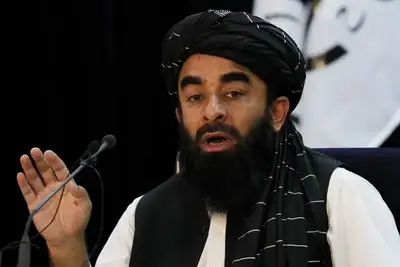
Khenjani told Afghanistan International that Registani’s presence was part of a broader plan to begin a new phase of operations on the ground.
In an interview with Afghanistan International on Tuesday, Khenjani stressed that Registani’s return to the foothills of the Hindu Kush as the NRF’s operational commander was not a temporary move, but part of an ongoing process.
He expressed hope that the presence of the NRF’s operational commander would bring “fresh energy” to the group’s forces and boost the morale of Taliban opponents.
The NRF announced on Monday, in a video, that Rigistani had returned to Afghanistan and was in the foothills of the Hindu Kush.
In the video, Rigistani said that “the resistance continues” and that other fronts were also fighting the Taliban in different parts of the country.
Following the release of the video, several political and military figures opposed to the Taliban welcomed his return.
The NRF spokesperson rejected reports of divisions among armed groups opposed to the Taliban, saying there were no differences among the military fronts fighting the group. According to Khenjani, the NRF is coordinating with prominent anti-Taliban groups and there are no obstacles or problems in relations and coordination among them.
Khenjani added that the NRF had sought in recent years to change the perception that resistance depended on foreign support. He said Taliban opponents did not need to coordinate with regional countries or foreign intelligence agencies to operate inside Afghanistan, nor did they require permission from any party to enter or leave their own country.
He stressed that Afghans should not wait for support from countries in the East or Western world. According to Khenjani, Afghans have the “capacity, courage and willingness to make sacrifices” for their own future and should rely on their own capabilities.
Asked about the potential impact of Rigistani’s return, the NRF spokesman said the group assessed that the Taliban was facing multiple layers of domestic and external pressure. According to him, the Taliban is seeking to address some regional challenges through mediation and dialogue, while exerting widespread pressure on people inside Afghanistan and increasing its military presence, particularly in Panjshir.
Khenjani added that the NRF believed the current situation would not remain stable and that the Taliban was aware of its vulnerabilities and the challenges ahead. He said the first step towards defeating the Taliban was the group’s “psychological defeat”, claiming that it faced internal divisions, corruption and growing public discontent.
The NRF spokesperson also said some Taliban members had established contacts with regional countries and certain figures opposed to the group, but declined to provide further details.
Referring to what he described as the Taliban’s “violations of citizens’ rights, land seizures, intrusions into homes and removal of cultural symbols”, Khenjani said such grievances were accumulating in society and would eventually find a way to manifest themselves.
The NRF spokesperson urged Afghans not to remain neutral in the face of developments in the country and called on them to support Taliban opponents. He said Afghanistan had faced international isolation under Taliban rule and that the group had failed to address the problems facing the population.
Khenjani said the Taliban had not directly responded to Rigistani’s return. He said the Taliban had previously denied the presence of opposition fronts, but was now increasingly arguing that these groups lacked clear objectives — a claim that, according to Khenjani, was inconsistent with Rigistani’s stated positions and goals.
In the interview, the NRF spokesperson accused the Taliban of spending significant resources on efforts to create divisions among opposition fronts and wage psychological warfare against them. He stressed, however, that Taliban opponents would continue their struggle.