• العربية
  • پښتو
  • فارسی
BrandBrand
  • Afghanistan
  • Sport
  • Analysis
  • Markets
  • Afghanistan
  • Sport
  • Analysis
  • Markets
  • Theme
  • Language
    • العربية
    • پښتو
    • فارسی
  • Afghanistan
  • Sport
  • Analysis
  • Markets
All rights reserved for Volant Media UK Limited
volant media logo

Pakistan Army Chief Visits Area Near Afghan Border, Vows To Eliminate Terrorism

Nov 20, 2026, 09:27 GMT+0

Pakistan's army chief, Field Marshal Asim Munir, has visited Miranshah, the administrative centre of North Waziristan district in Khyber Pakhtunkhwa province, near the Afghanistan border.

Addressing Pakistani military officers and soldiers, Munir stressed the need to eliminate the threat of terrorism.

In a statement issued on Friday, 20 November, Pakistan's military media wing, Inter-Services Public Relations (ISPR), said Munir was briefed on the prevailing security situation in the region, ongoing operations and measures being taken by security forces to combat terrorism.

According to the statement, Munir also praised the Khyber Pakhtunkhwa police for their resilience and sacrifices in the fight against terrorism.

Relations between Pakistan and the Afghan Taliban have deteriorated sharply over the past 18 months over Islamabad's allegations that anti-Pakistan militant groups are operating in Afghanistan.

Pakistani officials accuse these groups of using Afghan territory to launch attacks against Pakistani security forces. The Taliban deny the allegations.

In the latest reported incident, Pakistani sources said Taliban forces had attacked a Pakistani border outpost in the Angoor Adda area of South Waziristan.

Neither side has issued an official statement regarding the reported clash.

Taliban and Pakistani forces have previously engaged in armed clashes along the border.

Several civilians were killed or injured in earlier clashes, following which the Taliban relocated a number of families from the Angoor Adda area to other locations.

Most Viewed

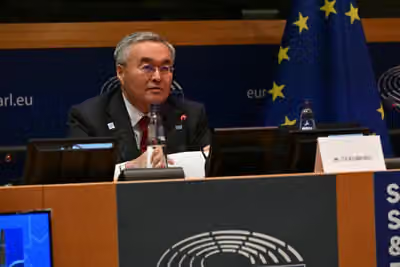
Security Threats From Afghanistan Require Coordinated Global Action, Says Kazakhstan
1

Security Threats From Afghanistan Require Coordinated Global Action, Says Kazakhstan

2

Terrorist Groups In Afghanistan Have Acquired Advanced Equipment, Says UN Official

3

Mosques, Madrassas & Obedience: Inside Akhundzada's Visit To Kabul

4

UN Concerns Over ISIS-K's Growing Capabilities Are Unfounded, Says Taliban

5

Pakistan Army Chief Visits Balochistan As Traders Protest Afghan Border Closure

•
•
•

More Stories

Samarkand Talks Focus On US-Central Asia Cooperation Against Terrorism

Oct 19, 2026, 15:14 GMT+1
100%

US Secretary of State Marco Rubio and the foreign ministers of five Central Asian countries met in Samarkand on Monday for a C5+1 meeting focused on security, trade, energy and regional cooperation.

The meeting on 19 October brought together the foreign ministers of Uzbekistan, Kazakhstan, Kyrgyzstan, Tajikistan and Turkmenistan alongside Rubio.

In a joint statement issued after the meeting, the ministers said their governments attached particular importance to combating terrorism and transnational organised crime and strengthening border security.

However, despite repeated concerns from Central Asian countries about terrorist threats and the activities of extremist groups in Afghanistan, the joint statement from the Samarkand meeting made no direct reference to Afghanistan or the Taliban.

The statement said cooperation between the United States and Central Asian countries would be expanded to tackle illegal migration, human trafficking, drug trafficking and arms smuggling.

The two sides also emphasised stronger cybersecurity cooperation and efforts to counter digital threats and cybercrime.

Elsewhere in the statement, member countries stressed greater cooperation on nuclear security, the protection of nuclear materials and the peaceful use of nuclear energy.

Expanding Economic and Trade Cooperation

The joint statement said the United States and Central Asian countries would work together to expand trade and investment, strengthen transport connectivity and develop the Trans-Caspian trade route.

The cooperation is intended to increase bilateral and intra-regional trade, simplify customs procedures and promote a competitive market in Central Asia.

The two sides also emphasised expanding cooperation in energy, mineral extraction and processing, and developing high-value supply chains.

According to the statement, member countries aim to use their natural resources and technological capacity to support economic growth, increase exports and create new business opportunities.

Technology development, e-commerce, English-language education and greater digital connectivity were also identified as areas of cooperation between the United States and Central Asian countries.

Rubio Holds Bilateral Talks With Regional Foreign Ministers

Following his meetings with Central Asian foreign ministers, Rubio said cooperation between Washington and countries in the region could create new business opportunities, strengthen economies and contribute to greater regional security.

Rubio also said he held a separate meeting with Uzbekistan’s Foreign Minister Bakhtiyor Saidov.

According to Rubio, the two discussed expanding the strategic partnership between Washington and Tashkent, including cooperation on infrastructure, space technology, critical minerals and the C5+1 framework.

The US secretary of state also emphasised expanding bilateral economic and security cooperation during a meeting with Kazakhstan’s foreign minister.

He thanked Kazakhstan for supporting peace initiatives by the Donald Trump administration, including the Abraham Accords.

Sergio Gor, the US ambassador to India and special envoy for South and Central Asian affairs, said Rubio’s meetings with regional foreign ministers focused on Washington’s commitment to supporting the sovereignty of Central Asian countries, energy security and stronger supply-chain resilience.

What Is the C5+1 Mechanism?

The Samarkand meeting was held under the C5+1 mechanism, a framework established in 2015 between the United States and the five Central Asian countries of Uzbekistan, Kazakhstan, Tajikistan, Turkmenistan and Kyrgyzstan.

The mechanism aims to expand political, economic, trade, security and energy cooperation between the United States and countries in the region.

Afghanistan Absent From the Agenda

Afghanistan shares borders with Central Asian countries, and security developments there have contributed to regional concerns over terrorism and extremism.

Countries in the region have repeatedly expressed concern in recent years about the activities of Islamic State Khorasan Province and other armed groups in Afghanistan.

However, the joint statement from the Samarkand meeting did not identify Afghanistan as a specific area of cooperation or security concern.

Instead, it referred only to the members’ broader commitment to combating terrorism, transnational organised crime and cross-border threats.

The C5+1 framework was established in 2015 between the United States and five Central Asian countries to expand political, economic, security and energy cooperation between Washington and the region.

Azad Kashmir: Protest Movement Stalls as Dispute Over Refugee Seats Deepens

Aug 7, 2026, 15:05 GMT+1
100%

Four years after the Joint Awami Action Committee (JAAC) launched widespread protests in Pakistan-administered Kashmir over rising electricity tariffs and wheat flour subsidies, authorities say they have accepted almost all economic grievances.

However, they accuse the group of escalating its political demands.

According to official figures, the government of Azad Jammu and Kashmir (AJK)—the Pakistani-administered portion of the disputed region—has accepted 37 of JAAC’s 38 demands. Twenty-four have been implemented, while 13 remain in progress, including energy pricing and subsidy reforms. Officials maintain this demonstrates the state's responsiveness to public concerns.

However, a major constitutional impasse remains over JAAC’s demand to abolish the 12 legislative assembly seats reserved for refugees from Indian-administered Kashmir who reside in Pakistan. Authorities argue that this issue falls entirely outside the regional government's jurisdiction.

On 7 June 2026, the AJK Supreme Court ruled that these refugee seats are constitutionally protected and cannot be dissolved without a full constitutional amendment. A conference of major political parties also rejected the proposal, while the Kashmir Refugees Council called for doubling the reserved seats from 12 to 24.

Government officials state that refugee representation has been integral to the region’s legal framework since 1947. The arrangement reflects Islamabad’s official stance that the entire former princely state remains disputed until a final decision is reached through a UN-backed plebiscite. Authorities maintain that eliminating these seats would dismantle this constitutional structure rather than resolve an administrative issue.

Officials further argue that while the region has an elected parliament, JAAC has bypassed formal political channels in favor of street demonstrations and strikes.

Government circles also assert that elements within the protest group are pursuing broader geopolitical objectives that challenge Pakistan’s constitutional position on Kashmir. Official sources confided to Afghanistan International that JAAC’s leadership is heavily influenced by members of the Jammu Kashmir Liberation Front (JKLF)—a group historically advocating for full independence for Kashmir from both India and Pakistan. Authorities allege these figures are using popular economic grievances to revive the weakened political movement.

With economic and subsidy agreements largely secured since 2022, government officials maintain that the remaining standoff is no longer about public services, but about core constitutional principles that cannot be altered through street pressure.