• العربية
  • پښتو
  • فارسی
Brand
  • Afghanistan
  • Sport
  • Analysis
  • Markets
  • Afghanistan
  • Sport
  • Analysis
  • Markets
  • Theme
  • Language
    • العربية
    • پښتو
    • فارسی
  • Afghanistan
  • Sport
  • Analysis
  • Markets
All rights reserved for Volant Media UK Limited
volant media logo

Pakistani Taliban Operate Training Centres in Four Afghan Provinces, Say Sources

Sep 25, 2026, 12:58 GMT+1

Pakistani security sources told Afghanistan International that the Tehreek Taliban Pakistan (TTP) has established military training centres in Kunar, Nangarhar, Khost and Paktika. They said some Afghan Taliban fighters have joined the centres and the TTP’s ranks.

According to Pakistani security sources, the presence of Afghan Taliban fighters at TTP training centres indicates an overlap between Taliban structures and the Pakistani Taliban’s infrastructure.

The sources added that whenever TTP hideouts and facilities are targeted, the Taliban defend the group’s members and shelters rather than dismantling them.

Pakistani security sources also said that armed group activity in Afghanistan is not limited to the TTP, claiming that al-Qaeda, the East Turkestan Islamic Movement and ISIS are also present in parts of the country.

Previous United Nations reports have also documented the continued presence and activities of these groups in Afghanistan.

In recent months, Pakistan has repeatedly accused the Taliban of providing safe havens for the TTP and allowing the group to carry out attacks against Pakistan. The Taliban has denied the allegations, saying it does not allow Afghan territory to be used against other countries.

Widespread Afghan Presence in TTP Ranks

Pakistani security sources said more than 70% of TTP fighters entering Pakistan from Afghanistan are Afghan nationals.

According to the sources, the Taliban has also supplied TTP fighters with weapons and equipment left behind by US and NATO forces. They cited M4 rifles, Remington sniper rifles and night-vision equipment as examples.

According to information provided by Pakistani sources, the identities of 260 Afghan nationals killed in attacks and what the sources described as “terrorist activities in Pakistan” have been established, including their names, addresses and family details.

Pakistani sources said the figure does not include unidentified individuals or active fighters, adding that some of those killed were buried in their home areas in Afghanistan.

The sources also claimed that terrorist activities originating from Afghan territory have killed 1,327 Pakistanis and wounded another 2,484 so far in 2026.

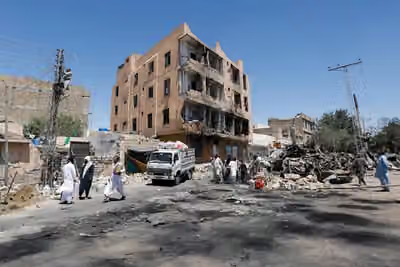
In response to an increase in armed attacks in Pakistan, Islamabad has carried out airstrikes on several Taliban bases and military facilities in three Afghan provinces in recent days.

Pakistan said its strikes on September 21 targeted militant positions in Kunar and Paktika, killing 28 people, while the Taliban and the United Nations reported that three civilians had been killed in Kunar.

On September 24, Pakistan also announced that it had targeted 10 sites in Afghanistan associated with the storage and launch of drones. The Taliban said at least four civilians had been killed in recent Pakistani strikes across three provinces.

The Taliban described the strikes as a violation of Afghanistan’s sovereignty and said it had carried out attacks on Pakistani border positions in response.

Most Viewed

260 Afghans Killed Fighting Alongside Pakistani Taliban, Say Sources
1

260 Afghans Killed Fighting Alongside Pakistani Taliban, Say Sources

2

Pakistan Strikes 10 Sites in Afghanistan, Taliban Confirms

3

Pakistan Targets Taliban Leader’s Special Forces in Kandahar, Say Sources

4

Peshawar High Court Suspends Deportation of 17 Afghan Doctors

5

Taliban Detain Several Women in Herat, Say Sources

•
•
•

More Stories

260 Afghans Killed Fighting Alongside Pakistani Taliban, Say Sources

Sep 24, 2026, 16:38 GMT+1
100%

Pakistani security sources told Afghanistan International that 260 Afghans have been killed fighting alongside the Pakistani Taliban (TTP) in Pakistan, adding that their identities and addresses have been established.

Afghanistan International has obtained the names, personal details and photographs of these individuals.

According to the sources, the bodies of those killed were returned to their home villages for burial. They said even officials from the Taliban administration attended their funerals.

Pakistani security sources said the figure of 260 includes only those whose identities and personal details could be established. They stressed that the number of Afghans killed while fighting in the ranks of Tehreek-e-Taliban Pakistan (TTP) whose identities remain unknown has not been determined.

The sources also claimed that between 60 and 70 Afghan nationals are currently present in each TTP infiltration group.

Pakistani security sources also accused the Taliban administration of supplying weapons and equipment left behind by NATO and the United States to members of the Pakistani Taliban and Baloch separatists.

According to the sources, almost all members of these groups now possess American M4 rifles, Remington sniper rifles and night-vision equipment.

The Taliban administration has consistently denied Pakistan’s allegations that Afghan territory is being used by the TTP to carry out attacks against Pakistan. In recent years, Islamabad has repeatedly expressed concern over the presence and activities of TTP members in Afghanistan, identifying them as a major factor behind rising insecurity in Pakistan.

Pakistani security sources claimed that a proxy war against their country is being conducted with India’s full support. Both the Taliban and India have denied the allegation.

The sources said that in 2026 alone, terrorist attacks originating from Afghan territory have killed 1,327 Pakistanis and wounded another 2,484. According to them, these figures demonstrate the human cost of terrorism originating from Afghanistan.

The claims come amid escalating clashes between the Taliban and Pakistan in recent days. On Thursday, 24 September, Pakistan announced that it had targeted 10 locations in Afghanistan. In response, the Taliban warned that it would deliver a “crushing response” to the attacks.

Taliban Raid Shia Cleric’s Home in Ghor, Eight Reported Missing

Sep 23, 2026, 15:52 GMT+1
100%

Local sources in Ghor say Taliban intelligence forces raided the home of Mohammad Hamidi, imam of the Khatam al-Anbiya mosque. At least eight people have reportedly been detained or gone missing, with their families unaware of their whereabouts.

According to the sources, Taliban forces stormed Hamidi’s home in the Mohajerin township of Lal wa Sarjangal district on Tuesday, September 22, and surrounded his house and those of several relatives. The sources said the siege continued into Wednesday.

Information provided by local sources indicates that Hamidi’s son Abdullah and his brother Musa Fazel, along with several family friends, were detained during the operation. Accounts of the number of detainees vary among local sources and have not been independently verified.

A source close to the family said Hamidi also left his home during the raid, but it remains unclear whether he managed to escape the area or was detained by Taliban forces. One of his relatives said the family still had no information about his whereabouts or condition.

The incident came days after local sources reported that Hamidi had been detained for holding a religious ceremony and delivering a sermon commemorating Fatima Zahra. People close to the cleric said he was released after being detained by Taliban intelligence and morality police, but was subsequently barred from teaching, delivering religious sermons and leading congregational prayers.

Sources close to Hamidi said religious differences and his activities within the Shia community were among the reasons behind the pressure on him. They also alleged that the Taliban had collected recordings of several speeches he delivered during the former republic and used them as evidence against him. The Taliban has not confirmed these claims.

The Taliban has not officially commented on the operation, the number of people detained or their whereabouts.

Afghanistan’s Hazara and Shia communities have faced a range of security threats and religious restrictions in recent years.

In recent weeks, the Taliban has raided several major Shia political and cultural institutions in Kabul and shut down some universities, media outlets and political offices.

Taliban Forces Raid Karzai’s Home, Disperse Visitors, Say Sources

Sep 23, 2026, 12:19 GMT+1
100%

Taliban forces stormed former president Hamid Karzai’s home and dispersed a group of people who had gone there to meet him.

The reason for the raid remains unclear. Reliable sources in Kabul told Afghanistan International that Taliban forces prevented Karzai’s guests from meeting the former president.

The sources said Taliban forces stormed Karzai’s residence on Wednesday morning, September 23, and “disrespected” tribal elders who were on their way to meet him. It remains unclear whether the aim was to cancel the meeting or impose further restrictions on the former president’s activities.

According to the sources, Taliban personnel entered the former president’s residence without prior coordination. Some people protested against their conduct and asked to be allowed to meet Karzai, but armed Taliban forces dispersed them.

The Taliban has not yet explained the reason for the incident. It is also unclear which official ordered the forces to go to Karzai’s home. Sources said, however, that no attempt was made to arrest him.

One source said the latest restrictions were linked to Karzai’s recent statements on political developments in Afghanistan.

Over the past week, Karzai issued two messages marking the assassinations of Ahmad Shah Massoud and Burhanuddin Rabbani, Afghanistan’s former defence minister and president. He described one as a heroic mujahid and the other as a supporter of peace.

Neither the Taliban authorities nor Karzai’s office has so far commented on the incident.

The Taliban had previously imposed restrictions on Karzai’s movements and activities. In recent years, he has been prevented from making several foreign trips. In July, he was also barred from travelling to his home province of Kandahar.

Another source said restrictions on his social and political activities had also been tightened. According to the source, he cannot meet domestic or foreign figures, diplomats or political leaders without permission.

Sources also confirmed that the Taliban prevented Karzai from attending some Ashura ceremonies and from taking part in the funeral of Ali Khamenei, the former leader of the Islamic Republic of Iran.

According to the sources, some senior Taliban officials have told the former president to refrain from making public comments about the country’s political situation, girls’ education and other issues. Over the past five years, Karzai has repeatedly called on the Taliban authorities to reopen schools and universities to girls.

Karzai remained in Afghanistan after the Taliban returned to power. During this period, he made a limited number of foreign trips, including to Germany, reportedly for annual medical examinations. He also travelled to the United Arab Emirates and UK.

Taliban Officials Discuss Toti Maidan Gas Project Problems With Uzbek Minister

Sep 23, 2026, 11:40 GMT+1
100%

The Taliban’s Ministry of Mines and Petroleum says a technical delegation held talks in Uzbekistan on the Toti Maidan gas block in Jowzjan and the problems facing the project.

According to a ministry statement, the Taliban delegation, led by Ahmad Jan, a senior adviser to the Ministry of Mines and Petroleum, met Uzbek officials on Tuesday, September 22, to review the project’s status, technical and financial problems, and obstacles to implementing the contract.

The Taliban’s Ministry of Mines and Petroleum said that during a previous visit by an Uzbek delegation to Afghanistan, the two sides had set a 120-day period to assess problems affecting the Toti Maidan project. Under the agreement, both sides were expected to examine the obstacles and work towards resolving them during that period.

Uzbek officials said that although the contract for the Toti Maidan gas block had been signed between a private company and the Taliban’s Ministry of Mines and Petroleum, the Uzbek government was following the project at the state level and was ready to cooperate on oversight, financing and resolving technical problems.

The ministry also said it would cooperate in areas under its responsibility to remove obstacles and advance the project.

Exploration and extraction work at the Toti Maidan gas project in Jowzjan began on September 14, 2025. Ismatulla Irgashev, the Uzbek president’s special representative for Afghanistan, Abdul Ghani Baradar, the Taliban’s deputy prime minister for economic affairs, and other officials from both sides attended the launch ceremony.

At the time, Baradar said the completion of gas exploration and extraction would help meet part of Afghanistan’s domestic demand and reduce its dependence on imported gas and electricity. He also said increased production could eventually create opportunities for gas exports.

In recent years, the Taliban has signed several contracts with companies and countries for the exploration and extraction of Afghanistan’s oil, gas and mineral resources. However, some of these projects have faced delays, technical difficulties or funding shortages.

The Toti Maidan project has also encountered technical and financial problems, despite being presented by the Taliban at its launch as an important project for developing Afghanistan’s energy sector and reducing dependence on imports.

Registani Has Entered Battlefield In Calculated Move, Says NRF

Sep 22, 2026, 15:28 GMT+1
100%

Abdullah Khenjani, spokesperson for the National Resistance Front (NRF), said Saleh Mohammad Registani’s return to the battlefield was “calculated”.

Khenjani told Afghanistan International that Registani’s presence was part of a broader plan to begin a new phase of operations on the ground.

In an interview with Afghanistan International on Tuesday, Khenjani stressed that Registani’s return to the foothills of the Hindu Kush as the NRF’s operational commander was not a temporary move, but part of an ongoing process.

He expressed hope that the presence of the NRF’s operational commander would bring “fresh energy” to the group’s forces and boost the morale of Taliban opponents.

The NRF announced on Monday, in a video, that Rigistani had returned to Afghanistan and was in the foothills of the Hindu Kush.

In the video, Rigistani said that “the resistance continues” and that other fronts were also fighting the Taliban in different parts of the country.

Following the release of the video, several political and military figures opposed to the Taliban welcomed his return.

The NRF spokesperson rejected reports of divisions among armed groups opposed to the Taliban, saying there were no differences among the military fronts fighting the group. According to Khenjani, the NRF is coordinating with prominent anti-Taliban groups and there are no obstacles or problems in relations and coordination among them.

Khenjani added that the NRF had sought in recent years to change the perception that resistance depended on foreign support. He said Taliban opponents did not need to coordinate with regional countries or foreign intelligence agencies to operate inside Afghanistan, nor did they require permission from any party to enter or leave their own country.

He stressed that Afghans should not wait for support from countries in the East or Western world. According to Khenjani, Afghans have the “capacity, courage and willingness to make sacrifices” for their own future and should rely on their own capabilities.

Asked about the potential impact of Rigistani’s return, the NRF spokesman said the group assessed that the Taliban was facing multiple layers of domestic and external pressure. According to him, the Taliban is seeking to address some regional challenges through mediation and dialogue, while exerting widespread pressure on people inside Afghanistan and increasing its military presence, particularly in Panjshir.

Khenjani added that the NRF believed the current situation would not remain stable and that the Taliban was aware of its vulnerabilities and the challenges ahead. He said the first step towards defeating the Taliban was the group’s “psychological defeat”, claiming that it faced internal divisions, corruption and growing public discontent.

The NRF spokesperson also said some Taliban members had established contacts with regional countries and certain figures opposed to the group, but declined to provide further details.

Referring to what he described as the Taliban’s “violations of citizens’ rights, land seizures, intrusions into homes and removal of cultural symbols”, Khenjani said such grievances were accumulating in society and would eventually find a way to manifest themselves.

The NRF spokesperson urged Afghans not to remain neutral in the face of developments in the country and called on them to support Taliban opponents. He said Afghanistan had faced international isolation under Taliban rule and that the group had failed to address the problems facing the population.

Khenjani said the Taliban had not directly responded to Rigistani’s return. He said the Taliban had previously denied the presence of opposition fronts, but was now increasingly arguing that these groups lacked clear objectives — a claim that, according to Khenjani, was inconsistent with Rigistani’s stated positions and goals.

In the interview, the NRF spokesperson accused the Taliban of spending significant resources on efforts to create divisions among opposition fronts and wage psychological warfare against them. He stressed, however, that Taliban opponents would continue their struggle.