• العربية
  • پښتو
  • فارسی
BrandBrand
  • Afghanistan
  • Sport
  • Analysis
  • Markets
  • Afghanistan
  • Sport
  • Analysis
  • Markets
  • Theme
  • Language
    • العربية
    • پښتو
    • فارسی
  • Afghanistan
  • Sport
  • Analysis
  • Markets
All rights reserved for Volant Media UK Limited
volant media logo

Taliban Foreign Minister Discusses Security Cooperation With Russian Security Chief

Oct 6, 2026, 17:58 GMT+1

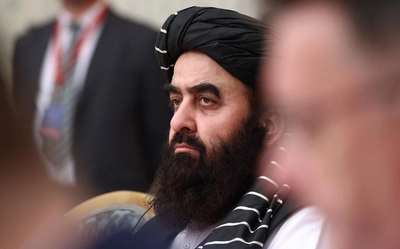
Taliban Foreign Minister Amir Khan Muttaqi called for expanded security, political and economic cooperation with Moscow during a meeting with Russian Security Council Secretary Sergei Shoigu.

The Taliban’s foreign ministry said on Tuesday that the two sides discussed expanding Afghanistan-Russia relations and strengthening cooperation in the security and political fields.

According to the ministry’s statement, Muttaqi referred to what he called the positive trajectory of political relations between Kabul and Moscow and thanked the Russian leadership for recognising the Taliban administration.

He also stressed the importance of expanding security cooperation, continuing regular political consultations and developing economic and trade relations between the two countries.

The Taliban foreign minister said the group’s government supported developing relations with countries in the region through direct contacts and practical cooperation.

The ministry also said Sergei Shoigu described relations between Russia and Afghanistan as expanding and spoke positively about the Taliban’s handling of the security situation and its efforts to combat narcotics.

Muttaqi said the Taliban administration would continue its efforts to maintain regional security and combat drug trafficking.

The meeting took place a day after the eighth Moscow Format consultations, where Muttaqi also addressed recent tensions between the Taliban and Pakistan.

He accused Islamabad of using the language of force and maximum pressure against the Taliban and said disputes between the two sides should be resolved through dialogue and diplomacy rather than military action.

Russia has steadily expanded its relations with the Taliban in recent years. Alongside political and economic engagement, Moscow has increasingly focused on security cooperation and regional coordination with the group’s administration.

Most Viewed

Pakistan Using Force, Maximum Pressure Against Taliban, Says Muttaqi
1

Pakistan Using Force, Maximum Pressure Against Taliban, Says Muttaqi

2

Taliban-Pakistan Dispute Blocks Joint Statement At Moscow Meet

3

Russia Steps Up Support For Security Along Tajikistan-Afghanistan Border

4

Russia Opposes NATO Military Presence In Afghanistan, Says Lavrov

5

Taliban Rule, IS-K Threats Increase Risks For Hazaras, Says Report

•
•
•

More Stories

No Alternative To Expanding Ties With Taliban, Says Russia

Oct 6, 2026, 15:40 GMT+1
100%

Russia’s foreign ministry said Moscow Format participants agreed there was no alternative to expanding cooperation with the Taliban administration and integrating Afghanistan into the global economy.

The eighth Moscow Format meeting was held in Moscow on Monday, 5 October, with representatives and senior officials from Russia, the Taliban, India, Iran, Kazakhstan, Kyrgyzstan, China, Pakistan, Tajikistan and Uzbekistan.

Taliban Foreign Minister Amir Khan Muttaqi led the group’s delegation, while representatives from Belarus and Egypt attended as guests.

In a statement, Russia’s foreign ministry said participants stressed the importance of developing relations with the Taliban administration “on the basis of equality and mutual benefit” and called for support for Afghanistan’s further integration into the global economy.

Participating countries also urged the international community to continue providing humanitarian assistance to the Afghan people on a regular basis and not make such aid conditional on political requirements.

The Moscow Format is one of the regional frameworks for discussions on Afghanistan. Russia, China, Iran, Pakistan, India and Central Asian countries are among its main participants. Previous meetings have addressed issues including security, counter-terrorism, narcotics, the economy and Afghanistan’s regional relations.

On the sidelines of Monday’s meeting, Russian Foreign Minister Sergei Lavrov met Muttaqi. Russia’s foreign ministry said the two discussed expanding bilateral relations and cooperation within regional and international meetings and organisations.

The Taliban’s foreign ministry also said in a statement that Muttaqi and Lavrov discussed political relations, economic and trade cooperation, regional issues and the continuation of political consultations between the two sides.

According to the Taliban foreign ministry, Muttaqi called for greater focus on economic, trade and transit cooperation, saying the Taliban attached considerable importance to developing long-term relations with Russia.

The ministry quoted Lavrov as saying Russia was also interested in expanding economic and trade relations with Afghanistan. It said Lavrov also praised the Taliban’s efforts to combat narcotics and maintain security.

Russia has gradually expanded its relations with the Taliban in recent years and has recognised the group’s administration. Moscow has repeatedly supported increased economic and political engagement with the Taliban at regional meetings, while also expressing concern in previous Moscow Format sessions about militant groups operating in Afghanistan.

Russian officials have said expanded relations with the Taliban are necessary for security reasons. Moscow is concerned about the potential movement of Central Asian and other foreign militants from northern Afghanistan into Tajikistan and other countries in the region.

Taliban Should Transfer Power To Afghan People, Says Hezb-e Islami Leader

Oct 6, 2026, 14:25 GMT+1
100%

Gulbuddin Hekmatyar, leader of Hezb-e Islami Afghanistan, has criticised the Taliban administration and called for power to be transferred to the people, saying Afghanistan’s future should be determined by its citizens.

Hekmatyar made the remarks in a recent online address attended by a number of his supporters. He said he wanted power transferred from the Taliban to the Afghan people so that citizens could elect a council and determine the country’s future political system and government.

He stressed that Afghanistan’s political future should be decided by the people rather than political parties or groups, and that the will of citizens should form the basis of any future political structure.

Referring to Afghanistan’s political future, Hekmatyar said “change is inevitable and near”, arguing that just as governments backed by the Soviet Union and the United States had failed to endure, Taliban rule would also not last.

He also said the Taliban administration remained politically isolated and, contrary to its claims, had no genuine and lasting allies in the region or internationally. According to Hekmatyar, countries that once supported the Taliban were no longer firmly aligned with the group, while no state offered it complete support.

Criticism of Taliban Foreign Policy

Hekmatyar also criticised the Taliban’s foreign policy, saying the group did not have any stable and reliable allies. He claimed that countries including Pakistan, Saudi Arabia and the United States had supported the Taliban in different ways in the past, but no longer backed the group and, in some cases, were now in political confrontation with it.

He said the Taliban had sought in recent years to expand relations with Russia, Iran and India and turn them into its main regional partners, but argued that these relationships did not amount to lasting or unconditional support.

Hekmatyar said that although Moscow had recognised the Taliban government, Russian officials had repeatedly raised concerns about security threats emanating from Afghanistan, the activities of militant groups and the Taliban’s system of governance.

He added that Tehran and New Delhi had also shaped their relations with the Taliban according to their own interests and considerations rather than on the basis of a strategic alliance.

The Hezb-e Islami leader said the Taliban faced a serious lack of international legitimacy and had failed to establish a stable position for itself in the regional and international order.

Hekmatyar added that although Russia had recognised the Taliban government, Moscow had repeatedly expressed concern over Afghanistan’s security situation and the Taliban’s governance, which he said showed that even the group’s closest foreign partners had reservations about its conduct.

He also accused the Taliban of intolerance towards opponents, saying that under its rule even unarmed critics and political opponents were unable to operate freely.

Addressing the Taliban, Hekmatyar said: “When you say opponents have no place in Afghanistan, then you have no place either, because you do not tolerate others.”

He said political disputes and disagreements should be addressed through “principled and Islamic” solutions and that Afghanistan’s problems should be resolved through dialogue and national understanding.

Hekmatyar also said proxy wars were continuing in the country while Afghans faced widespread problems including unemployment, insecurity and poverty.

He added that the mass expulsion of Afghan migrants from neighbouring countries had further compounded the country’s existing crises.

Taliban Minister Reverses Position, Rules Out Talks With Opponents

Oct 6, 2026, 11:23 GMT+1
100%

A Taliban minister who last week said the group was ready for talks with its opponents has reversed his position, saying the time for negotiations has passed and opposition groups are “not worth negotiating with”.

Noorullah Noori, the Taliban’s minister of borders, ethnic affairs and tribes, said in his latest remarks that there was no longer any need for dialogue or understanding with the group’s opponents and that the time for negotiations had ended.

Addressing Taliban opponents, he said they should not wait for talks to resume, adding: “This is not the time for negotiations. There is no need for negotiations or understanding.”

He made the remarks at a meeting with elders and religious scholars from Jaghori district in Ghazni province.

Less than a week earlier, the senior Taliban official had said the group was ready to hold talks with its opponents. On 30 September, during a meeting with Kuchi elders from six provinces, he called on opponents to abandon armed struggle and return to Afghanistan.

At that meeting, Noori had told opponents: “Afghanistan is the home of all Afghans. We are open to understanding and we will talk to you.” He also urged them to return to the country and “live peacefully”, while warning that they would be defeated if they continued armed resistance.

The Taliban official now says that “an Islamic system” is in place in Afghanistan and that opponents should explain what plan or alternative they have for the current system. Addressing them, he asked: “If you want an Islamic system, what is your version and what is your plan?”

The Taliban minister also claimed that the group had established security in Afghanistan and called on its opponents to explain what plans they had for maintaining security.

Noori again stressed the authority of the Taliban system under the leadership of Hibatullah Akhundzada and said “Sharia” was being enforced in the country. He also accused Taliban opponents of receiving financial support from the intelligence agencies of foreign countries.

The Taliban official went on to warn that opponents would not be able to disrupt security in Afghanistan.

Taliban opponents consider the group’s administration illegitimate and unlawful, saying it seized power through war and has deprived citizens, particularly women, of their fundamental rights.

Warning to Pakistan: Do not test the patience of the Afghan people

In another part of his remarks at the meeting with elders, religious scholars and residents of Jaghori district in Ghazni province, Noori criticised Pakistan and called on the country to respect the principles of good neighbourly relations.

The Taliban’s minister of borders, ethnic affairs and tribes said Pakistan should learn from the history, geography and past of both countries and should not take advantage of the “patience and tolerance” of the Afghan people.

He added that it was surprising that a country familiar with Afghanistan’s history and struggles would, in his words, continue to violate Afghan territory contrary to the principles of Islamic neighbourliness and international law.

Taliban, North Korea Hold Talks on Military Cooperation

Oct 6, 2026, 10:06 GMT+1
100%

A Taliban military delegation met a North Korean official during Russian military exercises, with South Korean media reporting talks on military training and the exchange of experience.

South Korean media reported that the Taliban military delegation took part in the multinational “Centre 2026” exercises at Russia’s invitation. The drills were held from 28 September to 3 October across several locations in Russia, including Chelyabinsk.

According to South Korean media, the delegation was led by Mawlawi Nasibullah Madani, commander of the Taliban’s Abdullah bin Masoud Joint Combat Training Centre. NK News also reported that Madani met Ro Ki Chol, North Korea’s military attaché.

A photograph released by the Taliban’s defence ministry shows the two officials together at a weapons exhibition held during the exercises.

The Taliban’s defence ministry only confirmed that its delegation met military representatives from several countries during the exercises, including North Korea, China, India, Vietnam, Colombia, Uzbekistan and Tajikistan.

According to the ministry, the sides discussed bilateral relations, the exchange of military experience, specialised training and potential areas of cooperation.

Rare Contact Between the Taliban and North Korea

This is the first reported instance of direct contact between Taliban and North Korean military officials. The two sides do not have formal diplomatic relations, and Pyongyang has not recognised the Taliban government.

The meeting comes as Russia has expanded its relations with both the Taliban and North Korea. Moscow has recognised the Taliban government, while Russia’s relationship with North Korea has developed into extensive military cooperation since the start of the war in Ukraine.

Russian President Vladimir Putin and North Korean leader Kim Jong Un signed a “Comprehensive Strategic Partnership” treaty in June 2024, expanding security and military cooperation between the two countries.

The Taliban declared a neutral position at the beginning of Russia’s full-scale invasion of Ukraine. On 25 February 2022, a day after the invasion began, the Taliban’s foreign ministry called on Russia and Ukraine to exercise restraint and resolve their differences through dialogue.

Taliban’s Treatment Of Afghan Women Should ‘Shock The Conscience Of Humanity’, Says UN

Oct 6, 2026, 08:38 GMT+1
100%

The UN Human Rights Council on Monday urged the Taliban to repeal all policies and measures violating the fundamental rights and freedoms of women and girls, saying systematic discrimination in Afghanistan should shock the conscience of humanity.

The 39th meeting of the council’s 63rd session was held in Geneva on Monday, 5 October, where the resolution on the human rights situation in Afghanistan was adopted without a vote.

Referring to the worsening human rights situation in Afghanistan, the council expressed deep concern over what it described as the Taliban’s severe, increasing, widespread and systematic repression of all women and girls in Afghanistan.

The council said the Taliban’s institutionalisation of a system of discrimination, segregation, domination, disregard for human dignity and exclusion of women and girls, and its consequences, were intolerable and unjustifiable and should shock the conscience of humanity.

Conformity, Fear and Exclusion

The UN Human Rights Council said that over the past five years, many rights in Afghanistan had been widely violated and restricted. It added that through new decrees and regulations, the Taliban had shaped society around fear, restrictions and the exclusion of opponents.

The council called on the Taliban to repeal all policies and measures that restrict women’s and girls’ enjoyment of human rights and fundamental freedoms. These restrictions include freedom of peaceful assembly, education, employment and the right to vote.

The Human Rights Council also urged the international community to consider the human rights and fundamental freedoms of all Afghans in its engagement with the Taliban in Afghanistan.

The resolution was sponsored by 37 European countries, Canada and Chile. The council also extended the mandate of Richard Bennett, the UN special rapporteur on human rights in Afghanistan, for another year.

The UN Human Rights Council has previously condemned the Taliban’s policies towards women in Afghanistan and called for them to be changed. UN experts have described the policies as part of an institutionalised system of discrimination against women and said they could be examined within the framework of “gender apartheid”.

The International Criminal Court on Monday also unsealed arrest warrants for two senior Taliban officials. ICC judges accused the Taliban’s education and higher education ministers of gender-based persecution over their alleged roles in depriving women and girls of education and other fundamental rights. The court considers the alleged conduct to amount to a crime against humanity.

In response, the Taliban said it did not recognise the International Criminal Court and did not consider its rulings valid.