• العربية
  • پښتو
  • فارسی
BrandBrand
  • Afghanistan
  • Sport
  • Analysis
  • Markets
  • Afghanistan
  • Sport
  • Analysis
  • Markets
  • Theme
  • Language
    • العربية
    • پښتو
    • فارسی
  • Afghanistan
  • Sport
  • Analysis
  • Markets
All rights reserved for Volant Media UK Limited
volant media logo

Taliban Invites Saudi Arabia To Explore Renewable Energy Investment In Afghanistan

Oct 15, 2026, 11:33 GMT+1

The Taliban’s water and energy minister has discussed solar and wind power cooperation with a Saudi energy official. The Taliban says a Saudi technical delegation is expected to visit Afghanistan to assess investment opportunities.

The Taliban’s Ministry of Water and Energy said on Wednesday that Mohammad Younus Akhundzada, the minister, met Saudi Deputy Energy Minister Mohammad Ibrahim during his visit to Saudi Arabia.

According to the ministry, the two sides discussed the potential for generating electricity from solar and wind energy, exchanging expertise and exploring areas of cooperation in the sector.

Akhundzada invited Saudi energy officials to visit Afghanistan to assess potential projects.

The Taliban’s Ministry of Water and Energy said the Saudi deputy energy minister had promised to send a technical delegation to Afghanistan to examine opportunities for cooperation.

However, no specific agreement on investment or joint projects has yet been announced, and no date has been given for the Saudi delegation’s visit.

Mohammad Younus Akhundzada travelled to Riyadh on Saturday, 11 October, to attend the 17th World Energy Forum.

Most Viewed

Afghanistan Replaces Lost Pakistan Trade Through Central Asia, Says Taliban
1

Afghanistan Replaces Lost Pakistan Trade Through Central Asia, Says Taliban

2

Taliban, Qatar Discuss Doha’s Support For Expanding International Ties

3

Afghan Traders Sign $55 Million Worth Of Contracts With Kazakhstan

4

Taliban Suspends BBC World Service FM Broadcasts In Afghanistan

5

Seven Taliban Governors Meet In Kabul As Armed Attacks Increase

•
•
•

More Stories

Taliban Morality Police Arbitrarily Detained 443 People In Three Months, Says UN

Oct 15, 2026, 10:20 GMT+1
100%

UNAMA says Taliban morality police arbitrarily detained or held at least 443 people over the past three months and documented 97 cases of ill-treatment involving women and men.

UNAMA published its quarterly report on the human rights situation in Afghanistan on Thursday, 15 October, covering the period from July to September 2026.

The mission said it documented more than 50 cases in which women were detained, held or warned over what the Taliban considers violations of its hijab rules.

Most of the detentions took place in Herat, where, according to UNAMA, the chador remains the mandatory form of dress for women.

The mission also recorded cases in Kabul and Badakhshan.

In one case, UNAMA said morality police detained a 13-year-old girl for allegedly failing to comply with the hijab rules. She was held overnight and released the following day after her father intervened.

On 10 July, morality police in Herat city also detained 10 women who were not wearing chadors. They were held until family guardians and local representatives pledged that the women would comply with the hijab rules in future.

Saif-ul-Islam Khyber, spokesman for the Taliban’s Ministry for the Promotion of Virtue and Prevention of Vice, confirmed on 27 September that women and girls had been detained in Herat and Kabul over their clothing and described non-compliance with the hijab rules as a very serious offence.

In another interview, he said that, in the Taliban’s view, a woman who is aware of the hijab rules but does not comply with them is considered an offender.

UNAMA also documented cases in which women were denied access to healthcare facilities or markets because they were not accompanied by a mahram, or male guardian.

According to UNAMA, on 8 August in Parwan, morality police prevented two women from entering a healthcare facility because they did not have a mahram with them.

On 17 August in Helmand, a woman was similarly denied access to a market because she was unaccompanied by a mahram.

During the same period, Taliban institutions issued official messages telling women to remain at home and obey their husbands.

In a sermon prepared for Friday prayers on 7 August, the Taliban’s Ministry of Hajj and Religious Affairs said women should obey their husbands, remain at home and not leave without their husbands’ permission.

Russian Intelligence Chief Arrives In Kabul, Meets Taliban Spy Chief

Oct 15, 2026, 09:26 GMT+1
100%

Sergei Naryshkin, head of Russia’s Foreign Intelligence Service, arrived in Kabul on Wednesday and met Taliban intelligence chief Abdul Haq Wasiq. Neither side has disclosed the purpose of the visit.

The visit comes as relations between Moscow and the Taliban continue to expand. Russia formally recognised the Taliban government in July 2025 after removing the group from its list of banned organisations.

Since then, Moscow has emphasised the importance of expanding political, economic and security cooperation with the Taliban.

Naryshkin is among the senior Russian officials who supported closer relations with the Taliban even before Moscow formally recognised its government.

At a conference on Afghanistan in Baku in April 2025, he praised the Taliban’s governance and said international recognition of its government was inevitable.

At the same meeting, the Russian intelligence chief accused Western countries of seeking to prolong instability in Afghanistan by keeping Afghan assets frozen and providing intelligence support to Taliban opponents.

On 18 October 2025, on the sidelines of a meeting of intelligence and security chiefs from Commonwealth of Independent States countries in Samarkand, Uzbekistan, Naryshkin also expressed opposition to the establishment of foreign military bases in Afghanistan.

He said Afghanistan had always attracted the attention of international actors, but Russia’s position was clear: Afghanistan should remain an independent country without foreign military bases. He described this as being in the interests of regional countries and, above all, the Afghan people.

In June 2024, Naryshkin also said the Taliban was the only force capable of controlling Afghanistan’s territory.

He has previously praised the Taliban’s efforts against Islamic State Khorasan Province (ISKP), saying the authorities in Afghanistan were making extensive efforts to combat the group.

Naryshkin’s visit to Kabul comes as Russia continues to express concern about security threats originating in Afghanistan, particularly the activities of extremist groups and the risk of instability spreading into Central Asia.

Moscow has repeatedly warned about the activities of ISKP in Afghanistan and called for greater regional cooperation to counter terrorist threats.

Tehran May Lease Part Of Chabahar Land To Taliban, Says Iranian MP

Oct 14, 2026, 14:45 GMT+1
100%

Iranian MP Mohammad Mehdi Shahriari says Tehran may make 100 hectares of land at Chabahar port available to Afghanistan for two to five years for imports and transit activities.

Shahriari is a member of the Iranian parliament’s National Security and Foreign Policy Commission.

He said Afghanistan has no access to international waters and that the land could be made available to the Afghan side to import goods through Chabahar port and transport them through Iranian territory.

He stressed that any such arrangement would preserve Iran’s territorial sovereignty and would not amount to transferring Iranian territory.

Iranian Foreign Ministry spokesman Esmaeil Baghaei recently stressed that transferring Iranian territory to another country was not possible and said claims to that effect were the result of a misunderstanding.

He said the issue under discussion concerned possible ways of helping landlocked countries gain access to ports and international waters and that no formal proposal existed to transfer Iranian land or territory to Afghanistan.

Baghaei also said discussions about transferring sovereignty or handing over part of Iranian territory to Afghanistan had no factual basis, adding that Tehran was only considering ways to facilitate Afghan trade and investment in Chabahar.

Shahriari’s remarks have once again brought the issue of Afghanistan’s presence and investment at Chabahar port to the centre of political debate in Iran.

The issue had previously sparked controversy. On 9 October, Iranian MP Mohsen Zangeneh, who travelled to Kabul as part of a parliamentary delegation, said around 10 hectares of land at Chabahar port and more than 100 hectares in the port’s free zone had been designated for Afghan investment.

His remarks drew widespread reaction in Iranian media and on social networks, with some interpreting them as suggesting that part of Iranian territory would be handed over to Afghanistan.

Zangeneh later walked back his initial comments, explaining that he had not meant a transfer of ownership or sovereignty over Iranian territory.

He said the proposal was instead intended to provide facilities for Afghan investment and to develop transit infrastructure, including a dry port, in Chabahar.

Chabahar port has in recent years become one of Afghanistan’s most important routes to international waters.

Its importance has grown particularly amid increasing border and trade tensions between the Taliban and Pakistan, while Taliban officials have repeatedly stressed expanding the use of the route for trade and the transit of goods.

Afghanistan Replaces Lost Pakistan Trade Through Central Asia, Says Taliban

Oct 14, 2026, 09:40 GMT+1
100%

Taliban spokesperson Zabihullah Mujahid says Afghanistan is offsetting losses from closed Pakistani border crossings by using alternative routes and expanding trade with Central Asian countries.

Before the crossings were closed, annual trade between Afghanistan and Pakistan was estimated at around $2.35 billion.

Mujahid told state television on Tuesday that Afghanistan’s import and export needs were now being met through Iran and Central Asian countries.

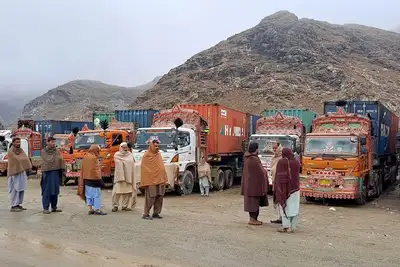
Following border clashes between the Taliban and Pakistan in October 2025, the main crossings between the two countries, including Torkham and Spin Boldak, were closed, forcing Afghan traders to move goods through alternative routes.

According to a World Bank report, 48 per cent of Afghanistan’s imports in August this year arrived through Central Asian routes and 46 per cent through Iran, while Pakistan’s share fell to almost zero.

Figures from the Taliban’s Ministry of Industry and Commerce show that Afghanistan’s trade with the five Central Asian countries reached $2.62 billion in 2025, up 45 per cent from the previous year.

During that period, Afghanistan’s imports from Uzbekistan, Turkmenistan, Tajikistan, Kazakhstan and Kyrgyzstan rose by 43 per cent, while exports to those countries increased by 77 per cent. However, part of this growth occurred before the closure of the Pakistani border.

According to the Taliban’s Ministry of Industry and Commerce, Afghanistan’s trade with Central Asia reached $1.278 billion in the first five months of 2026, including $1.204 billion in imports and $74 million in exports.

By contrast, the value of Afghan exports to other countries through the Wagah crossing and Pakistani ports fell from $454 million in the 2025 financial year to $7 million in the 2026 financial year.

Before the border closures, direct trade between Afghanistan and Pakistan was estimated at at least $6.45 million a day, equivalent to around $2.35 billion a year.

The World Bank says the continued closure of Pakistan’s crossings has reduced Afghanistan’s food exports and almost halted coal exports.

Textile exports, however, have increased, with some shipments being transported to China through Central Asia.

Taliban, Qatar Discuss Doha’s Support For Expanding International Ties

Oct 14, 2026, 08:23 GMT+1
100%

Taliban Foreign Minister Amir Khan Muttaqi thanked Qatar on Tuesday for its efforts to expand the Taliban’s relations with other countries during a meeting with Qatari Ambassador to Kabul Mirdef Al-Qashouti.

According to the Taliban Foreign Ministry, the two discussed relations between the Taliban and Qatar and ways to broaden the group’s engagement with the international community.

Muttaqi described the Taliban’s relations with countries around the world as expanding.

The ministry said in a brief statement that the meeting included comprehensive discussions on bilateral relations between Afghanistan and Qatar, particularly Qatar’s facilitation and efforts to strengthen the Islamic Emirate of Afghanistan’s relations with the international community.

The statement added that the foreign minister described the Islamic Emirate of Afghanistan’s relations with the international community as expanding and said Qatar’s efforts in this regard were worthy of appreciation.

According to the Taliban Foreign Ministry, the Qatari ambassador also stressed that his country would continue working to expand these relations and described the progress made so far as encouraging.

Qatar has for years served as one of the Taliban’s most important channels of communication with the United States and Western countries and hosts the group’s political office in Doha.

The office facilitated negotiations between the Taliban and the United States, which led to the Doha agreement and the withdrawal of US forces from Afghanistan. As those forces withdrew, Ashraf Ghani’s government collapsed and the Taliban returned to power.

Qatar maintained its relations with the Taliban following the group’s return to power and has become one of its most important intermediaries with the international community.

According to the Taliban, Qatar’s prime minister is the only senior foreign official to have met Taliban leader Hibatullah Akhundzada in Kandahar.

Qatar has also played a role in diplomatic efforts concerning Afghanistan in recent years. It has hosted talks between the Taliban and Pakistan and assisted with meetings related to engagement between the Taliban and the United Nations.

Despite these ties, Qatar has not recognised the Taliban government.

Russia is the first country to have formally recognised the Taliban government. Several other countries have maintained relations and engagement with the Taliban without formally recognising its government.