Pakistan Detains 104 Afghans In Balochistan Over Alleged Illegal Migration

Pakistani security forces have detained 104 Afghans in two operations in Balochistan while they were allegedly attempting to travel illegally to Iran and Europe.
Pakistani security forces have detained 104 Afghans in two operations in Balochistan while they were allegedly attempting to travel illegally to Iran and Europe.
Pakistani media reported that the operations were carried out as part of efforts to prevent human trafficking in Balochistan.
According to Pakistani security sources, security forces stopped the Afghan nationals from travelling through illegal routes.
No further details have been released about the identities of those detained, any suspected human trafficking network or what legal action may follow.
In recent months, several groups of Afghan nationals have been detained in Pakistan’s Balochistan province while allegedly attempting to travel to Iran.
Pakistani officials have said the individuals intended to travel onwards from Iran to European countries.
At the same time, Pakistan’s Interior Ministry ordered the detention, from 10 July, of Afghan nationals living in the country without valid visas.
The directive is part of Pakistan’s programme to return undocumented foreign nationals.
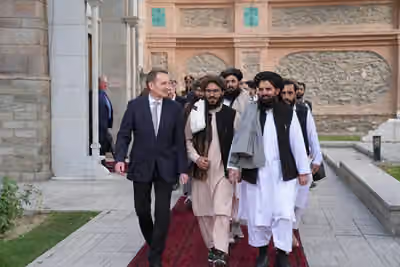
CIS Secretary-General Sergey Lebedev says Afghanistan’s security situation remains tense, warning that Islamic State Khorasan, al-Qaeda and other groups are seeking to spread instability into Central Asia.
Speaking at a joint meeting of the Collective Security Treaty Organisation, the Commonwealth of Independent States and the Shanghai Cooperation Organisation, Lebedev said international terrorist groups remained active in Afghanistan and aimed to spread instability and extremist ideologies to neighbouring Central Asian countries.
The meeting was held in Moscow on Friday, 16 October.
Lebedev described drug trafficking and cross-border crime as the second major threat. He said that despite restrictions imposed by the Taliban authorities, the underground production of synthetic drugs and opiates, as well as trafficking routes, remained active.
According to him, proceeds from these activities help finance terrorist cells.
The CIS secretary-general said the organisation’s approach towards Afghanistan had been consistent and pragmatic.
Russian Foreign Minister Sergei Lavrov said Islamic State Khorasan Province intends to use Afghanistan as a base from which to expand its terrorist activities into Central Asia and Russia.
Lavrov said terrorist groups had established a significant number of training camps in areas of Afghanistan bordering Tajikistan and Uzbekistan.
Lebedev added that CIS member states maintain regular dialogue with the Taliban authorities and said both sides had concluded that building a sustainable economic foundation could help Afghans determine their own future and reduce factors that contributed to previous crises.
He said CIS countries were pursuing projects aimed at increasing Afghanistan’s economic capacity.
Lebedev added that Afghanistan’s participation in regional infrastructure and energy projects, along with expanded trade with Central Asian countries, could help create conditions for peaceful coexistence with neighbouring states.
At the same time, the CIS secretary-general stressed that the security of the organisation’s southern borders remained a priority.
He said member states, in cooperation with the CSTO, were focused on continuous monitoring of the Tajikistan-Afghanistan border and providing technical assistance to strengthen the defence capabilities of Central Asian countries.
Lebedev warned that any attempt at armed provocation or cross-border incursion would face a strong response.
He described cooperation with the Taliban authorities as an important condition for ensuring the security of Russia and Central Asia, saying the CSTO, CIS and SCO had the necessary tools and capacity to cooperate on Afghanistan’s stability.
According to him, the first priority should be Afghanistan’s sustainable economic development.
Lebedev said expanding trade cooperation among the three organisations, developing transport routes and incorporating trans-Afghan corridors into these projects could create a more sustainable social and economic foundation.
He also said Central Asia and Afghanistan face the effects of climate change, extreme weather and natural disasters, with the Afghan population particularly vulnerable to these challenges.
The CIS secretary-general called for continued humanitarian assistance to Afghanistan and support for developing the country’s national system for preventing and responding to natural disasters.
He also said Afghanistan’s economic growth required the development of its human capital and professional expertise.
Shanghai Cooperation Organization (SCO) Deputy Secretary-General Ahmad Saeed Moradzadeh says an inclusive government involving Afghanistan’s ethnic and political groups is the only path to lasting peace and stability.
Speaking at a joint meeting of SCO, the Collective Security Treaty Organisation and the Commonwealth of Independent States, Moradzadeh said member states’ common position on Afghanistan was reflected in the Bishkek Declaration.
He said leaders of member states had stressed the need to rebuild Afghanistan as an independent, neutral and peaceful country free from terrorism, war and drugs, and had expressed readiness to support international efforts for peace and development.
Moradzadeh said the SCO’s assessment was that the situation in Afghanistan was currently broadly under control, but that the risk of rapid deterioration remained in place.
He added that Afghanistan’s humanitarian situation had worsened because of reduced international aid and a decline in foreign trade following the closure of the border with Pakistan.
The SCO deputy secretary-general said this made greater participation by Kabul in social and economic projects, including those within the organisation’s region, increasingly necessary.
Citing the executive committee of the SCO’s Regional Anti-Terrorist Structure, he said Islamic State Khorasan Province remained the main destabilising force in Afghanistan and was seeking to expand its activities beyond the country’s borders.
He said other armed groups were also active in Afghanistan. According to him, al-Qaeda has around 600 fighters in the country, while Tehreek-e-Taliban Pakistan has carried out more than 600 attacks over the past two years.
Moradzadeh also named the East Turkestan Islamic Movement, the Islamic Movement of Uzbekistan and Jamaat Ansarullah as groups active in Afghanistan.
He expressed concern about continuing cross-border military clashes between Afghanistan and Pakistan, as well as recent attacks by armed groups from Afghan territory on border areas of Tajikistan.
The SCO deputy secretary-general said the organisation had issued a statement on 3 December last year strongly condemning an attack on Tajik territory.
He said the SCO secretariat regularly consults UNAMA, the UN Secretariat’s political affairs department in New York and the UN Regional Centre for Preventive Diplomacy for Central Asia in Ashgabat on the situation in Afghanistan.
According to Moradzadeh, the SCO has also begun participating this year in meetings of the CSTO Council of Foreign Ministers’ working group on Afghanistan.
He said the SCO-Afghanistan Contact Group was established in 2005 and that in 2018 the level of representation was raised to deputy foreign minister level.
However, he added that no meeting of the group had taken place since the change of power in Kabul in 2021.
The SCO deputy secretary-general said there was currently no consensus among member states on resuming the Contact Group’s work and that, in the words of Russia’s foreign minister, the mechanism remained suspended.
He added that in September last year, under Tajikistan’s chairmanship, representatives of the SCO’s 10 member states held consultations on Afghanistan for the first time at the level of special representatives.
He said the possible resumption of the SCO-Afghanistan Contact Group was among the issues discussed.
Moradzadeh also said the SCO was establishing new permanent bodies to counter security threats, including a counter-narcotics centre in Dushanbe and a comprehensive security threats centre in Tashkent.
He added that information security and transnational organised crime centres would also operate within this framework.
The National Resistance Front and Afghanistan Freedom Front have warned of possible organised threats against diplomatic missions, UN offices and international organisations in Afghanistan.
In a joint statement on Thursday, 15 October, the two anti-Taliban political and military groups said intelligence they had received indicated that individuals within, or linked to, Taliban security structures could be planning attacks against international interests and institutions in Afghanistan.
They alleged that such individuals might be acting in coordination with extremist networks and some foreign circles.
The statement said those behind any potential attacks could use the name of Islamic State or other aliases to conceal their identity and objectives.
However, the National Resistance Front and Afghanistan Freedom Front stressed that the details of the intelligence should be independently examined and verified by credible security organisations.
Recently, Taliban police said they had arrested four people in Kabul who were allegedly planning to attack UNAMA offices and staff. The Taliban claimed the suspects were members of the National Resistance Front.
The National Resistance Front rejected the allegation and described a video released by the Taliban as intelligence propaganda.
The group called on UNAMA to investigate the matter and said it was prepared to respond to any evidence or questions.
The two fronts said such a scenario could be intended to create fear, convince the international community that it depends on Taliban security structures, exert political pressure on countries and international organisations, divert public attention from existing crises, and discredit opposition groups.
The National Resistance Front and Afghanistan Freedom Front condemned any attack or threat against diplomatic missions, United Nations offices, humanitarian organisations, human rights institutions and their civilian staff.
They urged diplomatic missions and international organisations to review their security and protection measures and not base assessments of potential threats solely on information provided by the Taliban.
The two groups also called on the United Nations and other international organisations to independently assess available information about the alleged threats and establish a mechanism to monitor, document and investigate them.
The statement said the Taliban, as Afghanistan’s de facto authorities, bear direct responsibility for the security of diplomatic missions, international organisations, human rights bodies and their staff.
The National Resistance Front and Afghanistan Freedom Front said that if individuals or networks linked to the Taliban were proven to have been involved in planning, facilitating or carrying out such attacks, those responsible and those who ordered them should be held accountable.
The two groups concluded by stressing what they described as a distinction between legitimate resistance and “terrorist acts”, saying attacks on civilians, diplomatic missions, humanitarian organisations and human rights bodies had no place in their activities.
They called on the international community to take the warning seriously and to take necessary steps to independently assess possible threats and protect its institutions and personnel in Afghanistan before any incident occurs.
UNAMA says 512 civilians were killed and 1,236 others injured over the past year in military incidents along the Afghanistan-Pakistan border.
The United Nations Assistance Mission in Afghanistan published its quarterly human rights report on Thursday, 15 October, covering the period from July to September 2026.
UNAMA said the casualty figures were recorded between 1 October 2025 and 30 September 2026.
According to the report, between 1 July and 30 September this year alone, 13 people were killed and 20 others injured.
UNAMA referred to civilian deaths caused by attacks by Pakistani forces in Kunar, Paktika and Helmand.
The UN mission said women and children were among the victims. It also documented several cases of civilians being injured by pressure-plate improvised explosive devices in border areas of Kunar.
Tensions between the Taliban and Pakistan escalated into widespread border clashes from October 2025.
Taliban Officials Arbitrarily Detained 443 People in Three Months
UNAMA said Taliban morality police arbitrarily arrested or detained at least 443 people over the past three months and documented 97 cases of ill-treatment involving women and men.
The mission said it recorded more than 50 cases in which women were arrested, detained or warned over what the Taliban considers violations of its hijab rules.
Most of the detentions took place in Herat, where, according to UNAMA, the chador remains the mandatory form of dress for women.
Cases were also documented in Kabul and Badakhshan.
In one incident, UNAMA said morality police detained a 13-year-old girl for allegedly failing to comply with the hijab rules. She was held overnight and released the following day after her father intervened.
On 10 July, morality police in Herat also detained 10 women who were not wearing chadors. They were held until family guardians and local representatives pledged that the women would comply with the hijab rules in future.
Saif-ul-Islam Khyber, spokesperson for the Taliban’s Ministry for the Propagation of Virtue and Prevention of Vice, confirmed on 27 September that women and girls had been detained in Herat and Kabul over their clothing and described non-compliance with the hijab rules as a “very serious offence”.
In another interview, he said a woman who was aware of the hijab rules but failed to comply with them was considered an offender by the Taliban.
UNAMA also documented cases in which women were denied access to healthcare facilities or markets because they were not accompanied by a mahram, or male guardian.
According to UNAMA, on 8 August in Parwan, morality police prevented two women from entering a healthcare facility because they did not have a mahram (male guardian) with them.
On 17 August in Helmand, a woman was similarly denied access to a market because she was unaccompanied by a male guardian.
During the same period, Taliban institutions issued official messages telling women to remain at home and obey their husbands.
In a sermon prepared for Friday prayers on 7 August, the Taliban’s Ministry of Hajj and Religious Affairs said women should obey their husbands, stay at home and not leave without their husbands’ permission.
Shias Detained and Religious and Educational Centres Closed
UNAMA confirmed that the Taliban detained a number of employees of institutions affiliated with Afghanistan’s Shia community in September and closed several educational, religious and healthcare centres in Kabul.
Afghanistan International had published several reports during the same period about Taliban actions against Shias in Kabul and the closure of their religious and educational centres.
The cases included the detention of 28 employees of Khatam al-Nabieen University and the closure of seven centres in western Kabul.
According to the report, the detentions and closures were linked to Taliban claims of ownership over land used by these institutions.
UNAMA said that on 5 September, employees of the Taliban’s Ministry of Justice, accompanied by security forces, detained 28 male staff members of Khatam al-Nabieen University on Darul Aman Road in Kabul. The university is described as an institution affiliated with the Shia community.
Four lecturers were released the same day, while the remaining 24 were freed on 8 and 9 September.
Between 6 and 9 September, UNAMA documented the detention of at least six other people in connection with events at Khatam al-Nabieen University.
According to UNAMA, they were detained for criticising or protesting the Taliban’s actions concerning the university, with their detention lasting from several hours to seven days.
On 16 September, the Taliban’s Ministry of Higher Education revoked the operating licence of Khatam al-Nabieen University in Kabul and its branch in Ghazni.
A ministry spokesperson said the licence had been revoked because of the “continued violation of applicable regulations” and failure to implement corrective measures despite several rounds of discussions and warnings.
UNAMA also said that on 19 September, the Taliban’s Ministry of Justice detained six employees of Al-Anbiya school and cultural complex in the Qala-e-Nazer area of Kabul. They were released later the same day.
On 27 September, the Ministry of Justice also closed seven centres in different parts of western Kabul that primarily served the Shia community.
UNAMA said the centres included one health clinic, two educational centres, one sports club, two religious schools and one mosque.
Despite Taliban efforts to take part in CICA activities, the organisation’s seventh summit opened in Baku on Thursday without a Taliban representative. Afghanistan has been a CICA member since 1999.
The Conference on Interaction and Confidence Building Measures in Asia (CICA) has 28 member states, covering around 90 per cent of Asia’s territory and population.
Its members include China, India, Pakistan, Iran, Russia, Türkiye, Qatar, the United Arab Emirates, Israel, Palestine and the Central Asian countries.
This year’s summit is being hosted in Baku by Azerbaijani President Ilham Aliyev.
Azerbaijan’s presidential office said heads of state and government from participating countries arrived at the summit on Thursday.
Israeli President Isaac Herzog also travelled to Baku to attend the meeting. Israel, like Afghanistan, is a full member of CICA.
Taliban efforts to restore Afghanistan’s participation in CICA
The Taliban has sought in recent months to increase Afghanistan’s participation in CICA activities.
On 8 July this year, Mohammad ur-Rahman Rahmani, chargé d’affaires of the Taliban embassy in Kazakhstan, met CICA Secretary-General Kairat Sarybay at the organisation’s headquarters.
Bakhtar News Agency, which is controlled by the Taliban, reported at the time that the two discussed Afghanistan’s membership, greater participation in CICA meetings and activities, and Afghanistan’s role in regional cooperation.
CICA says Afghanistan’s seat remains reserved
CICA Secretary-General Kairat Sarybay has previously said that although an Afghan delegation has stopped attending the organisation’s meetings, Afghanistan remains a full member and its place is reserved.
In 2023, he said Afghanistan’s delegation was not participating in CICA events but that the country’s membership would continue.
The CICA secretary-general described Afghanistan as a country with significant influence on Central Asian security and said member states should ensure that terrorist threats do not originate from Afghan territory and that the country does not become a haven for terrorist groups.
Despite the absence of a Taliban delegation, CICA has maintained contacts concerning Afghanistan in recent years. In August 2025, the CICA secretariat held its first informal consultative meeting on engagement with Afghanistan.
Afghanistan’s last participation in a CICA summit
Afghanistan’s last confirmed participation in a CICA summit was on 15 June 2019.
Abdullah Abdullah, chief executive of the former Afghan government, represented Afghanistan at the fifth CICA summit in Dushanbe, Tajikistan.
Following the collapse of the former government, Afghanistan had no representative at the sixth CICA summit in Astana in 2022.
In the final list of participating delegations, Afghanistan was listed first among the member states, but the section for the name and position of its representative was left blank.
Despite Afghanistan having no representative, the country’s situation has remained among the issues discussed at CICA meetings over the past five years.
What is CICA?
CICA is a multilateral framework for dialogue and cooperation among Asian countries. The initiative to establish it was proposed by then-Kazakh President Nursultan Nazarbayev at the UN General Assembly in 1992.
Its first meeting of foreign ministers was held in 1999, and its first summit took place in 2002. CICA’s permanent secretariat is based in Astana, Kazakhstan.
The organisation focuses on issues including security, counterterrorism, trade, transit, energy, the environment, technology and economic cooperation. Its decisions are made by consensus among member states.