• العربية
  • پښتو
  • فارسی
BrandBrand
  • Afghanistan
  • Sport
  • Analysis
  • Markets
  • Afghanistan
  • Sport
  • Analysis
  • Markets
  • Theme
  • Language
    • العربية
    • پښتو
    • فارسی
  • Afghanistan
  • Sport
  • Analysis
  • Markets
All rights reserved for Volant Media UK Limited
volant media logo

20 Police Officers Abducted in Pakistan’s Balochistan

Oct 17, 2026, 12:50 GMT+1

Twenty police officers have been abducted by unidentified gunmen in Pakistan’s Balochistan province, while armed men separately destroyed an empty police post in Qila Abdullah district.

According to reports, the abducted officers were travelling from Kalat towards Nushki and were seized along the Sarband route, a shorter road between the two districts.

A senior government official, speaking on condition of anonymity, said on Saturday, 17 October, that the officers were from Washuk, Chagai, Kharan and Nushki districts in the Rakhshan region and had been undergoing training at the police training centre in Kalat.

The official said the officers were travelling on leave in a private passenger vehicle when armed men abducted them within Kalat district and later moved them towards Mastung district.

The attackers released the driver and two or three other passengers along the way, but took the police officers to an unknown location.

Officials said efforts had begun to secure the release of the abducted officers. No group has so far claimed responsibility.

In a separate incident, unidentified armed men destroyed an empty police post in the Pankai area of Qila Abdullah district.

A police officer in Quetta said police and security forces launched an operation against the attackers after receiving reports of the incident. The gunmen later fled towards the Panjpai area.

Rising Insecurity and Kidnappings in Balochistan

The incidents come as Balochistan has seen a rise in armed attacks, kidnappings of government officials and assaults on security forces in recent years.

Baloch separatist groups, particularly the Balochistan Liberation Army, are among the main groups involved in the armed insurgency against the Pakistani state.

These groups seek independence for Balochistan and have targeted security forces, government facilities and some economic projects.

In one of the most significant recent incidents, armed men linked to the Balochistan Liberation Army stopped the Jaffar Express passenger train, travelling from Quetta to Peshawar, on 11 March 2025 and took hundreds of passengers hostage.

Pakistani security forces launched an operation to free the hostages, and dozens of people, including passengers and attackers, were killed.

The attack was one of the most prominent examples in recent years of the growing operational capacity of Baloch separatist groups.

Despite its extensive natural resources, Balochistan remains one of Pakistan’s less developed regions.

Long-standing grievances over local communities’ share of natural resources, political demands and reports of enforced disappearances of Baloch activists are among the factors that have contributed to the continuation of the insurgency in the province.

Alongside Balochistan, Khyber Pakhtunkhwa province also faces frequent attacks by armed groups, particularly Tehreek-e-Taliban Pakistan.

The two provinces remain among the main centres of insecurity in Pakistan.
Most Viewed

Regional Security Threats Come From Pakistan, Says Taliban
1

Regional Security Threats Come From Pakistan, Says Taliban

2

Taliban Isolation Could Trigger New Conflict In Afghanistan, Says CIS Secretary-General

3

Inclusive Government Is Key To Lasting Peace In Afghanistan, Says SCO

4

China Urges Taliban To Take Concrete Action Against Terror Groups In Afghanistan

5

Pakistan Detains 104 Afghans In Balochistan Over Alleged Illegal Migration

•
•
•

More Stories

Pakistan Trained & Supported Militants During Afghan War, Says Achakzai

Oct 17, 2026, 09:25 GMT+1
100%

Mahmood Khan Achakzai, leader of the Pashtunkhwa Milli Awami Party, has blamed Pakistan’s policies for regional insecurity, accusing the state of recruiting, training and supporting militants during the Soviet-Afghan war.

Speaking at a protest rally on Friday, 16 October, against the imposition of a state of emergency in Khyber Pakhtunkhwa, Achakzai accused Pakistan authorities of contributing to the spread of militancy.

He said Pakistan authorities, rather than the Pashtun population, were responsible for spreading terrorism in the country.

Achakzai alleged that during the Soviet military intervention in Afghanistan, Pakistan had brought militants from around the world into the region, trained them, taught them how to make bombs and provided them with facilities and support.

The Pashtun nationalist leader called for an end to violence and said Pakistan’s domestic and foreign policies should be determined by elected representatives in the National Assembly, Senate and Khyber Pakhtunkhwa Assembly, rather than by military generals.

He also urged the military, civilian administration and judiciary to operate within their constitutional responsibilities.

Achakzai warned that Pashtuns would resist any attempt to seize control of their land and natural resources, including water and minerals, by force.

He added that if Pakistan’s courts failed to address their grievances and protect their rights, they would seek justice through international courts.

Fazlur Rehman Criticises Pakistan’s Economic Policies

Meanwhile, Maulana Fazlur Rehman, leader of Jamiat Ulema-e-Islam, criticised Pakistan’s economic policies, arguing that the prolonged closure of trade routes with Afghanistan and restrictions on border trade with India had damaged the country’s economy.

He said trade routes with Afghanistan had remained closed for nearly a year, undermining economic activity.

Fazlur Rehman contrasted Pakistan’s economic situation with developments in Afghanistan, saying that despite decades of war and destruction, foreign investment in Afghanistan was increasing and agreements were being signed with international businesspeople.

By contrast, he said, investors showed little willingness to invest in Pakistan.

He also alleged that the state of emergency in Khyber Pakhtunkhwa was intended to facilitate access to the province’s valuable mineral resources.

According to Fazlur Rehman, efforts were under way to transfer control of mineral deposits to the United States, and agreements concerning the resources had already been reached with Washington. He provided no evidence for the allegation in the remarks reported.

He further claimed that moves by Pakistan’s government to facilitate the presence of foreign forces had raised concerns in Russia and China.

Regional Security Threats Come From Pakistan, Says Taliban

Oct 16, 2026, 15:07 GMT+1
100%

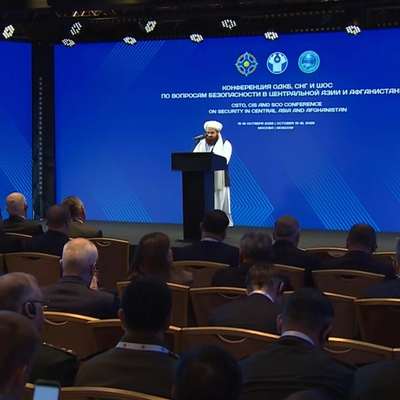
The Taliban’s ambassador to Russia has accused Pakistan of threatening regional security, harbouring armed Taliban opponents and enabling Islamic State activity on its territory.

Gul Hassan Hassan, the Taliban’s ambassador in Moscow, said the Taliban authorities wanted to expand relations with Central Asian countries, the wider region and the international community.

Speaking at a meeting on Central Asian and Afghan security in Moscow, Hassan claimed that security had been established inside Afghanistan over the past five years and that Taliban security agencies had dismantled Islamic State centres and eliminated the group’s leadership presence in the country.

Hassan said the Taliban’s security institutions and Defence Ministry had cooperated with agencies in other countries over the past five years to control armed groups and secure Afghanistan’s borders.

According to him, the Taliban Defence Ministry held 19 meetings with Tajik officials, 16 with Turkmenistan, nine with Iran and six with Uzbekistan on border security during this period.

The Taliban ambassador said that at present, the threat to the security and stability of our region originates from Pakistan.

He accused Pakistan of harbouring armed Taliban opponents and providing conditions for drug trafficking and Islamic State activities on its territory.

To support the allegation, Hassan referred to the arrest of several key members of Islamic State Khorasan Province in Pakistan’s Balochistan province and cited remarks by Balochistan Assembly member Fazal Qadir Mandokhail about the presence of Islamic State fighters and former Afghan government forces in the province.

He also claimed that reports based on international research and satellite imagery indicated an increase in poppy cultivation in Pakistan.

The Taliban ambassador further alleged that, in addition to enabling the activities, recruitment and fundraising of these groups, Pakistan attempted on 24 July to move hundreds of armed fighters through Chitral into Afghanistan’s Zebak district.

In another part of his remarks, Hassan said the Taliban Interior Ministry had carried out 25,116 counternarcotics operations in 2026.

According to him, poppy and cannabis crops covering more than 40,000 hectares were destroyed during the operations, along with 318 drug-production laboratories.

The Taliban ambassador in Moscow said drugs, chemicals and precursor substances were also seized and 10,026 people suspected of involvement in drug trafficking were detained and referred to judicial authorities.

Taliban Isolation Could Trigger New Conflict In Afghanistan, Says CIS Secretary-General

Oct 16, 2026, 13:02 GMT+1
100%

CIS Secretary-General Sergey Lebedev says Afghanistan’s security situation remains tense, warning that Islamic State Khorasan, al-Qaeda and other groups are seeking to spread instability into Central Asia.

Speaking at a joint meeting of the Collective Security Treaty Organisation, the Commonwealth of Independent States and the Shanghai Cooperation Organisation, Lebedev said international terrorist groups remained active in Afghanistan and aimed to spread instability and extremist ideologies to neighbouring Central Asian countries.

The meeting was held in Moscow on Friday, 16 October.

Lebedev described drug trafficking and cross-border crime as the second major threat. He said that despite restrictions imposed by the Taliban authorities, the underground production of synthetic drugs and opiates, as well as trafficking routes, remained active.

According to him, proceeds from these activities help finance terrorist cells.

The CIS secretary-general said the organisation’s approach towards Afghanistan had been consistent and pragmatic.

Russian Foreign Minister Sergei Lavrov said Islamic State Khorasan Province intends to use Afghanistan as a base from which to expand its terrorist activities into Central Asia and Russia.

Lavrov said terrorist groups had established a significant number of training camps in areas of Afghanistan bordering Tajikistan and Uzbekistan.

Lebedev added that CIS member states maintain regular dialogue with the Taliban authorities and said both sides had concluded that building a sustainable economic foundation could help Afghans determine their own future and reduce factors that contributed to previous crises.

He said CIS countries were pursuing projects aimed at increasing Afghanistan’s economic capacity.

Lebedev added that Afghanistan’s participation in regional infrastructure and energy projects, along with expanded trade with Central Asian countries, could help create conditions for peaceful coexistence with neighbouring states.

At the same time, the CIS secretary-general stressed that the security of the organisation’s southern borders remained a priority.

He said member states, in cooperation with the CSTO, were focused on continuous monitoring of the Tajikistan-Afghanistan border and providing technical assistance to strengthen the defence capabilities of Central Asian countries.

Lebedev warned that any attempt at armed provocation or cross-border incursion would face a strong response.

He described cooperation with the Taliban authorities as an important condition for ensuring the security of Russia and Central Asia, saying the CSTO, CIS and SCO had the necessary tools and capacity to cooperate on Afghanistan’s stability.

According to him, the first priority should be Afghanistan’s sustainable economic development.

Lebedev said expanding trade cooperation among the three organisations, developing transport routes and incorporating trans-Afghan corridors into these projects could create a more sustainable social and economic foundation.

He also said Central Asia and Afghanistan face the effects of climate change, extreme weather and natural disasters, with the Afghan population particularly vulnerable to these challenges.

The CIS secretary-general called for continued humanitarian assistance to Afghanistan and support for developing the country’s national system for preventing and responding to natural disasters.

He also said Afghanistan’s economic growth required the development of its human capital and professional expertise.

Inclusive Government Is Key To Lasting Peace In Afghanistan, Says SCO

Oct 16, 2026, 11:01 GMT+1
100%

Shanghai Cooperation Organization (SCO) Deputy Secretary-General Ahmad Saeed Moradzadeh says an inclusive government involving Afghanistan’s ethnic and political groups is the only path to lasting peace and stability.

Speaking at a joint meeting of SCO, the Collective Security Treaty Organisation and the Commonwealth of Independent States, Moradzadeh said member states’ common position on Afghanistan was reflected in the Bishkek Declaration.

He said leaders of member states had stressed the need to rebuild Afghanistan as an independent, neutral and peaceful country free from terrorism, war and drugs, and had expressed readiness to support international efforts for peace and development.

Moradzadeh said the SCO’s assessment was that the situation in Afghanistan was currently broadly under control, but that the risk of rapid deterioration remained in place.

He added that Afghanistan’s humanitarian situation had worsened because of reduced international aid and a decline in foreign trade following the closure of the border with Pakistan.

The SCO deputy secretary-general said this made greater participation by Kabul in social and economic projects, including those within the organisation’s region, increasingly necessary.

Citing the executive committee of the SCO’s Regional Anti-Terrorist Structure, he said Islamic State Khorasan Province remained the main destabilising force in Afghanistan and was seeking to expand its activities beyond the country’s borders.

He said other armed groups were also active in Afghanistan. According to him, al-Qaeda has around 600 fighters in the country, while Tehreek-e-Taliban Pakistan has carried out more than 600 attacks over the past two years.

Moradzadeh also named the East Turkestan Islamic Movement, the Islamic Movement of Uzbekistan and Jamaat Ansarullah as groups active in Afghanistan.

He expressed concern about continuing cross-border military clashes between Afghanistan and Pakistan, as well as recent attacks by armed groups from Afghan territory on border areas of Tajikistan.

The SCO deputy secretary-general said the organisation had issued a statement on 3 December last year strongly condemning an attack on Tajik territory.

He said the SCO secretariat regularly consults UNAMA, the UN Secretariat’s political affairs department in New York and the UN Regional Centre for Preventive Diplomacy for Central Asia in Ashgabat on the situation in Afghanistan.

According to Moradzadeh, the SCO has also begun participating this year in meetings of the CSTO Council of Foreign Ministers’ working group on Afghanistan.

He said the SCO-Afghanistan Contact Group was established in 2005 and that in 2018 the level of representation was raised to deputy foreign minister level.

However, he added that no meeting of the group had taken place since the change of power in Kabul in 2021.

The SCO deputy secretary-general said there was currently no consensus among member states on resuming the Contact Group’s work and that, in the words of Russia’s foreign minister, the mechanism remained suspended.

He added that in September last year, under Tajikistan’s chairmanship, representatives of the SCO’s 10 member states held consultations on Afghanistan for the first time at the level of special representatives.

He said the possible resumption of the SCO-Afghanistan Contact Group was among the issues discussed.

Moradzadeh also said the SCO was establishing new permanent bodies to counter security threats, including a counter-narcotics centre in Dushanbe and a comprehensive security threats centre in Tashkent.

He added that information security and transnational organised crime centres would also operate within this framework.

Opposition Groups Warn Of Possible Taliban-Linked Attacks On Foreign Missions

Oct 15, 2026, 16:24 GMT+1
100%

The National Resistance Front and Afghanistan Freedom Front have warned of possible organised threats against diplomatic missions, UN offices and international organisations in Afghanistan.

In a joint statement on Thursday, 15 October, the two anti-Taliban political and military groups said intelligence they had received indicated that individuals within, or linked to, Taliban security structures could be planning attacks against international interests and institutions in Afghanistan.

They alleged that such individuals might be acting in coordination with extremist networks and some foreign circles.

The statement said those behind any potential attacks could use the name of Islamic State or other aliases to conceal their identity and objectives.

However, the National Resistance Front and Afghanistan Freedom Front stressed that the details of the intelligence should be independently examined and verified by credible security organisations.

Recently, Taliban police said they had arrested four people in Kabul who were allegedly planning to attack UNAMA offices and staff. The Taliban claimed the suspects were members of the National Resistance Front.

The National Resistance Front rejected the allegation and described a video released by the Taliban as intelligence propaganda.

The group called on UNAMA to investigate the matter and said it was prepared to respond to any evidence or questions.

The two fronts said such a scenario could be intended to create fear, convince the international community that it depends on Taliban security structures, exert political pressure on countries and international organisations, divert public attention from existing crises, and discredit opposition groups.

The National Resistance Front and Afghanistan Freedom Front condemned any attack or threat against diplomatic missions, United Nations offices, humanitarian organisations, human rights institutions and their civilian staff.

They urged diplomatic missions and international organisations to review their security and protection measures and not base assessments of potential threats solely on information provided by the Taliban.

The two groups also called on the United Nations and other international organisations to independently assess available information about the alleged threats and establish a mechanism to monitor, document and investigate them.

The statement said the Taliban, as Afghanistan’s de facto authorities, bear direct responsibility for the security of diplomatic missions, international organisations, human rights bodies and their staff.

The National Resistance Front and Afghanistan Freedom Front said that if individuals or networks linked to the Taliban were proven to have been involved in planning, facilitating or carrying out such attacks, those responsible and those who ordered them should be held accountable.

The two groups concluded by stressing what they described as a distinction between legitimate resistance and “terrorist acts”, saying attacks on civilians, diplomatic missions, humanitarian organisations and human rights bodies had no place in their activities.

They called on the international community to take the warning seriously and to take necessary steps to independently assess possible threats and protect its institutions and personnel in Afghanistan before any incident occurs.