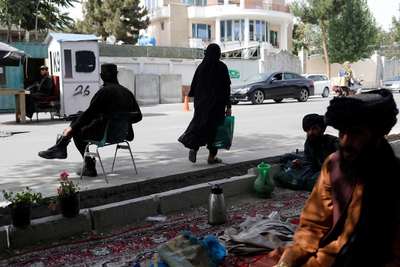
Speaking at a UN Security Council meeting on women, peace and security on Tuesday, 27 October, Guterres named Afghanistan alongside Mali, Yemen and Somalia as countries where women and girls face severe restrictions and increasing repression of their rights.
The UN chief said women and girls continued to face violence, discrimination, deprivation and abuse. He added that girls were being denied education, a fundamental right, while women politicians, journalists and human rights defenders were being marginalised and targeted.
Guterres cited support for local women-led organisations in Afghanistan, the Democratic Republic of the Congo and Syria as part of the United Nations' efforts to advance the women, peace and security agenda.
He warned that funding cuts had worsened conditions for women and girls, forcing some women's organisations to suspend their activities. According to Guterres, the closure of clinics and safe spaces, along with the loss of vital humanitarian assistance, were among the consequences of reduced funding.
The UN secretary-general said that while global military spending had reached nearly $2.9 trillion last year, humanitarian assistance continued to decline sharply.
He urged countries to honour their development aid commitments and immediately restore funding for organisations supporting women and girls in conflict-affected areas.
Criticising the gap between international commitments and action, Guterres said that 26 years after the adoption of UN Security Council Resolution 1325, there had often been plenty of words, but not enough action.
He stressed that women's participation in peace processes was not merely symbolic and that their meaningful involvement increased the likelihood of achieving lasting peace. According to Guterres, societies become stronger when women and girls can live free from fear and violence.
Guterres said women accounted for just 5% of negotiators across 57 peace processes last year, while fewer than one in five peace agreements contained at least one reference to women, girls, gender or sexual violence. He described the gap between commitments and implementation as unacceptable.
The UN chief called for binding targets and quotas for women's participation, stressing that their needs and demands must be reflected in all negotiations, ceasefires and peace agreements.
He also said the number of conflict-related sexual violence cases verified by the United Nations had exceeded 9,700 last year, adding that the actual figure was undoubtedly higher.
Guterres identified women's participation at every peace negotiating table, increased funding and efforts to combat violence against women and girls as three urgent priorities. He also called for full accountability for perpetrators of violence.
He urged countries to incorporate their commitments on women, peace and security into national laws and policies and to ensure women's economic security.
"Equality is not a dream. It is a decision," Guterres said.