• العربية
  • پښتو
  • فارسی
BrandBrand
  • Afghanistan
  • Sport
  • Analysis
  • Markets
  • Afghanistan
  • Sport
  • Analysis
  • Markets
  • Theme
  • Language
    • العربية
    • پښتو
    • فارسی
  • Afghanistan
  • Sport
  • Analysis
  • Markets
All rights reserved for Volant Media UK Limited
volant media logo

Tajik President Briefs Putin On Security Situation Along Afghan Border

Nov 20, 2026, 13:16 GMT+0

The Kremlin spokesperson said Tajik President Emomali Rahmon briefed Russian President Vladimir Putin on the situation along Tajikistan's border with Afghanistan during their meeting in Dushanbe.

He said security incidents continued to occur along the border and smugglers remained active.

Russia's TASS news agency reported on Friday, 20 November, citing Kremlin spokesperson Dmitry Peskov, that Putin and Rahmon had discussed the situation along the Tajikistan–Afghanistan border since the Taliban returned to power.

Peskov added that despite these challenges, a degree of stability and predictability remained along the border.

He noted that smugglers and individuals attempting to traffic drugs across the border had long been active in the area, stressing the importance of cooperation between Russian and Tajik border protection and intelligence agencies in combating such activities.

Meanwhile, the Tajik presidential office said Putin and Rahmon had discussed regional security threats in detail during their meeting.

According to TASS, the two leaders discussed efforts to combat terrorism, extremism, cyber threats and drug trafficking.

Before travelling to Dushanbe, Putin said developments in Afghanistan and the continued operation of Russia's 201st Military Base in Tajikistan would be among the topics of his talks with Rahmon.

Putin arrived in Dushanbe, the capital of Tajikistan, following his visit to China. Developments in Afghanistan and prospects for cooperation on Afghanistan-related issues were among the main items on the agenda.

Speaking to reporters before departing China, Putin said a Russian government delegation led by Deputy Prime Minister Alexei Overchuk had recently visited Afghanistan. He said he intended to brief Rahmon on the outcome of the visit and prospects for expanding cooperation on Afghanistan-related issues.

The talks took place on Friday, 20 November.

Russia remains the only country to have formally recognised the Taliban administration, having done so in July 2025.

The meeting marked the second round of talks between the Russian and Tajik presidents this month.

Rahmon recently travelled to Moscow to attend a summit of the Collective Security Treaty Organisation (CSTO) and held separate talks with Putin at the Kremlin. According to Putin, their busy schedules in Moscow had prevented them from addressing all the issues on the bilateral agenda.

Speaking at the CSTO summit on 11 November, Putin said developments in Afghanistan were being closely monitored as part of efforts to strengthen security along the organisation's external borders.

Rahmon also stressed at the summit that strengthening security along Tajikistan's border with Afghanistan was among the organisation's priorities.

The continued operation of Russia's 201st Military Base in Tajikistan was another item on the bilateral agenda. Putin had previously described the base as a major guarantor of security in Central Asia.

The agenda also included the further development of bilateral relations, expanding trade and economic ties, and prospective joint projects.

Before travelling to Tajikistan, Putin attended the Asia-Pacific Economic Cooperation (APEC) summit in the Chinese city of Shenzhen on 18 and 19 November, where he also held trilateral talks with Chinese President Xi Jinping and US President Donald Trump.

Most Viewed

Security Threats From Afghanistan Require Coordinated Global Action, Says Kazakhstan
1

Security Threats From Afghanistan Require Coordinated Global Action, Says Kazakhstan

2

Terrorist Groups In Afghanistan Have Acquired Advanced Equipment, Says UN Official

3

Mosques, Madrassas & Obedience: Inside Akhundzada's Visit To Kabul

4

Political Power Is No One's Personal Property, Say Jamiat-e Islami & NRF

5

UN Concerns Over ISIS-K's Growing Capabilities Are Unfounded, Says Taliban

•
•
•

More Stories

Over 4,700 Pakistanis Killed In Attacks Originating From Afghanistan, Says Pakistan

Nov 20, 2026, 11:14 GMT+0
100%

Pakistan's ambassador to the United Nations has claimed that more than 4,700 Pakistanis have been killed over the past three years in terrorist attacks originating from Afghan territory.

He said Islamic State's Khorasan branch (ISIS-K) and Tehreek-e-Taliban Pakistan (TTP) were operating in Afghanistan and called for stronger international cooperation to combat terrorism.

Addressing the UN Security Council on Thursday, 19 November, Syed Haider Shah, Pakistan's permanent representative to the United Nations, said the global terrorism landscape was evolving rapidly, with terrorist groups exploiting emerging technologies, the internet and the dark web to expand their activities.

Shah made the remarks during a briefing on the work of the Security Council's subsidiary bodies established under resolutions 1267, 1373 and 1540.

The Pakistani envoy alleged that ISIS-K, Tehreek-e-Taliban Pakistan (TTP) and its affiliates, the Balochistan Liberation Army (BLA), the Majeed Brigade and the East Turkestan Islamic Movement (ETIM) were operating in Afghanistan with the support of their hosts.

He also alleged that these groups were receiving external backing from Pakistan's principal regional adversary, an apparent reference to India.

Shah said terrorist organisations were using the internet and the dark web for recruitment, organisation and incitement to violence, while increasingly relying on cryptocurrencies and digital wallets to finance their activities and evade conventional regulatory oversight.

The Pakistani ambassador called on the UN Security Council to broaden its existing counter-terrorism sanctions framework and establish more effective mechanisms to designate terrorist individuals and entities and curb their activities.

He also called for the regulation of social media platforms, artificial intelligence and digital payment systems to prevent their misuse for spreading hatred, promoting online radicalisation, exploiting vulnerable young people and disseminating terrorist propaganda and disinformation.

Shah stressed the need for stronger international cooperation in combating terrorism and urged the UN Counter-Terrorism Committee Executive Directorate (CTED) to pay particular attention to countries most severely affected by terrorism.

He said the Security Council's 1267 Sanctions Committee should assess proposals to designate terrorist individuals and entities objectively, impartially and without political considerations.

The Pakistani envoy also called for the UN counter-terrorism framework to address the growing threat posed by violent far-right, ultranationalist, xenophobic and Islamophobic movements.

Shah reaffirmed Pakistan's support for international efforts to prevent the proliferation of weapons of mass destruction to non-state actors, saying his country had taken measures at the national level to implement UN Security Council Resolution 1540.

He also called for greater coordination among the Security Council's subsidiary bodies and their respective groups of experts.

Afghanistan High On Agenda As Putin Arrives In Tajikistan

Nov 20, 2026, 08:26 GMT+0
100%

Russian President Vladimir Putin has arrived in Dushanbe, the capital of Tajikistan, following his visit to China.

During his visit, Putin is expected to discuss bilateral cooperation, developments in Afghanistan and the outcome of a recent visit to Kabul by a high-level Russian delegation with Tajik President Emomali Rahmon.

Developments in Afghanistan and prospects for cooperation on Afghanistan-related issues are expected to be among the main topics of discussion in Dushanbe.

Speaking to reporters before departing China, Putin said a Russian government delegation led by Deputy Prime Minister Alexei Overchuk had recently visited Afghanistan. He added that he intended to brief Rahmon on the outcome of the visit and the prospects for expanding cooperation on Afghanistan-related issues.

The talks are scheduled to take place on Friday, 20 November.

Russia remains the only country to have formally recognised the Taliban administration, having done so in July 2025.

The meeting marks the second round of talks between the Russian and Tajik presidents this month.

Rahmon recently travelled to Moscow to attend a summit of the Collective Security Treaty Organisation (CSTO) and held separate talks with Putin at the Kremlin on 12 November. According to the Russian president, their busy schedules in Moscow prevented them from addressing all the issues on the bilateral agenda.

Speaking at the CSTO summit on 11 November, Putin said developments in Afghanistan were receiving particular attention as part of efforts to strengthen security along the organisation's external borders.

At the same summit, Rahmon identified strengthening security along Tajikistan's border with Afghanistan as one of the priorities for his country's chairmanship of the CSTO in 2027.

The continued operation of Russia's 201st Military Base in Tajikistan is also on the agenda. Putin described the base as a major guarantor of regional security and stability across Central Asia.

The two leaders are also expected to discuss the development of bilateral relations, expanding trade and economic ties, and prospective joint projects.

Before travelling to Tajikistan, Putin attended the Asia-Pacific Economic Cooperation (APEC) summit in the Chinese city of Shenzhen on 18 and 19 November, where he also held trilateral talks with Chinese President Xi Jinping and US President Donald Trump.

Pakistan Deeply Concerned Over Terrorist Attacks From Afghanistan, Says FM Dar

Nov 20, 2026, 07:12 GMT+0
100%

Pakistan’s Foreign Minister Ishaq Dar has expressed Islamabad’s deep concern over the continued use of Afghan territory to carry out terrorist attacks against other countries, particularly Pakistan.

Speaking at a joint press conference with Kao Kim Hourn, Secretary-General of the Association of Southeast Asian Nations (ASEAN), in Islamabad on Thursday, 19 November, Dar said he had raised these concerns during their talks.

Pakistan has repeatedly accused the Taliban administration of allowing armed groups to operate in Afghanistan and use its territory to launch attacks against Pakistan. The Taliban deny the allegations, maintaining that they will not allow Afghan territory to be used to threaten the security of other countries.

In the latest warning, Alexandre Zouev, the UN Acting Under-Secretary-General for Counter-Terrorism, expressed concern over the growing operational capabilities of terrorist groups in Afghanistan, particularly Islamic State’s Khorasan branch (ISIS-K).

In an interview with Russia’s TASS news agency, Zouev said ISIS-K and Al-Qaeda continued to operate in Afghanistan and that ISIS-K appeared to be rebuilding its operational capabilities.

According to Zouev, information provided by some UN member states indicated that ISIS-K had acquired modern tactical equipment, including drones, and was seeking to conduct operations both within Afghanistan and beyond its borders.

Taliban spokesperson Zabihullah Mujahid dismissed these concerns as unfounded on Thursday, saying Afghanistan was not a place where ISIS and other groups could operate freely. He claimed that Taliban security forces were capable of preventing foreign groups from expanding their activities and would not allow Afghan territory to be used to threaten the security of Afghanistan or other countries.

Concerns over the activities of terrorist groups in Afghanistan extend beyond Pakistan and the United Nations.

At a quadrilateral meeting of foreign ministers in New York on 25 September 2025, China, Iran, Russia and Pakistan expressed concern over the security situation in Afghanistan and the activities of terrorist organisations, including Islamic State, Al-Qaeda, Tehreek-e-Taliban Pakistan (TTP) and the East Turkestan Islamic Movement (ETIM).

The four countries urged the Taliban administration to take effective and verifiable counter-terrorism measures and prevent Afghan territory from being used to threaten other countries.

China also warned at a UN Security Council briefing in August 2026 that terrorist groups based in Afghanistan, including ISIS-K, had demonstrated a growing capability and intent to carry out cross-border attacks.

Mosques, Madrassas & Obedience: Inside Akhundzada's Visit To Kabul

Nov 19, 2026, 12:47 GMT+0
100%

The Taliban heavily publicised the group's leader Hibatullah Akhundzada's visit to Kabul, portraying it as a major event.

In practice, however, the Taliban leader's visit to the capital was largely confined to speeches, demands for obedience to his leadership and the laying of foundation stones for mosques and a religious school.

Many had expected the Taliban leader to outline new positions on Afghanistan's major challenges, internal divisions within the group, the economic crisis, foreign relations or sweeping restrictions on women and girls. No such announcements were made.

According to information released by the Taliban, this was Akhundzada's second official visit to Kabul since the group returned to power in August 2021. Taliban officials said that during his three-day visit, he delivered speeches at Kabul University and the Ministry of Defence, met senior Taliban officials and attended ceremonies to lay the foundation stones for two mosques and a so-called jihadi madrassa.

A Historic Speech Shrouded In Secrecy

The significance of Akhundzada's latest visit becomes clearer when compared with his first appearance in Kabul following the collapse of the former republic order in Afghanistan.

On 1 July 2022, the Taliban leader travelled to Kabul to attend a major gathering of pro-Taliban religious scholars, addressing thousands of clerics. The speech marked one of his most significant public appearances since the Taliban's return to power.

However, the Taliban have never released any images of Akhundzada's visits to the capital.

Kabul University: A Gathering To Promote The Taliban Leader's Decrees

A conference examining Akhundzada's decrees began at Kabul University on Monday. Organised by the Taliban's Ministry of Higher Education, the event brought together dozens of religious clerics, university lecturers and researchers from across Afghanistan.

Kabul University was closed for several days to accommodate the gathering, and students were required to vacate their university accommodation.

Several students told Afghanistan International that the decision had caused considerable difficulties during the final weeks of the semester. Some were forced to return to their home provinces at their own expense, while others spent the night in mosques or stayed with friends.

The Taliban announced that Akhundzada addressed participants on the second day of the conference. During the gathering, several clerics close to the Taliban renewed their allegiance to him and bestowed upon him the religious title of Sheikh al-Islam.

An Indirect Response To Internal Criticism

Akhundzada's visit to Kabul came as divisions within the Taliban became increasingly apparent.

A day before his address, Taliban Interior Minister Sirajuddin Haqqani told the same gathering that many people disagreed with the Taliban leader's policies, warning against the dangers of making the entire political system dependent on a single individual.

Without directly referring to Haqqani's remarks, Akhundzada emphasised obedience to the leadership, saying Taliban members must not oppose their “emir”. He urged Taliban officials to set aside their differences and refrain from competing for power and positions.

The Taliban leader also called on political opponents to return to Afghanistan, claiming that those with the necessary qualifications could assume positions within the Taliban administration.

He reiterated his commitment to the general amnesty, insisting that those who had worked with foreign forces during the previous two decades were covered by it.

Defining Roles For Students, Clerics And Fighters

One of the central themes of Akhundzada's speech at Kabul University was the role of different sections of society within the Taliban's governing structure.

He urged students to acquire modern knowledge to strengthen the political system and the economy. In his view, students were responsible for strengthening the administration's economic foundations, religious clerics for preserving its religious legitimacy, and fighters for maintaining security.

The Taliban leader also defended changes introduced to university curricula and promised to provide additional facilities for students and lecturers.

He described the drafting of the Taliban's penal code as one of his administration's major achievements and urged religious scholars to explain its provisions to the public.

A Closed-Door Meeting At The Ministry Of Defence

The following day, Akhundzada met senior Taliban officials, provincial governors and military commanders at the Ministry of Defence.

According to sources who attended the meeting, stringent security measures were in place, with participants prohibited from bringing mobile phones, metal objects or even pens into the conference hall.

Before Akhundzada's address, a 52-page booklet was distributed among participants. It largely contained his previously expressed views on leadership, obedience, the promotion of virtue and prevention of vice, unity, the role of religious clerics and the prevention of internal divisions.

Sources present at the meeting said a considerable portion of Akhundzada's speech focused on preserving internal cohesion within the Taliban, preventing disputes over positions of power and expanding the influence of religious clerics in society.

He also instructed clerics to travel to different parts of the country to explain his decrees and views to the public.

Mosques And Madrassas: The Main Projects Of The Visit

Perhaps the most tangible outcome of Akhundzada's visit was his emphasis on the construction of religious institutions.

During the meeting at the Ministry of Defence, he repeatedly referred to what he described as a shortage of mosques in Kabul and urged Taliban officials to prioritise the construction of mosques and madrassas.

Akhundzada subsequently laid the foundation stone for a religious school at Tappa-e Maranjan and for two mosques in Kabul's Chaman-e-Hozori and Mirwais Maidan areas.

The Taliban provided no details about the costs of these projects, their sources of funding or their expected completion dates.

Many had anticipated that the Taliban leader's visit to the capital would bring significant announcements addressing economic hardship, unemployment, the migration crisis, foreign relations or restrictions on women's access to education and employment.

Instead, his primary focus remained on expanding religious institutions and reinforcing obedience to his leadership.

Why Did Akhundzada Not Meet The Public?

Despite the extensive publicity surrounding his visit, Akhundzada held no publicly announced meetings with independent community groups, civil society activists, businesspeople, women, university lecturers outside official gatherings or representatives of different sections of Afghan society.

His appearances were confined to gatherings attended predominantly by religious clerics, Taliban officials, military commanders and figures aligned with the group.

Like his first visit to Kabul in 2022, Akhundzada's second visit appeared to serve more as a demonstration of internal Taliban unity and a reaffirmation of his authority than an opportunity to engage with wider Afghan society.

Discussions On The Taliban Leader's Decrees Continue

The conference examining Akhundzada's decrees continued at Kabul University following his address.

The Taliban's Ministry of Higher Education announced that on the third day of the conference, religious clerics, university lecturers and researchers presented 132 research papers across ten separate sessions.

Much of the conference was devoted to explaining the authority of the Taliban leadership and how the group's leader's decrees should be implemented.

In one session, Mohammad Ismail Rahmani, head of Kabul's Jihadi Madrassa, spoke about the responsibilities of rulers and citizens.

He stressed that those in power were responsible for ensuring security, maintaining stability and respecting citizens' rights. At the same time, he described the role of religious clerics as explaining and interpreting the Taliban leader's decrees, while maintaining that the public had a duty to obey them.

The proceedings, however, indicated that the conference's primary focus was on promoting and explaining Akhundzada's decrees and reinforcing his position within the Taliban's political structure.

Akhundzada Visits The Presidential Palace

On Wednesday evening, Akhundzada visited the presidential palace, known as the Arg, where he met several senior Taliban officials.

Taliban spokesperson Zabihullah Mujahid announced on Thursday that the group's leader had held talks with Taliban Prime Minister Mohammad Hassan Akhund, several ministers and senior administration officials.

However, the Taliban released no details about the discussions or any decisions that may have been taken during the meetings.

The Taliban have not released a single image of Hibatullah Akhundzada's latest visit to Kabul.

Security Threats From Afghanistan Require Coordinated Global Action, Says Kazakhstan

Nov 19, 2026, 08:09 GMT+0
100%

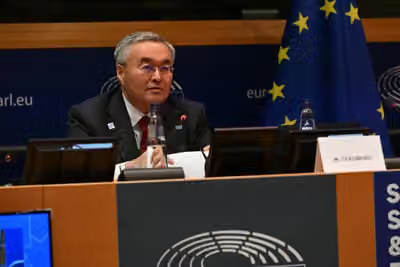
Kazakhstan's foreign minister has warned of the implications of developments in Afghanistan for Central Asian security, saying terrorist and extremist networks, illicit trafficking and the spread of radical ideologies continue to threaten regional stability.

Speaking on Wednesday, 18 November, at the third Schuman Security and Defence Forum in Brussels, Kazakh Foreign Minister Mukhtar Tileuberdi said addressing these threats required a coordinated international response.

Tileuberdi stressed that the cross-border nature of these threats underscored the importance of international cooperation, information-sharing and stronger measures to prevent radicalisation.

Emphasising the need for pragmatic engagement with Afghanistan, he said Kazakhstan supported expanding humanitarian assistance and economic cooperation with the country.

The Kazakh foreign minister identified education, healthcare, transport connectivity and institutional capacity-building as priorities for promoting Afghanistan's long-term stability and development.

He also proposed making greater use of the United Nations Regional Centre for the Sustainable Development Goals for Central Asia and Afghanistan, based in Almaty, to strengthen international cooperation.

Tileuberdi highlighted the importance of expanding educational programmes for Afghan women in partnership with international organisations and donor countries.

He stressed that lasting security could not be achieved through military and security measures alone, but required political engagement, humanitarian assistance and sustainable economic and social development.

Security Concerns And Expanding Economic Ties

Central Asian countries remain concerned about the activities of extremist organisations and armed networks, particularly those linked to developments in Afghanistan.

Drug trafficking and the potential spillover of insecurity from Afghanistan into neighbouring countries remain among the region's security concerns.

Despite these challenges, Central Asian countries have continued to expand economic engagement with the Taliban administration, seeking to strengthen trade, transit links and regional economic cooperation.

The third Schuman Security and Defence Forum took place in Brussels on 17 and 18 November, bringing together representatives of numerous countries and international organisations.

Tileuberdi addressed a roundtable entitled “From Conflict to Terror: Understanding the Evolving Security Nexus”, which examined the links between armed conflict, terrorist threats and regional instability.