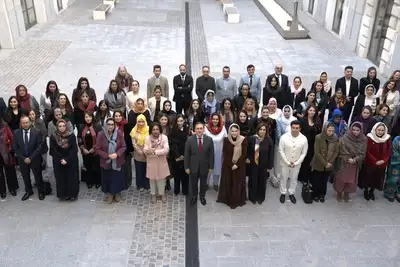
The two-day gathering, held on Sunday and Monday, 22 and 23 November, at Spain's Ministry of Foreign Affairs was organised in partnership with Women for Afghanistan.
Held under the theme "Afghan Women's Leadership in Achieving Justice and Peace through Accountability", the summit brought together around 70 participants, including Afghan women and men, UN officials, diplomats, researchers, religious scholars and civil society representatives.
Why Was The Summit Held?
The fourth HearUs Summit took place more than five years after the Taliban returned to power in Afghanistan, where women and girls continue to face sweeping restrictions on education, employment, freedom of movement and participation in political and public life.
Organisers said the gathering aimed to strengthen efforts to hold the Taliban accountable for human rights violations, promote women's participation in political and peace processes, and improve coordination among governments, international organisations and civil society.
Participants stressed that lasting peace and stability in Afghanistan could not be achieved without meaningful participation by women and accountability for human rights abuses.
They urged the international community to maintain its support for justice, women's rights and international accountability mechanisms relating to Afghanistan.
What Did The Speakers Say?
Spanish Foreign Minister José Manuel Albares Bueno reaffirmed that his country would not recognise the Taliban government and stressed that Afghan women's rights must not become a bargaining chip in political negotiations.
He also expressed support for recognising gender apartheid under international law and called for investigations into abuses committed against Afghan women.
Pramila Patten, the UN Secretary-General's Special Representative on Sexual Violence in Conflict, warned that there were no signs of improvement in the Taliban's treatment of women and girls.
Referring to reports of forced marriage, sexual violence and increasingly severe restrictions, she called for stronger international efforts to document abuses and preserve evidence for future accountability.
Patten also warned that funding shortages were undermining programmes intended to support Afghan women.
Another speaker, Navanethem "Navi" Pillay, a South African jurist and former UN High Commissioner for Human Rights, addressed the summit in a video message.
Drawing parallels with the struggle against racial apartheid in South Africa, Pillay expressed confidence that efforts to end what she described as gender apartheid in Afghanistan would ultimately succeed.
She supported international efforts to hold Taliban leaders accountable and stressed the importance of pursuing justice for victims of human rights violations.
Fawzia Koofi, chair of the board of Women for Afghanistan and a former member of Afghanistan's parliament, described the situation in Afghanistan as one of the world's most severe human rights crises.
She criticised the Taliban's exclusionary system of government, describing it as a government "of the Taliban, by the Taliban and for the Taliban".
Koofi urged the international community to move beyond expressions of sympathy and take concrete steps towards accountability.
One Million Signatures Campaign
One of the summit's key initiatives was the launch of the One Million Signatures campaign, aimed at mobilising international support for the recognition of gender apartheid and increasing pressure on the Taliban to restore women's rights.
The initiative was presented by Katrín Jakobsdóttir, Iceland's former prime minister. Spanish Foreign Minister José Manuel Albares also expressed support for the campaign.
The campaign, known as "One Million Voices for the Women and Girls of Afghanistan", calls on the United Nations and governments worldwide to refrain from recognising the Taliban and take concrete action to restore the rights of Afghan women and girls.
It also advocates women's meaningful participation in political decision-making concerning Afghanistan's future.
The organisers of the fourth HearUs Summit prepared the campaign statement and launched the initiative to collect one million signatures in support of Afghan women's and girls' rights.
On the sidelines of the summit, a women's rights activist presented Albares with photographs of Bibi Sediqa and Mozhda Uzbek, two women reportedly detained by the Taliban, along with letters from their families, and urged him to help secure their release.
In response, Albares described the situation facing Afghan women as completely unacceptable and reaffirmed Spain's commitment to supporting their freedom and security and pursuing accountability for abuses committed by the Taliban.
Panel Discussions And Specialist Sessions
Following the opening ceremony, participants took part in four specialist panel discussions covering education and women's resilience, employment and economic empowerment, accountability and justice, women's rights in Islam, and women, peace and security.
The summit programme also included plans to present an accountability framework for Afghanistan, intended to coordinate legal, political and international efforts to hold perpetrators of human rights violations accountable.
The discussions focused on strengthening cooperation among Afghan women leaders, international institutions and governments, and identifying practical measures to advance women's rights and participation in Afghanistan's future.
Spain's Support For Afghan Women
The HearUs initiative was launched in February 2022 to amplify Afghan women's voices in international forums and promote their meaningful participation in decisions affecting their country.
The fourth summit was held more than five years after the Taliban's return to power in August 2021, with restrictions on Afghan women and girls remaining in place.
Spain adopted a feminist foreign policy approach in 2021, placing gender equality, women's political participation and the protection of women's rights among its foreign policy priorities.
Under this approach, Madrid has become a prominent international supporter of Afghan women's rights, hosting successive HearUs conferences and advocating access to education, employment and political participation for women and girls in Afghanistan.