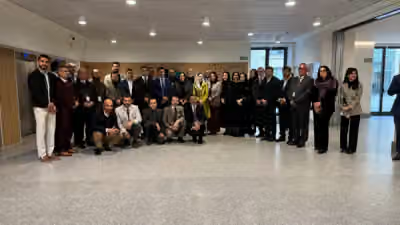
Gul Hassan made the proposal at the fourth Astrakhan International Forum, entitled “International North–South Transport Corridor: New Horizons and Opportunities”.
The ambassador called for broader cooperation in transport and logistics, including the development of multimodal transport services, closer cooperation between freight transport companies and the establishment of commercial and logistics hubs.
He also called for increased trade in agricultural and food products, saying Afghanistan sought to expand exports of fresh and dried fruit and other agricultural produce to Russia while importing grain, vegetable oils and other commodities.
He added that Afghanistan was interested in attracting Russian investment in textile manufacturing, agricultural processing, construction materials production and mineral extraction.
**Relations Between Russia And The Taliban**
Relations between Moscow and the Taliban have gradually expanded in recent years. Following the Taliban’s return to power in August 2021, Russia maintained diplomatic and economic contacts with the group despite having designated it a terrorist organisation.
On 3 July 2025, Russia became the first country to formally recognise the Taliban government. The decision followed a ruling by Russia’s Supreme Court in April that year suspending the ban on the Taliban’s activities. Moscow said the move could pave the way for broader bilateral cooperation, particularly in trade and counterterrorism.
Russia has also emphasised the importance of expanding security, economic and trade cooperation with the Taliban in recent months.
In May 2026, Sergei Shoigu, secretary of Russia’s Security Council, said Moscow was working towards establishing a comprehensive partnership with the Taliban, with discussions covering security, trade, cultural and humanitarian cooperation.
As part of these efforts, Russian Deputy Prime Minister Alexei Overchuk visited Kabul on 12 November 2026, accompanied by a delegation of more than 70 Russian business representatives.
During the visit, Taliban officials invited Russian companies to invest in mining, infrastructure, agriculture, transport and manufacturing. They also called on Moscow to facilitate access for Afghan products to Russian markets and help reduce transport and transit costs.
According to Overchuk, bilateral trade more than doubled in the first eight months of 2026 compared with the same period a year earlier, exceeding $349 million.
The two sides have also expressed interest in expanding cooperation in freight transport, logistics, agriculture and the establishment of fertiliser production facilities in Afghanistan.
Despite the expansion of these relations, Russia remains the only country to have formally recognised the Taliban government. Alongside its economic interests, Moscow regards security cooperation and efforts to counter militant groups, particularly Islamic State’s Khorasan Province (ISIS-K), as important elements of its engagement with the Taliban.
The fourth Astrakhan International Forum began on Wednesday, 25 November, and runs until Friday, 27 November. The event aims to facilitate Russian companies’ access to markets in Iran, Iraq, Afghanistan, the Middle East, East Africa and India.