Astana Ready To Implement Educational Programmes for Afghans, Says Kazakh Trade Minister
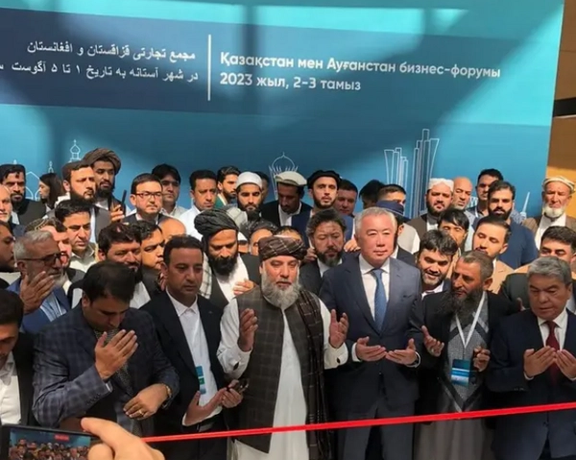
Kazakhstan’s Minister of Trade and Integration Serik Zhumangarin announced that his country is ready to implement educational programmes for Afghan students.

Kazakhstan’s Minister of Trade and Integration Serik Zhumangarin announced that his country is ready to implement educational programmes for Afghan students.
Zhumangarin said that Kazakhstan is ready to give scholarships to 30 Afghan students this year.
On Thursday, at the Afghanistan-Kazakhstan business conference, the Kazakh trade minister said that Astana will continue to provide humanitarian aid to the people of Afghanistan.
Nooruddin Azizi, Minister of Trade of the Taliban, had also been present at this business conference.
After taking over Afghanistan in August 2021, the Taliban have closed schools and universities for girls and have not elaborated on when the group will reopen these educational centers.
However, several countries, including Kazakhstan, provide scholarships to Afghan students so that girls can continue their education.
According to Kazakh media reports, more than 450 Afghan students are currently studying in Kazakhstan.


Michael McCaul, Chairman of the US House Committee on Foreign Affairs, criticised the country’s special envoy for women and human rights in Afghanistan for meeting Taliban members in Doha.
McCaul said, “There are more repressive edicts against Afghan women and girls today than there were when Amiri took office.”
The Chairman of the US House Committee on Foreign Affairs stressed that the US representatives’ engagement with the Taliban doesn’t help Afghan women.
Following the meeting with the Taliban's foreign minister in Doha, Amiri said that she met with the group's representatives due to "Afghans and human rights defenders insisting on direct engagement with the Taliban”.
The US-Taliban meeting in Doha has been met with wide-ranging criticisms. Several Afghans who have been part of the protest movement of Afghan women have said that Amiri as a US government envoy should not justify her meetings with the Taliban for human rights or women’s rights issues.
Meanwhile, the chairman of the US House Committee on Foreign Affairs stressed that US engagement with the Taliban is like legitimising the group and said that Afghans didn’t ask for more US engagement with the group.
He said that “these meetings should stop”.
Some Afghan politicians and activists have said that the US sees its own interests in engaging with the Taliban and that Rina Amiri, an envoy of the US Department, acts based on Washington's policy and interests.
Former Afghan parliamentarian, Fawzia Kofi, on Wednesday, said that foreign diplomats cannot be blamed for "protecting the interests of their governments". She asked the anti-Taliban fronts to “mobilise around” their own narratives.

Pakistan’s deputy foreign minister Hina Rabbani Khar announced that Afghans are involved in the destabilisation of the country and Islamabad has shared its evidence with the Taliban.
Khar told Pakistan media outlets that even those Afghans who had entered the country with medical visas had taken part in some of the attacks against targets inside Pakistan.
On Wednesday, Khar added that Islamabad has evidence which show that Afghans are involved in terrorist attacks in Pakistan.
Pakistan's Foreign Ministry also said in a separate statement that Afghan citizens were involved in the deadly attack on an army base in Baluchistan province. In a statement on Wednesday, the ministry added that the attackers were residents of Kandahar province.
According to Pakistani media reports, the Ministry of Foreign Affairs of Pakistan has sent a letter to the Taliban-controlled Embassy in Islamabad and asked the representatives of the Taliban to receive the bodies of the three terrorists.
Last month, the Pakistani army issued a statement about the participation of Afghan citizens in attacks inside Pakistan and said that such attacks have become a grave concern for Islamabad.

Taliban announced that in the last two days, the group has rejected 17 Iranian fuel tankers due to quality issues.
In a statement, the Taliban's National Standard Authority stressed that 13 tankers had been returned to Iran from Farah province’s Mil 78 border terminal on Tuesday and four tankers had been returned from Nimroz border terminals with Iran on Wednesday.
The Taliban’s office added that it has recently increased its assessments of the quality of fuel imported from Iran.
Earlier, the Taliban had announced that they had rejected another 40 tankers of low-quality fuel from Iran.
This group has previously too often announced that it had returned low-quality imported Iranian petroleum products back to the country.
The petroleum products needed by the Afghan market have been mainly imported from neighbouring countries including Iran, Pakistan and Central Asian countries.

Ali Salajegheh, Iranian Vice-President and head of the country’s Department of Environment, said that despite the Taliban accepting the Helmand water treaty, the group has released only 15 million cubic meters of water to the country.
According to Salajegheh, the Taliban has not accepted Iran’s repeated calls to engage in dialogue on the issue.
According to 1973 water treaty between Iran and Afghanistan, annually Afghanistan is legally obligated to release 820 million cubic meters of water from the Helmand River to Iran.
According to Iranian Student News Agency (ISNA), Salajegheh told reporters on Wednesday, "We have requested the Afghan ruling body to hold a meeting several times, but unfortunately they did not accept it. In addition, the Minister of Energy was mandated by the government to follow up on the issue."
The Iranian Vice-President stressed that there is enough water in Afghanistan and that the Taliban must release 850 million cubic meters of water to Iran every year.
The head of Iran's Department of Environment emphasised that the Taliban must comply with the 1973 water treaty between the two countries.
Referring to the rainfall in Afghanistan, he added that enough water has entered the Helmand River and he hopes that the Taliban will allow this water to pass through the Kamal Khan Dam so that it does not go in another direction.

The Taliban’s Statistics and Information Authority announced that in the last two years, it has distributed electronic identity cards to 4.6 million citizens of Afghanistan.
The Taliban officials said since the beginning of the digitisation process, electronic identity cards have been distributed to 10.7 million people across the country.
Taliban officials added that last year, the group distributed 1.5 million electronic ID cards to men and issued nearly one million electronic ID cards for women in Afghanistan.
According to the Taliban-controlled Bakhtar news agency, the Taliban claimed that as part of the anti-corruption efforts, in the past year, they have arrested forty illegal brokers. According to Taliban officials in the Statistics and Information Authority, the group investigated 130 cases of administrative corruption in one year, because of which four corruption cases have been handed over to the judicial bodies of the group and they have also fired nearly forty employees of the Taliban body.