Taliban Prevents Karzai From Meeting Iranian Delegation In Kabul
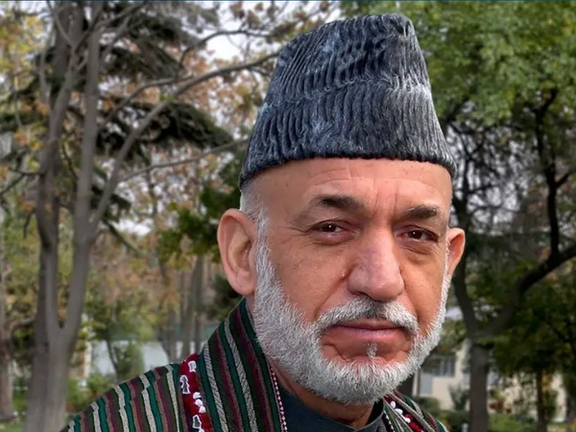
Sources from the office of the former president Hamid Karzai said that the Taliban did not allow an Iranian delegation to meet him in Kabul.
Sources from the office of the former president Hamid Karzai said that the Taliban did not allow an Iranian delegation to meet him in Kabul.
According to these sources, the members of the Iranian parliament wanted to meet Karzai on August 28 in Kabul, but the Taliban refused to allow the meeting to take place.
The Taliban has not yet given an official explanation about the reasons behind preventing this delegation’s meeting with the former president of Afghanistan.
This seven-member Iranian delegation, which traveled to Kabul last week, met with Taliban officials.
Over the past few months, the Taliban has imposed restrictions on cultural centers affiliated with the Islamic Republic in Afghanistan too.
Similarly, the Taliban has imposed restrictions on the political activity and travels of the former president of Afghanistan.
On July 8, sources close to Karzai confirmed to Afghanistan International that the Taliban prevented the former president from visiting Iran, Germany, and China.
Sources said that in one case, the Taliban did not allow Karzai to travel to Berlin to meet the German Foreign Minister.

Sources confirmed to Afghanistan International that the Taliban has imposed new restrictions on former president Hamid Karzai’s meetings with Taliban officials, foreign ambassadors, the public, and his visits inside and abroad Afghanistan.
The Taliban claimed that these restrictions have been imposed to protect Karzai from ISIS attacks.
Karzai had a soft and conciliatory stance towards the Taliban during his presidency and is now in a highly fragile situation.
Sources close to Hamid Karzai said that currently his fate is unknown and he hopes that his situation will change when the political situation transforms in the country.
According to sources, there is no contact between Taliban leader Hibatullah Akhundzada and former president Hamid Karzai. Karzai has not made any effort to communicate with Mullah Hibatullah to ease these restrictions.
Even though Hamid Karzai is from Kandahar, Kandahari Taliban do not have any contact with him. On the contrary, Sirajuddin Haqqani, the founder of the Haqqani network and the Taliban's interior minister, has a lasting and warm acquittance with the former president.
According to Afghanistan International’s sources, Sirajuddin Haqqani has visited Karzai's house several times and met him there.
Also, the Taliban’s Foreign Minister Amir Khan Muttaqi; Minister of Mines and Petroleum Shahabuddin Delawar, and Intelligence Chief Abdul Haq Wasiq are among the Taliban officials who have visited former president Karzai.
On some occasions, the Taliban leaders in Kabul have discussed with Karzai regarding some of their common subjects.
These restrictions, which are not limited to Hamid Karzai alone, have been imposed by the Taliban while a number of high-ranking officials of the group have said that they are against the monopoly of power in Kandahar and are in favour of starting a "national dialogue" about the ban on women's education and work and the formation of an inclusive government.
Sources close to Hamid Karzai confirmed to Afghanistan International that on August 30, the Taliban did not allow the former president to meet with a delegation from the Islamic Republic of Iran.
Although Karzai travelled to foreign countries and returned several times under the Taliban regime, after his last trip to the United Kingdom, the Taliban imposed an absolute travel ban on him and did not allow him to travel to Germany.
The Taliban’s precondition for allowing Karzai to visit Germany has been for the German foreign minister to meet the Taliban’s foreign minister. According to the Taliban, Karzai is not a representative of Afghanistan to be engaged with.
Sources told Afghanistan International that the Taliban authorities have also restricted Karzai’s meetings with the public inside Afghanistan and cited security threats as the reason for imposed restrictions.
Taliban intelligence, which is responsible for the security of Hamid Karzai's residence, has told the former president several times that ISIS is a security threat to him.
Karzai usually informs the Taliban and especially the group’s intelligence agency before leaving his residence. Taliban authorities in Kabul do not have the authority to allow him to leave his house, and it is only the Taliban leader’s office in Kandahar that has the authority to allow Hamid Karzai’s movement in Kabul. Also, the Taliban leader's office allows Karzai’s meetings and travel outside of Afghanistan.
Sources said that foreign and domestic media organisations have contacted Hamid Karzai’s office for interviews, but the Taliban has prevented the former president from speaking to the media.
France 24 TV revealed in June that the Taliban did not allow the reporter of the TV channel to conduct an interview with Hamid Karzai at his residence in Kabul.
The Taliban, especially in Kandahar, has asked Hamid Karzai to refrain from talking about the ban on education and work of Afghan girls and women, inclusive government, and "intra-Afghan dialogue". According to them, those who do not support the Taliban government cannot criticise the group. Therefore, they asked him to live in silence like all ordinary Afghan people.
According to the Taliban, Hamid Karzai is no longer the representative of Afghanistan and cannot meet with Afghans and foreigners.
Abdul Salam Hanafi, the Taliban’s deputy prime minister, said that the group’s fighters could have engaged in revenge killings as soon as the takeover of Afghanistan in August 2021.
However, Hanafi claimed that the decree of general amnesty by the group’s leader prevented the revenge killings by the Taliban fighters.
On Sunday, Hanafi reminded the nation that according to the order of the Taliban leader, no one should take revenge based on the last 20 years of animosity and differences.
The Taliban’s deputy prime minister also added that the amnesty decree has been implemented so far.
Hanafi’s statement comes while the United Nations Assistance Mission in Afghanistan (UNAMA), in a recent report, confirmed that in the past two years, the UN agency has recorded 800 cases of human rights violations against former Afghan security forces by the Taliban fighters.
UNAMA added that it has recorded at least 218 cases of killings of former Afghan government officials and members of former security forces by the Taliban, and the perpetrators of their murders have not been arrested.
UNAMA emphasised that except for the recommendation of the Taliban leader, the group has not issued any written decree or document about general amnesty granted to Afghan citizens.
Anwaar Ul Haq Kakar, Pakistan’s interim prime minister, said that the weapons leftover by the United States in Afghanistan are being used against Pakistan, China, Iran, and other countries in the region.
Kakar said that they thought with the Taliban’s takeover of power in Afghanistan, Pakistan’s situation would get better. “But it got worse,” he said.
In an interview with GeoNews, Kakar said that the new and advanced US equipment in Afghanistan could be dangerous for the countries of the region. He stated that the equipment is not only a big threat for Pakistan, but also for the region.
According to him, the dangerous equipment will threaten China, Central Asia and Iran in the future and may cause a great disturbance in the region.
He added that the hasty withdrawal of the US from Afghanistan resulted in weapons from the former Afghan government and American forces falling into the hands of other armed groups besides the Taliban.
According to a Pentagon report, the US Department of Defence provided $18.6 billion worth of military equipment to the Afghan National Army and Security Forces from 2005 to August 2021.
Reports indicate that after the withdrawal of the US from Afghanistan, equipment worth 7.12 billion dollars remained in Afghanistan.
Yue Xiaoyong, Chinese Special Representative for Afghanistan, said that he has discussed Afghanistan with Mohammed bin Abdulaziz Al-Khulaifi, Qatar’s Minister of State for Foreign Affairs.
Xiaoyong said that both sides stressed on enhancing engagement and cooperation for peace and stability in Afghanistan.
On Monday, the Chinese Special Envoy on social media platform X, said that both the countries should also work for sustainable peace and reconstruction of Afghanistan.
Qatar and China have not recognised the Taliban government, but both countries enjoy close ties with the group.
China's Special Representative for Afghanistan Affairs has also assured that Beijing has no intention or plan to recognise the Taliban.
Hossein Amir Abdollahian, Iran’s foreign minister, said that the Taliban has not met Tehran's expectations. According to Amir Abdollahian, Taliban’s behaviour is not in line with the interests of the two sides, and stressed that the two countries “face challenges”.
On Saturday, the Iranian foreign minister pointed to the border clashes between the Taliban and Iranian forces and said that such clashes have taken place several times in the past two years, but the Taliban blamed the clashes on people who act arbitrarily.
Amir Abdollahian said that although the Taliban has tried to manage and control the border skirmishes, still, there was a clash between Iranian forces and the Taliban fighters.
In an interview with Etilaat daily, the Iranian foreign minister once again emphasised on the formation of an inclusive government in Afghanistan and said that in such a government “we consider the Pashtun ethnic group and the Taliban to be one of the important realities of Afghanistan”.
Amir Abdollahian also said that issues which take place in Afghanistan have direct impacts on Iran.
He also emphasised that the Taliban must give the water rights of Iran from the Helmand River. However, he has stressed that compared to former president Ashraf Ghani's era, Iran is in a better position on the water rights issues.
The Foreign Minister of the Islamic Republic said, "We will not forget what Ashraf Ghani said when he wanted to inaugurate the Kajaki Dam, but the Taliban has repeatedly stated clearly that it adheres to its water rights treaty."
In 2021, before the Taliban’s return to power, former Afghan president Ashraf Ghani had said “we are committed to water rights with Iran, but we will exchange water for oil”.
The Iranian foreign minister also emphasised that pursuing Iran’s water rights is an inherent duty of the ministry of foreign affairs of the country and “we will continue to follow up on the issue with all our might”.