Taliban & Pakistan Forces Engage in Border Skirmish At Torkham Border
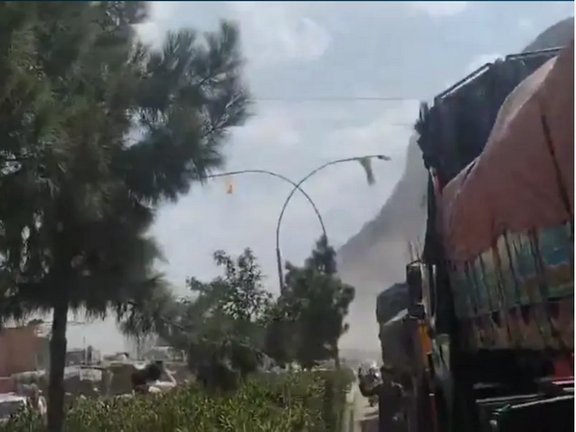
Local sources told Afghanistan International that Taliban forces and Pakistani border guards engaged in a gunfight at the Torkham border.

Local sources told Afghanistan International that Taliban forces and Pakistani border guards engaged in a gunfight at the Torkham border.
According to the sources, the Torkham border had been closed to traffic after the border skirmish.
A video clip received by Afghanistan International shows people and trucks fleeing the border areas as the gunfire could be heard in the background.
Pakistani and Taliban officials have not commented on the issue yet.
According to the sources, the clash began after the Taliban tried to set up an outpost in the border area.
Meanwhile, sources in Pakistan also said the clash occurred after the Taliban tried to set up an outpost.
Sources in Pakistan also confirmed the closure of the Torkham border.
Recently, the Taliban’s spokesperson for the Ministry of Interior said that during the last two years, the group has had around fifty border clashes with Iran, Pakistan, Turkmenistan, and Uzbekistan.


The Taliban’s Ministry of Refugees and Repatriation announced that around 2,277 Afghan refugees have returned to Afghanistan from Iran.
The ministry said that these people entered Afghanistan from the Islam Qala border in Herat province on Tuesday.
The Taliban Ministry of Refugees said that nearly 1,000 of these migrants have been referred to the International Organisation for Migration (IOM) to receive humanitarian assistance.
Over the past few months, the Taliban has always announced the "forced and voluntary" return of Afghan refugees from Iran.

Khairullah Khairkhwa, Taliban’s Minister of Information and Culture, lashed out that not even a single Islamic country has recognised the government of the group in Afghanistan.
Khairkhwa pointed to these countries and said that if the United States, Russia, and China "do not recognise [Taliban], they will not recognise" them.
He called on these countries and asked them to recognise the Taliban government for the sake of Islam.
During a meeting in Takhar, the senior Taliban official addressed the Islamic countries on Monday and said that when the group was engaged in Jihad, they were called "crazy" and no one supported them.
According to him, the issue of recognition of the Taliban is a “test” for Islamic countries.
Referring to the preconditions for the formation of an inclusive government by the Taliban to be recognised in Afghanistan, Khairkhwa said, “Some countries have been ruled by a family for decades, so why has no one objected to them?”
He did not mention any country which is ruled by “a family”, but it seems that he pointed out to some Arab countries, which have been accused of supporting the Taliban.
So far, no country has recognised the Taliban government. The group has been accused of widespread human rights violations, and the international community, including Islamic governments, have criticised the policies of the Taliban, especially towards Afghan women and girls.
The formation of an inclusive government is one of the other demands of the international community for the recognition of the Taliban regime.
The Taliban government consists of members of the group and its senior officials are all Sunni and mostly from the Pashtun ethnic group.

The Taliban has waged an operation on the Afghanistan Freedom Front (AFF) forces in Dawlat Shah district, after AFF’s attack on the Taliban district governor's office in Laghman province.
Local sources told Afghanistan International that the Taliban’s operation continues in various regions of Dawlat Shah district.
On Monday night, the Taliban launched the military operation in Gadiala, Manangul and Noya villages of Dawlat Shah district.
On Tuesday, AFF posted on social media platform X that on Monday night, the Taliban launched a "clearance and search operation" in several areas in the district of Dawlat Shah of Laghman to "harass the people". The front said that its forces ambushed the Taliban in two areas.
AFF claimed that its forces have inflicted casualties on the Taliban.
They also confirmed that the clashes have continued in several areas of the district.
Taliban officials have not reacted to AFF’s claims.
Earlier, the Freedom Front had claimed that it had killed at least two members of the Taliban in an attack on the group’s district governor office in Dawlat Shah district. Following the incident, sources told Afghanistan International that senior Taliban officials from the capital of Laghman province visited the area and held an emergency meeting in the district center of Dawlat Shah.
According to the sources, the Taliban arrested three residents of the district after the attack on the district governor's office.

Continuing the hunger strike to highlight the situation of women in Afghanistan, Tamana Zaryab Paryani criticised the indifference of German politicians to the demands of the protesters and likened it to "murder”.
The hunger strike by Afghan activists, over the grave situation of women in Afghanistan, has now entered the fourth day in Germany.
Tamana Zaryba Paryani, who is also on hunger strike, harshly criticised the German politicians' negligence of their demands.
Paryani and other protestors started a hunger strike in Germany, wanting the German government to recognise the gender apartheid of the Taliban in Afghanistan.
Sixteen rights activists participated in the hunger strike and have set up a sit-in tent in the city of Cologne, Germany. Paryani said that she will continue her strike until September 15.
Apart from Afghans, activists from other countries have also supported the strike of these activists. An Iranian activist who joined the sit-in told Edris Joya, Afghanistan International’s reporter in Cologne, that the problems and pains of women in Iran and Afghanistan are common, and women rights supporters around the world should protest against the gender apartheid in Afghanistan.
Paryani told Afghanistan International, "Our protests have reached the German politicians, but just as we have had many protests in the past two years while being a witness of all the developments, they somehow have turned a blind eye.”
She described this attitude of the German politicians as "horrible".
Neither the Taliban nor their opposition politicians have reacted to this strike so far. However, Paryani insisted that she will continue the protest until her voice is heard.
Afghan activists abroad are trying to lobby with politicians in various countries to officially recognise the gender apartheid in Afghanistan under Taliban rule. This issue has also been reflected in the recent report by Richard Bennett, UN Special Rapporteur, about the situation of human rights in Afghanistan.

Sources from the office of the former president Hamid Karzai said that the Taliban did not allow an Iranian delegation to meet him in Kabul.
According to these sources, the members of the Iranian parliament wanted to meet Karzai on August 28 in Kabul, but the Taliban refused to allow the meeting to take place.
The Taliban has not yet given an official explanation about the reasons behind preventing this delegation’s meeting with the former president of Afghanistan.
This seven-member Iranian delegation, which traveled to Kabul last week, met with Taliban officials.
Over the past few months, the Taliban has imposed restrictions on cultural centers affiliated with the Islamic Republic in Afghanistan too.
Similarly, the Taliban has imposed restrictions on the political activity and travels of the former president of Afghanistan.
On July 8, sources close to Karzai confirmed to Afghanistan International that the Taliban prevented the former president from visiting Iran, Germany, and China.
Sources said that in one case, the Taliban did not allow Karzai to travel to Berlin to meet the German Foreign Minister.