Protesters Against Deportation Of Afghan Migrants Block Chaman-Quetta Highway
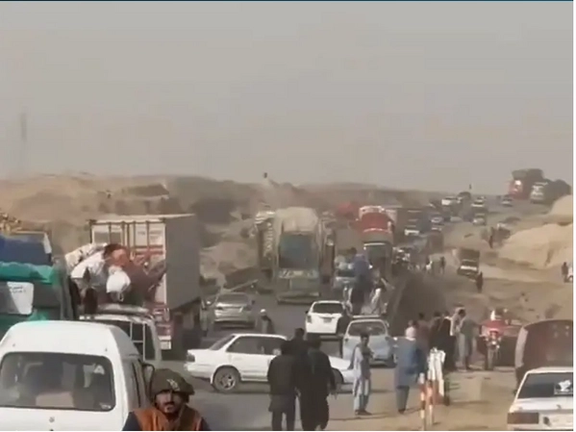
Protesters miffed with the deportation of Afghan immigrants from Pakistan blocked the Chaman-Quetta highway on Thursday.

Protesters miffed with the deportation of Afghan immigrants from Pakistan blocked the Chaman-Quetta highway on Thursday.
The government of Pakistan has announced that it has started the process of detention and deportation of "illegal" Afghan immigrants.
Sources said that these protests are part of the Khyber Pakhtunkhwa National Awami Party's plan to hold demonstrations in Balochistan and Khyber Pakhtunkhwa provinces.
Pakistan's Ministry of Interior has announced that today it has started the process of deportation of "illegal" Afghan immigrants.
The Pakistani media reported that more than 100 Afghan migrants were recently arrested on the outskirts of Quetta city in Balochistan province.
According to Pakistani officials, about 1.7 million Afghan immigrants live in Pakistan without residence documents.
The Pakistani government has stressed that these migrants will be detained, transferred to detention centres, and will be deported to Afghanistan.
The Pakistani government had given "illegal" immigrants until November 1 to leave the country.

The Ministry of Interior of Pakistan announced that the detention of "illegal" Afghan migrants has begun across the country.
On Thursday, Pakistani media outlets reported that more than 100 Afghan migrants had recently been detained in the suburbs of Quetta city in Baluchistan province.
It had been said that all of these detained immigrants were transferred to the migrant deportation camp, and they are going to be deported through the Chaman border with Afghanistan.
Pakistan had previously warned that Afghans without valid residency documents should voluntarily return to Afghanistan before November 1.
Pakistan's Ministry of Interior added that 140,322 Afghan refugees returned to Afghanistan "voluntarily" last month.
According to Dawn newspaper, among these immigrants, there were several Afghan prisoners who were imprisoned in Pakistan for minor crimes.
The United Nations High Commissioner for Refugees and the International Organisation for Migration have also announced that since September 15, 120,180 Afghan refugees have returned to Afghanistan through the Chaman and Torkham border crossings.
It is said that two percent of these deportees had registration documents at the United Nations High Commissioner for Refugees.
The United States, the European Union, and several other countries have asked Pakistan to provide a system for registering illegal Afghans instead of their forcible deportation to Afghanistan.
Despite the widespread criticism of countries, Pakistan has announced that it will continue to deport immigrants without residence documents and will not reconsider the country’s decision.

The Taliban’s Ministry of Refugees and Repatriation announced that 16,700 immigrants living in Pakistan returned to Afghanistan on Tuesday, October 31, through Torkham and Spin Boldak border crossings.
The ministry added that 3,608 other immigrants entered from Iran at the same time.
With the increase in the return of immigrants, Bilal Karimi, the Deputy Spokesperson of the Taliban, said that the group has moved its military vehicles to the border of Torkham to transport citizens.
Karimi said that the military vehicles include hundreds of big and small trucks that were moved to the Torkham crossing for transporting the immigrants.
The Taliban’s Ministry of Public Health has announced the dispatch of medical teams in Torkham to provide medical services to the refugees.
The Pakistani government's one-month deadline to deport undocumented immigrants expired on Wednesday, November 1.

Amnesty International on Tuesday once again called on Pakistan to immediately reverse the decision to deport Afghan refugees.
This human rights organisation also asked the countries of the world to support Pakistan financially for hosting Afghans refugees and those fleeing the persecution of the Taliban.
In a statement, the organisation urged the government of Pakistan to fulfil its international legal obligations, including the principle of non-refoulement and stop the crackdown against, and harassment of, Afghan refugees across the country.
Amnesty International said that more than 1.4 million Afghan refugees are at risk of deportation.
According to United Nations statistics, 600,000 of these refugees left Afghanistan after the Taliban’s takeover of power in 2021.
In another statement on Tuesday, Amnesty International said that as Afghan immigrants are deported, “families are rendered homeless, denied access to livelihood and basic services and separated in the lead up to the harsh winter months”.
Amnesty International added that that the deportation of Afghan refugees exposes women and girls to harassment and other serious human rights violations.
It also said that for the vast majority of women and girls who have fled Afghanistan, living and studying in Pakistan may be their only chance of accessing formal education.
This organisation has warned that Afghan refugees, including journalists, human rights defenders, women protestors, artists, former government officials and security personnel, will also be at risk of harassment and repression by the Taliban if they are forced to return to Afghanistan.

On Tuesday, the Taliban in a statement, called on countries like Pakistan and Iran to stop the forced deportation of Afghan immigrants.
In the statement, the group stressed that the countries should consider "good neighbourliness, Islamic brotherhood, and humanity" while dealing with Afghan immigrants.
Zabihullah Mujahid, Taliban spokesperson, published this statement on the X social media platform, and asked the neighbouring countries not to "deport Afghans by force and without preparation”. The group asked Pakistan and Iran to give Afghan immigrants time and be patient with them.
This week, the Taliban announced its plan to receive and settle Afghan refugees, but it has not announced further details such as financial resources. It is not clear as to what extent the Taliban has the facilities to settle at least 1.7 million immigrants whom Pakistan will deport after November 1.
Iran has also announced that it has started identifying and deporting illegal Afghan immigrants, however, unlike Pakistan, it has not yet announced a plan and deadline for their deportation. The country said that it has deported more than 800,000 Afghan immigrants since the beginning of this year.
The United Nations and international organisations have asked Pakistan to stop the forced deportation of Afghan immigrants. In response, the Ministry of Foreign Affairs of Pakistan said that Pakistan deports illegal immigrants according to domestic and international laws.

Sarfraz Bugti, Pakistan's Caretaker Interior Minister, said that the detention and deportation of illegal Afghan immigrants will begin on Thursday, November 2.
"We are not deporting any refugees. Only those who are completely illegal will leave Pakistan," said Bugti on Tuesday without providing further details.
In a statement released on Tuesday, he added that the deportation process would be "lengthy and gradual”.
Earlier this month, Islamabad announced the decision to deport illegal immigrants and claimed that Afghan citizens are involved in violence, smuggling, and crimes in Pakistan. The Taliban in Kabul rejected these accusations and human rights defender groups asked Islamabad to reconsider its decision.
The Ministry of Interior of Pakistan said that more than four million Afghan immigrants live in the country, and about 1.7 million of them do not have legal documentation.
Bugti said that those who leave voluntarily will receive help in temporary centres.
He added that they will try to provide these migrants with food and health facilities for two to three days.
On Tuesday, the Associated Press reported that, following the deadline for deporting undocumented immigrants from Pakistan, a significant number of Afghans arrived at the border crossings in trucks and buses.
Pakistani officials said that around 200,000 Afghans have returned to their country since the crackdown on migrants in Pakistan increased.
Refugee organisations have said that since the deadline was set earlier this month, around 4,000 people have crossed the border every day.
