Taliban’s Deputy PM Visits Tehran to Discuss Economic Cooperation With Iran
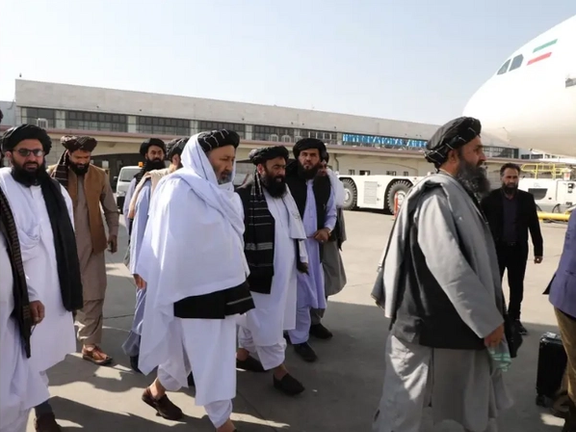
Mullah Abdul Ghani Baradar, the Taliban’s Deputy Prime Minister for Economic Affairs, left Kabul for Tehran on Saturday.
Mullah Abdul Ghani Baradar, the Taliban’s Deputy Prime Minister for Economic Affairs, left Kabul for Tehran on Saturday.
In a statement, the Taliban wrote that the visit was made at the official invitation of the Iranian government and Mullah Baradar and the delegation accompanying him will discuss economic cooperation, bilateral relations, trade, transit, transportation, infrastructure, railways, and regional connectivity with Iranian officials.
As per the Taliban's statement, this visit will involve deliberations on increasing trade via the Chabahar port, expanding Afghanistan's involvement at the port, and promoting economic cooperation between the two nations.
The Taliban said that Mullah Baradar will encourage Iranian businessmen to invest in Afghanistan during his visit to Tehran.
Taliban’s Office For Deputy PM for Economic Affairs wrote that "a high-ranking delegation" of the Taliban will accompany Mullah Baradar during his visit to Iran”. Iranian media outlets wrote that 30 Taliban members are included in the delegation.
ISNA news agency reported that prior to the Taliban's takeover of power in 2021, Mullah Baradar had traveled to Tehran "as the head of the Taliban's political office”. Nevertheless, following the Taliban's return to power and Mullah Baradar's appointment as the group's deputy prime minister, this marks his first visit to Tehran.
Hanif Atmar, former Foreign Minister of Afghanistan, said that the forced mass deportation of Afghan immigrants from Pakistan is a "human disaster".
In a statement, he emphasised that despite significant and fundamental differences in his perspectives with the Taliban, it is essential to engage in discussions and be ready for "national cooperation" to address this challenge.
Atmar said that his differences with the Taliban are on fundamental rights and freedoms of people, especially women, and regarding the political system, peace, and stability in Afghanistan.
In the statement, he wrote that the time has come for the Taliban leaders to make a "wise, responsible and patriotic" decision considering the fate of the "deplorable immigrants" and the widespread consequences of expelling the immigrants.
Atmar stressed that the Pakistani government has "disrespected" the human rights of Afghan immigrants and "disregarded" the wishes of the people of Pakistan and international organisations.
He added that the Taliban and the political opponents of the group should "cooperate" to protect the lives, property, and dignity of the immigrants.
In the statement, he said that the Taliban can turn this "tragedy into an opportunity for national reconciliation and the sustainable return of all Afghan refugees”.
Atmar strongly stated that the Pakistani government will never stop "exploiting the Afghan immigrant population for political and security objectives”.
He emphasised that the "instrumental use" of Afghan immigrants in "experimental policies and proxy wars, even against Afghanistan, is a shameful and unforgivable history”.
He stated that the time has come to end this "tyranny" and asked the Taliban to immediately stop "the policy of harassment, detention, and killing of people affiliated with the previous government, political and human rights activists and restrictions against the basic rights of citizens, especially women".
He also emphasised that, in the longterm, a legitimate political system, founded on the will of the people and national reconciliation, should be established through intra-Afghan dialogue.
Sarfraz Bugti, Pakistan's interior minister, said that the deportation of Afghan immigrants was an internal issue and emphasised that the Taliban has not requested Pakistan to reconsider its decision.
In an interview with Afghanistan International, Bugti added that the purpose of this decision is to deport "foreigners" who do not have residence permits in Pakistan.
He stressed that the deportation of illegal immigrants is not limited to "one or two million Afghan nationals", but is a matter related to 220 million Pakistani citizens.
The interior minister of Pakistan added that according to the plan of the interim government of Pakistan, any foreigner who entered Pakistan illegally will be deported.
Bugti considered the decision to deport migrants to be somehow related to Pakistan's security issues and said that Afghan citizens were involved in 14 suicide attacks of 24 in Pakistan last year.
This Pakistani official emphasised that the decision was made to establish law and order in Pakistan and safeguard the interests of its people.
He also addressed speculation that the interim government of Pakistan might have made this decision to settle scores with the Taliban and said that they have no scores with the Taliban at all.
Bugti added that in his recent meeting with the Taliban ambassador in Islamabad, there was no request made to stop the deportation of the immigrants. Instead, the primary focus of their discussion was to "facilitate and expedite the repatriation" of immigrants from Pakistan to Afghanistan.
Recently, several Taliban officials have voiced their objections to Pakistan's decision, which has fuelled speculation that the Taliban may be opposed to Pakistan's stance.
Meanwhile, the Pakistani interior minister said that the group's ambassador in Islamabad did not make any request to reconsider the decision to deport the immigrants.
On October 3, Bugti announced the interim government's decision to deport undocumented immigrants and said that the deadline for voluntary departure would expire on November 1.
As per the interim government of Pakistan's announcement, there are approximately 1.7 million undocumented immigrants in the country, with the majority being Afghan citizens.
Khan Jan Alokozay, the head of the Pakistan Afghanistan Joint Chamber of Commerce, announced that the assets of Afghan immigrants worth more than four billion dollars have been seized in Pakistan.
Alokozay told Afghanistan International that factories and cargo trucks are part of the confiscated assets.
"Four thousand containers of commercial goods remain in the Karachi port and similarly, the fate of 500 factories built by Afghans in Pakistan is not clear," he told Afghanistan International.
He added that the situation of 500 carpet weaving factories in Karachi and Quetta and about two thousand trucks of Afghan businessmen in Pakistan is still unclear.
Alokozay said that the total value of these factories and heavy vehicles reaches more than four billion dollars. He said that Afghans have a 30% share in the economic sector of Pakistan.
He asked the Taliban to start diplomatic efforts to extract the capital and return it to Afghanistan.
Mullah Hassan Akhund, the Taliban's Prime Minister, in a strong statement on Friday reacted to the confiscation of assets of Afghan immigrants and the destruction of their homes in Pakistan.
On Thursday, Zabihullah Mujahid, the spokesperson of the Taliban, referring to the confiscation of Afghans’ assets in Pakistan, said that no one has the right to seize the property and personal items of Afghans and that the country’s citizens can transfer their funds to their country according to the law.
On the other hand, Afghans who were forcibly deported from Pakistan say that in addition to their houses, livestock were left behind and the Pakistani police did not even allow them to move many of their personal belongings.
Although Pakistani officials have not said much about Afghan investment, on Thursday, the country's Interior Minister Sarfraz Bugti told a Pakistani media outlet that he is working on developing a strategy to determine the investment status of Afghan immigrants in Pakistan.
Pakistan has announced that more than 1.7 million immigrants without official residence documents live in the country and should leave Pakistan.
Mullah Hassan Akhund, the Taliban’s prime minister, asked the government of Pakistan to solve its problems with the group through dialogue and not to show its power to the Afghan immigrants.
On Friday, Mullah Hassan Akhund reacted to the mass deportation of Afghan immigrants from Pakistan and asked the Pakistani government to stop putting pressure on the immigrants.
In a video clip published by the Taliban on X social media platform, the prime minister of the group read a strong statement against the new decision of the Pakistani government.
In this video clip, Mullah Hassan Akhund asks the Pakistani officials, “Who gave you the right to enter the homes of immigrants, humiliate them, and take their money from their pockets?”
In the speech, he asks, "Who are you to confiscate [immigrants'] property and assets?"
According to the Taliban’s prime minister, if Pakistani officials have problems with the government of the group, they should solve their problems through understanding and dialogue. In his speech, he emphatically invited the Pakistani officials to a dialogue to solve the problems.
This senior Taliban official said that if the Pakistani government claims that it is deporting "illegal immigrants", then in which law is there a place for destroying their houses, humiliating them, and confiscating their property.
He stressed, “No immigrant's life, property, and honour are safe now."
Mullah Hassan Akhund warned the Pakistani officials to think about their future and how "we will live together" with such behaviour.
The Taliban’s Prime Minister, who rarely appears in the media and usually does not take a public stance on political issues, has responded to Islamabad’s claim about the involvement of Afghans in Pakistan's recent instability.
Rejecting the claim, Mullah Hassan Akhund said that Afghans have lived in Pakistan for the past 45 years without creating any security challenges for Islamabad.
As the November 1 deadline of the Pakistani government for migrants to leave the country ended, Islamabad has put unprecedented pressure on the Afghan immigrant population in the country.
In the past few days, numerous reports of mistreatment, detention, and forced deportation of Afghan immigrants have been published in the media.
Pakistani officials said that only 19,744 Afghans returned to Afghanistan through the Torkham border on Thursday. Meanwhile, 147,944 Afghans returned to Afghanistan from Pakistan in the last month.
Pakistan rejected demands from the United Nations, human rights groups, and Western embassies to review the deportation plan for Afghan migrants.
Pakistani officials said that the involvement of Afghan immigrants in attacks and cooperation with Islamist militants has weakened the country's security.
On Friday, Abdul Nasir Khan, deputy commissioner of Khyber district of Khyber Pakhtunkhwa province said, “Pakistan has opened 12 more border centres to speed up the repatriation of tens of thousands of Afghan citizens without residency documents, ignoring calls from refugee and human rights groups to reconsider the mass deportation programme.
Khan added that the facilities at the Torkham border crossing have been tripled to allow more Afghan immigrants to return to their country.
On November 1, the Pakistani government's one-month deadline for the voluntary return of Afghan refugees to their country ended, and the country intensified the process of arrest and forced deportation of these migrants.
Pakistani officials said that the main reason for the expulsion of Afghan refugees is the involvement of several Afghan immigrants in attacks by extremist Islamist militants in Pakistan, which has weakened the country's security. The Taliban have previously denied Islamabad’s claim.
Taliban officials in Kabul said that Pakistan's security is an internal problem and asked Islamabad to reconsider its decision.
Many Afghans sought refuge in different countries of the world, especially two neighbouring countries, Iran and Pakistan, in more than four decades of conflicts in Afghanistan.
According to the reports, with the return of the Taliban to power, more than 600,000 people have fled to Pakistan due to the Taliban's policies against human rights, especially women's rights.
Pakistani officials said that only 19,744 Afghans returned to Afghanistan through the Torkham border on Thursday. Meanwhile, 147,944 Afghans returned to Afghanistan from Pakistan in the last month.
Pakistani officials have said they will extend the deadline for Afghan patients and those who cannot travel from the country.
