Taliban Appoints Group’s Deputy Spokesperson As Ambassador To China

Sources from the Taliban's Ministry of Foreign Affairs in Kabul confirmed that Bilal Karimi has been appointed as the group's ambassador to China.

Sources from the Taliban's Ministry of Foreign Affairs in Kabul confirmed that Bilal Karimi has been appointed as the group's ambassador to China.
Previously, Karimi worked as the deputy spokesperson of the Taliban. The Taliban has not publicly announced the appointment of Karimi as the group’s ambassador to China.
Sources from the Taliban's Ministry of Foreign Affairs in Kabul confirmed to Afghanistan International on Saturday that Bilal Karimi has arrived in Beijing and is set to fill in the position of Taliban’s ambassador.
Bilal Karimi was a member of the Cultural Commission of the Taliban before the group’s takeover of power in August 2021. He was later appointed as the deputy spokesperson of the group.
China has not yet recognised the Taliban government, but has close commercial and political relations with this group.
Earlier, Beijing appointed a new ambassador for Afghanistan who in Kabul, handed over his credentials to Mullah Hassan Akhund, the prime minister of the Taliban.
After the collapse of the Islamic Republic of Afghanistan, China was one of the first countries after Pakistan and Russia to accept Taliban diplomats.
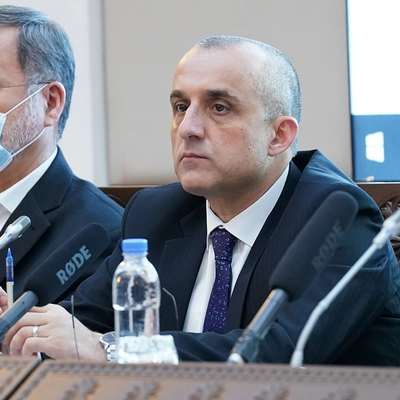
On the occasion of the International Day for the Elimination of Violence Against Women, Amnesty International launched a 16-day campaign to address the situation of women and girls in Afghanistan.
The views of human rights activists, politicians, artists, politicians, and teachers are supposed to be reflected in this campaign.
Amnesty International is urging all human rights activists, protestors, and various groups to send messages of solidarity and support for Afghan women and girls in the period starting from November 25 to December 10. Afghan women and girls are encouraged to share their experiences using the hashtags provided by the rights organisation.
On X social media platform, the organisation stated, "Today as we launch the #16DaysOfActivism, we will feature messages from human rights defenders, activists, protestors, artists, politicians, and teachers.”
Amnesty International requested that the following hashtags be used in sharing messages: #speakupforafghanwomen, #16DaysOfActivismAgainstGenderBasedViolence, #16DaysOfActivism.

Sima Samar, former chairperson of the Afghanistan Independent Human Rights Commission, said that human rights, especially the rights of women in Afghanistan, have been marginalised due to the priority of the political interests of countries.
On the occasion of the International Day for the Elimination of Violence Against Women, Samar told Afghanistan International that the interest issue has caused the international community to show flexibility to the Taliban.
In an exclusive interview with Radio Afghanistan International, she added that the Taliban has deprived women in Afghanistan of all their rights and emphasised that it is unprecedented in the world.
Samar said that, although Afghan women's rights have not been mentioned in the Doha Agreement, the UN Security Council, which positions itself as a global advocate for human rights, has approved the agreement.
The Doha Agreement was signed on February 29, 2020, between representatives of the Taliban and the United States in Qatar. A few weeks later, by passing a resolution, the UN Security Council endorsed the agreement and the joint declaration between the government of Afghanistan and the United States, which was signed at the same time in Kabul.
A section of the Doha Agreement, states that the United States will request the recognition and approval of the agreement by the United Nations Security Council.
Samar added that families of the Taliban send group members to religious schools for various reasons, including poverty. She said that a majority of the Taliban members did not experience the love and affection of a mother during their childhood.
She expressed concerns that, due to the deprivation of mothers' affections, the Taliban may lack respect for women, including their own mothers.
Samar said that the Taliban are now forcing people to send their children to religious schools. A place where, according to her, "there is free bread, but children are brainwashed”.

Khalid Zadran, the Taliban’s spokesperson for the police command in Kabul, confirmed that an explosion took place on Friday evening in Kote Sangi area of the city.
Radio Television Afghanistan, controlled by the Taliban, quoted Zadran as saying, "A grenade was thrown into the water tank by unknown persons, which luckily did not cause any casualties."
On Friday evening, the Afghanistan Freedom Front (AFF) had announced that it had killed and wounded four Taliban members, including a commander of the group, in an attack in the 5th police district of Kabul.
The front said that the Taliban commander who was killed in the attack was Mohammad Younes Torabi and three of his men were wounded. The Taliban has not confirmed the death of these individuals in its announcement.
AFF also released a video on Friday that shows the moment of the attack on the Taliban vehicle.
Several local sources in Kabul reported three explosions in the 5th and 6th police districts of Kabul city on Friday evening during a call with Afghanistan International. AFF claimed responsibility for all three explosions, stating that it caused casualties to the Taliban in these attacks.
The Front, actively opposing the Taliban by mobilising security forces from the previous Afghan government, announced that it conducted six attacks on its targets across various provinces of Afghanistan on Friday and Thursday.
In the AFF statement, it has been mentioned that the front's guerrillas carried out attacks in the Jabul Saraj and Bagram district of Parwan, the Koh Band district of Kapisa, as well as the 5th and 6th police districts of Kabul, and Khwaja Ghar district of Takhar province.
According to the front’s claim, at least 14 Taliban members were killed and 12 other members of the group were injured in six guerrilla operations.
The Taliban has not yet confirmed the casualties.

The Commonwealth of Independent States (CIS), in a recent announcement, has highlighted the ongoing issue of drug trafficking originating from Afghanistan, labeling it a significant regional threat.
This joint statement, issued by Russia, Belarus, Kazakhstan, Kyrgyzstan, Tajikistan, and Uzbekistan on Friday, was released on the Russian Ministry of Foreign Affairs' website.
These CIS nations expressed their deep concerns regarding the persistent flow of narcotics from Afghanistan to Central Asia. The statement particularly pointed out alarming levels of methamphetamine, cocaine, hashish, and various industrial drugs infiltrating the region.
In a united front, Russia, Belarus, Kazakhstan, Kyrgyzstan, Tajikistan, and Uzbekistan have declared their intention to bolster collaborative efforts to combat this drug trafficking menace. Their commitment, as reaffirmed in the statement, is to engage in effective, coordinated actions both nationally and internationally to address the global drug crisis.
Highlighting the severity of the situation, Tajikistan’s President Emomali Rahmon, in his address at the 78th United Nations General Assembly, reported that Tajik border forces have intercepted over 10 tonnes of drugs from the Afghanistan border in the past two years, underscoring the critical nature of the problem.

The Afghanistan Freedom Front (AFF) has announced its responsibility for two separate attacks on Taliban positions in districts five and six of western Kabul.
According to the AFF, the coordinated strikes resulted in the deaths of three Taliban members, including a commander, and injured six others. The attacks targeted Taliban outposts in the Kote Sangi and Gulkhana areas.
Taliban officials have yet to issue a statement regarding these incidents.
In more detail, the AFF disclosed that one of the assaults occurred in the Kote Sangi area of district five, resulting in the death of Taliban commander Mohammad Younes Torabi and injuries to three of his men. This attack took place at 6 pm local time on Friday.
The AFF described the members of the Kote Sangi Taliban outpost as particularly brutal, alleging their involvement in unwarranted house searches and looting in the district over the past month.
A separate AFF statement reported an additional attack on a Taliban outpost in the Gulkhana area of district six, occurring at 8:30 pm local time on the same Friday. This attack reportedly left two Taliban members dead and three wounded.
Local sources in Kabul, reporting to Afghanistan International, confirmed hearing multiple explosions and gunfire in the Kote Sangi area on Friday evening, followed by further reports of explosions and gunfire.
The AFF has released two videos purportedly showcasing their attacks in the fifth and sixth districts of Kabul, marking a significant escalation in attacks by the group on the Taliban.
