Three Afghans Among Numerous Executed In Iranian Prisons, Human Rights Group Reports

In a recent report by Hengaw, a human rights organisation, it was disclosed that three Afghan nationals were among those executed in Iranian prisons in November.

In a recent report by Hengaw, a human rights organisation, it was disclosed that three Afghan nationals were among those executed in Iranian prisons in November.
The organisation's findings reveal that a total of 122 prisoners of various ethnic groups faced execution in Iran during the last month. The report detailed that the executed included 23 Baloch, 19 Kurds, 8 Turks, 5 Lors and Bakhtiaris, 5 Gilaks, in addition to the aforementioned Afghans.
Hengaw did not provide specific charges for the executed Afghan prisoners but noted that a significant number of the executions were linked to drug-related offences.
The report further highlighted the alarming frequency of these executions, averaging to about 9 every two days in the past month in Iran.

In a profound act of protest against the ongoing systematic violence towards Hazaras and Shias in Afghanistan, residents of Jebrael town in Herat city have initially refused to bury the bodies of those killed in a recent attack.
This decision reflects the community's deep-seated frustration and grief.
On Saturday, following the attack, Noor Ahmad Islamjar, the Taliban-appointed governor of Herat, met with local representatives, urging them to proceed with the burials. During this meeting, the representatives voiced strong demands for the security of Hazaras and Shias in the city and called for the arrest and punishment of those responsible for the recent spate of assassinations of Hazara and Shia clerics in Herat.
Governor Islamjar attributed Friday's attack to what he termed "enemies" of Afghanistan, suggesting their intent to sow discord amongst Afghan communities. Despite these assertions, the grief and unrest within the Hazara community continue to resonate strongly.
Local sources from Herat disclosed that, following discussions with the Taliban governor, representatives from Jebrael town decided to bury the deceased. A funeral for the victims has been scheduled for Sunday in Herat city.
The attack, which claimed the lives of at least six individuals, including two Shia clerics, occurred on Friday afternoon in an area between Shuhada town and Kore Melli towns of Jebrael. The incident has not only caused mourning but also sparked significant reactions from political leaders across Afghanistan, many of whom view it as part of a broader, ongoing genocide against the Hazara community in the country.

Mohammad Karim Khalili, leader of the Islamic Unity Party of Afghanistan and former vice president, has publicly accused the Taliban of systematically hiding the killings of Hazaras and Shias in Afghanistan.
Khalili’s statement comes in the wake of a recent attack in Herat that targeted the Hazara community.
In his statement addressing the Herat incident, Khalili highlighted the Taliban's efforts to mask the ongoing violence against Hazaras to maintain their narrative of stability in the country. He strongly condemned these targeted attacks and urged the Taliban not to remain indifferent to such "brutal and targeted killings."
Khalili, with his experience as the former head of the High Peace Council in the previous Afghan government, called upon the Taliban to take decisive and effective actions to safeguard the security of all Afghan people, particularly the Hazaras. He warned of serious consequences if these killings continue to be ignored.
Khalili appealed to the United Nations to form an impartial international team to investigate the massacres targeting the Hazaras. He stressed the urgency for the UN to intervene, urging them to implement measures to halt these attacks and ensure the perpetrators are brought to justice.
The context of Khalili's statement is a recent tragic incident in Jebrael township of Herat city, where unknown assailants killed at least six individuals, including two Shia clerics. This event marks another in a series of violent acts against the Hazara community in Afghanistan.

The Iranian Embassy in Kabul has expressed its hope for the Taliban to swiftly identify and bring to justice the individuals responsible for the recent heinous attack in Herat city.
This violent incident tragically claimed the lives of at least six members of the Hazara community, including two Shia clerics, in the Jebrael area of Herat.
In a statement released on social media platform X on Saturday, the embassy vehemently condemned the attack, highlighting the loss of six individuals, amongst them two respected Shia clerics. The attack occurred on Friday afternoon in the Jebrael district, specifically between Shuhada town and Kore Melli town.
Sources indicate that the victims were returning from a memorial service for a Hazara cleric when they were ambushed and fatally shot in the Khoshroud area, located in the Injil district of Herat province. The aftermath of this tragedy saw Herat's residents protesting vehemently, carrying the deceased's bodies through the streets whilst raising their voices against the continued targeting of Hazaras.
This recent incident adds to a worrying trend in Herat, where four Hazara clerics have fallen victim to armed attacks over the past six weeks. The Taliban's Ministry of Interior has publicly decried the civilian deaths in Herat, labelling the event a "terrorist" act and acknowledging the loss of six "innocent compatriots." However, there has been no official statement regarding an investigation or efforts to apprehend those responsible.
In a strong response, the Afghanistan Freedom Front condemned the Herat killings as an ongoing assault on the Hazara and Shia populations in Afghanistan. The group has appealed to the international community, including the United Nations and the International Criminal Court, urging immediate intervention to halt these crimes against humanity and prevent further acts of genocide in the country.

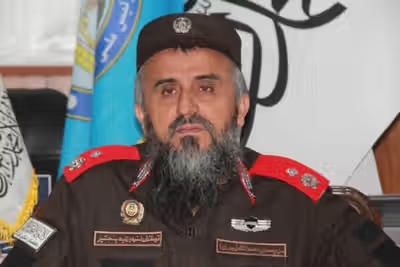
Mohammad Yaqoob, the Taliban’s defence minister, has warned the opponents of the group even as there have been an increase in guerrilla attacks and regional meetings of anti-Taliban figures.
The Taliban's defence minister warned that those who, according to him, are trying "to create chaos and disrupt security”, that "unnecessary propaganda will end up harming you”.
Radio Television Afghanistan, controlled by the Taliban, on Friday published a video of Yaqoob’s speech at the graduation ceremony of the group's special forces.
In the video, Yaqoob implicitly reacts to the regional meetings and statements of the Taliban’s oppositions regarding the increase in the guerrilla attacks.
Taliban’s defence minister said, "To those organising gatherings with the intent to undermine the country's security or create chaos, know that the Taliban leadership has granted you pardon, and the arms of the security forces are open to you.”
He asked the opposition groups to return to their country and take part in its development. He also asked the opposing parties to stand by the Taliban’s armed forces because according to him they are "genuine, Islamic and national forces and they will never betray you”.
Yaqoob, who is the son of Mullah Mohammad Omar, the founder of the Taliban, asked the opposition forces of the group to stop "propaganda and ineffective statements". Because according to him, it will not have a good result and it will cost them.
These statements have been made even though the opposition fronts of the Taliban have increased their guerrilla attacks on Taliban outposts during the past weeks.
Over the last 10 days, Afghanistan Freedom Front (AFF) has announced 14 guerilla attacks on Taliban positions in the capital and various provinces of the country.
According to AFF, these attacks were carried out in Kabul, Kapisa, Balkh, Baghlan, Laghman, Takhar and Parwan provinces. The front claimed that at least 30 Taliban members were killed and 16 others were wounded as a result.
Meanwhile, during the past weeks, Moscow and Dushanbe hosted two meetings with the presence of prominent anti-Taliban figures.

Sources in the Jibrail area of Herat said that at least six individuals from the Hazara community, comprising two clerics and two women, were tragically killed in an attack by unidentified armed assailants.
The incident, which also left three others injured, occurred around 2 PM on Friday. These individuals were ambushed while returning from a religious ceremony in the Khoshrud area of Injil district.
The attackers reportedly halted the victims' vehicle before opening fire. Among the deceased were participants in a ceremony for Eid Mohammad Etimadi, a religious scholar who himself was a victim of a similar attack on October 22.
This latest attack is part of a disturbing trend of increased violence against the Hazara community and Shia Muslims in Afghanistan. On November 23, Rajab Akhlaqi and Khadim Hussain Hedayati, members of the Herat Shia Ulema Council, were killed in a similar manner by motorcycle-riding gunmen in Jibrail. Both were originally from Lal wa Sarjangal districts in Ghor province.
The escalating attacks on Shiites and Hazaras have sparked widespread concern. Richard Bennett, the UN Special Rapporteur on Human Rights for Afghanistan, has called for a thorough and independent investigation into these assassinations, in line with international standards, and for the perpetrators to be brought to justice.