Pakistan Shuts Down Torkham Border Crossing Amidst Dispute With Taliban
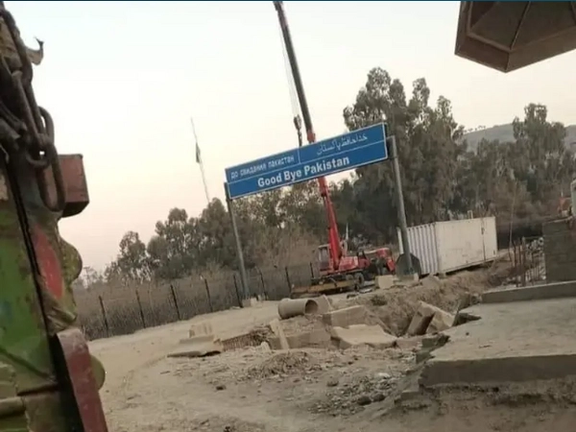
The Torkham border crossing, a pivotal point between Afghanistan and Pakistan, was shut down on Wednesday.
The Torkham border crossing, a pivotal point between Afghanistan and Pakistan, was shut down on Wednesday.
Reports from Pakistani media indicate that the closure occurred following a disagreement with Taliban forces over the placement of a new sign at the crossing's entrance. This disagreement led to the Pakistani border officials shutting down the crossing.
Taliban representatives have also confirmed the closure, attributing it to Pakistan. A statement from the Taliban governor's press office in Nangarhar, citing Ismatullah Yaqoob, the Taliban commissioner in Torkham, noted that Pakistani border guards attempted to erect an additional gate next to the existing one, ostensibly to mount a sign on what they claimed as the "presumed line" the previous night.
This Taliban official mentioned that their group obstructed the sign installation, resulting in the subsequent closure of the crossing by Pakistani guards.
Pakistani authorities, however, have yet to officially acknowledge this border closure.

Wang Wenbin, the spokesperson of the Chinese Foreign Ministry, said that for Beijing to recognise the Taliban government, the group must bring in fundamental changes in its governance.
Wenbin said on Tuesday that the recognition of the Taliban government requires the implementation of "political reforms” by the group.
He added that before the Taliban government is fully recognised diplomatically, it must improve domestic security and relations with its neighbours.
Beijing does not recognise the government of the Taliban, but it has maintained diplomatic relations with the group.
Wang Wenbin said that China hopes that the Taliban will pay more attention to the expectations of the international community, create an open and inclusive political structure, and adopt moderate and stable domestic and foreign policies so that they can integrate into the international community at the right time.
He also said that China has asked the Taliban to resolutely fight terrorism and live in harmony with all countries in the world, especially neighbouring countries, and integrate with the international community as soon as possible.
In response to the question of whether China now recognises the Taliban government, the spokesperson of the Chinese Foreign Ministry said that China has always believed that Afghanistan should not be excluded from the international community.
However, since the Taliban seized power in Afghanistan, no country has recognised the group's rule.
Fazal Ahmad Manawi, a senior member of the National Resistance Front (NRF), announced that an agreement has been reached and a "roadmap” has been created to address the Afghan crisis and help it transition to an alternative plan.
On the third day of the Vienna meeting, Manawi expressed optimism and considered the plan a source of hope.
On Tuesday, on his X social media platform, he congratulated the people of Afghanistan on reaching the agreement during the third day of the Vienna meeting.
Previously, he had stated that the third meeting of opponents of the Taliban, held in Vienna, Austria, is another opportunity for leading anti-Taliban figures to exchange views.
The "Vienna Meeting for a Democratic Afghanistan" began on Sunday, October 3, and ended on Tuesday.
At the meeting, leaders and representatives from 29 Afghan political parties and groups were in attendance. Additionally, representatives of several Western countries, including diplomats from the United States, the United Kingdom, Austria, Germany, Spain, and Norway have also participated in the meet. An adviser from the Islamic Republic of Iran's Embassy in Vienna was also present.
Since the Taliban’s takeover of power in Afghanistan, this is the third meeting of Taliban’s opponents in Vienna.
Charting a "roadmap" for discussing the future of Afghanistan was one of the main goals of the meeting.
Zakir Hussain Ershad, political activist and leader of Afghanistan Citizen Party, told Afghanistan International on Tuesday that these meetings are a platform for reaching consensus.
He stated that there have been serious discussions about the roadmap at the Vienna meeting. “There were differences of opinion, but after discussions and investigations, the satisfaction of the participants has been achieved," he said.
According to Ershad, "The roadmap outlines a plan to unite all opposition factions under one umbrella”.
He said that it is natural that all groups have their priorities, but what they all agree on is that they do not want the Taliban.
Experts say that organising these meetings requires the consent of influential powers, reflecting international dissatisfaction with the current state of Afghanistan under Taliban control.
The Taliban have consistently voiced their disapproval of these gatherings. Abbas Stanikzai, the Deputy of the Taliban's Foreign Ministry, has remarked that these meetings are held to "undermine and defame" the group.
He called the meetings "illegal" and said, "You have been tested; Your time is over now."
Along with the release of reports regarding Zhulia Parsi's "poor physical condition" attributed to "torture" in a Taliban prison, sources confirmed to Afghanistan International that she has been transferred to a hospital.
However, they expressed uncertainty about the reason for her transfer to the hospital.
A number of women wrote on social media that Parsi was taken to the hospital "with a poor physical and mental condition caused by brutal torture in the Taliban's prison”.
Sources, including one close to Parsi's family, have confirmed her transfer to the hospital. However, the Taliban has not provided any details to her family regarding the reason for the transfer, the nature of the illness, or the physical condition of this women's rights activist.
Sources said that Parsi's family is not aware of the hospital where she is receiving treatment.
On September 27, Parsi and her child were arrested by the Taliban from her house in Kabul. She was the head of the Spontaneous Movement of Afghan Women in Kabul, which protested against the discrimination and deprivation of women under the rule of the Taliban.
On October 31, Human Rights Watch (HRW) reported that the Taliban continue to detain, threaten and torture women protestors in Afghanistan.
The organisation stated that many families, by choosing not to publicise the detainment of these activists, hope for their release or reduced harassment.
According to HRW, the number of protesting women in Taliban detention centres is higher. However, neither their families nor anyone else is adequately informed about the situation of these women.
The organisation had expressed concerns about the continued detention and wellbeing of Zhulia Parsi, Neda Parwani, Manizha Sediqi, and Parisa Azada in Taliban prisons.
Protests against the “targeted killing of Hazaras” is gaining ground in Herat.
To pacify the situation, the Taliban’s governor of the province Noor Mohammad Islamjar has told the Shia community elders that there is no prejudice or discrimination in the Taliban's system.
It is however, interesting to note that earlier, the same governor in an Arabic book, had described the Shia sect of Islam as a "takfiri sect" [unbelievers] and "partners of infidels throughout history".
Usually, attacks on Shias, particularly the Hazara Shia community members, have been attributed to extremist groups such as ISIS, who excommunicate Shias and carry out attacks against them.
On December 2, the Taliban’s governor assured Shia and Hazara elders that the group would "protect all Afghans”, attributing such violence to the "divisiveness of enemies”.
However, Islamjar had authored a book in Arabic titled "Investigations into the Maturidite Faith”. A part of the book is dedicated to Shia Islam, and the author's perspective is characterised by hostility, rejecting their religious beliefs.
On Monday, Nisar Ahmad Elyas, Herat governor's spokesperson, confirmed to Afghanistan International that the book had been authored by Islamjar.
On page 174 of the book, Islamjar introduced "Shia" as the "unbelievers’ sect", which according to him "was founded by Abdullah Ibn Saba, the Jew". From his point of view, "belief in Imamate" which is one of the five principles of the Shia sect, requires "denying the end of prophethood, rejection of monotheism, and accepting in the distortion of the Quran”.
The number of Shia sect followers is estimated to be between 154 million and 200 million people worldwide.
Shias comprise majority of populations in Iraq, Iran, Bahrain, Azerbaijan and Yemen. A significant population of Shias also live in Afghanistan. Following the rise of ISIS attacks in Afghanistan, this religious-ethnic group has been continuously targeted by bloody attacks.
The Taliban’s governor for Herat, who describes himself as a senior Taliban thinker and teacher, believes that Shias have historically served as "a tool for the infidels" among Muslims.
It remains unclear to what extent the book reflects the views of other Taliban officials regarding the Shias. However, a source told Afghanistan International that "the book is being taught as an educational source in some Taliban madrassas”.
A large population of Shias and Hazaras live in Herat province, which is bordering Iran. Despite religious and political differences with the Taliban, the Iranian government has a good relationship with this Sunni Islamist group [Taliban].
Shia as unbelievers
Islamjar, in his book, calls Shias as “infields” and accuses them of blaspheming the companions of the Prophet of Islam.
However, he added, "One should be careful in excommunicating all Shias, because there may be people among them who have believed in this sect out of ignorance."
Shias in Afghanistan consider themselves victims of discrimination and oppression. In Afghanistan, they accuse the ISIS and Taliban of genocide.
In countries such as Afghanistan and Pakistan, Sunni extremist groups have consistently labeled Shias as "polytheists and atheists”, targeting both individuals and their places of worship.
Although the Taliban governor in Herat did not prescribe violence against Shias in the book, he agrees with the extremist groups that targets Shiites in Pakistan and Afghanistan in calling them as infidels.
In the past two days, Herat has seen protests by Hazaras following the shooting of two clerics and four Shia Hazara women.
Following the incident, residents of Herat protested over the killing of Hazaras and Shias by carrying the corpse of those who were shot in Jebrael area on Friday evening.
In recent months, Herat has experienced a series of assassinations targeting Shia clerics, attributed to "unknown armed men”.
Following the assassinations of Shia clerics in Herat, many have accused both the Taliban and ISIS of targeting them.
Critics said that given the Taliban's 23-year history of discrimination against Hazaras and Shias, the group could be responsible for the recent chain of assassinations of Shia clerics in Herat.
Taliban is accused of massacres and mass killing of Hazaras and Shia civilians in Mazar-e-Sharif city in 1998 and Yakaolang district of Bamiyan province in 2001.
On Monday, the Afghanistan Freedom Front (AFF) announced that three Taliban fighters had been killed and two others were wounded in an attack by its forces on a Taliban checkpoint in the fifth police district of Kabul.
The front posted a video on X social media platform, stating that the attack was carried out on Monday evening. The Taliban's security agencies in Kabul have not yet reacted on the matter.
Recently, AFF has increased its attacks on Taliban positions.
Earlier, the front had announced that its forces killed four members of the Taliban and wounded another in an attack on a Taliban outpost in the Hesa Awal Kohistan district of Kapisa province.